
Rs 725. That is the minimum daily budget an Indian advertiser can set in ChatGPT Ads Manager, about Rs 22,000 a month at the floor, and it is usually the first number anyone asks for. Everything else about the product moves faster. Ads reached Indian ChatGPT users in the last week of August 2026, self-serve buying followed within days, and on 21 October 2026 OpenAI said more than 100,000 advertisers had run campaigns across 89 countries.
This guide explains how ChatGPT Ads actually work, what they cost in India, how they differ from Google Ads and how to set up a first campaign. Every platform fact carries the date it was true, because on this channel a fact older than a month is a guess. If you want the service rather than the explainer, our ChatGPT Ads agency page covers how we plan and manage campaigns for Indian brands.
What Are ChatGPT Ads?
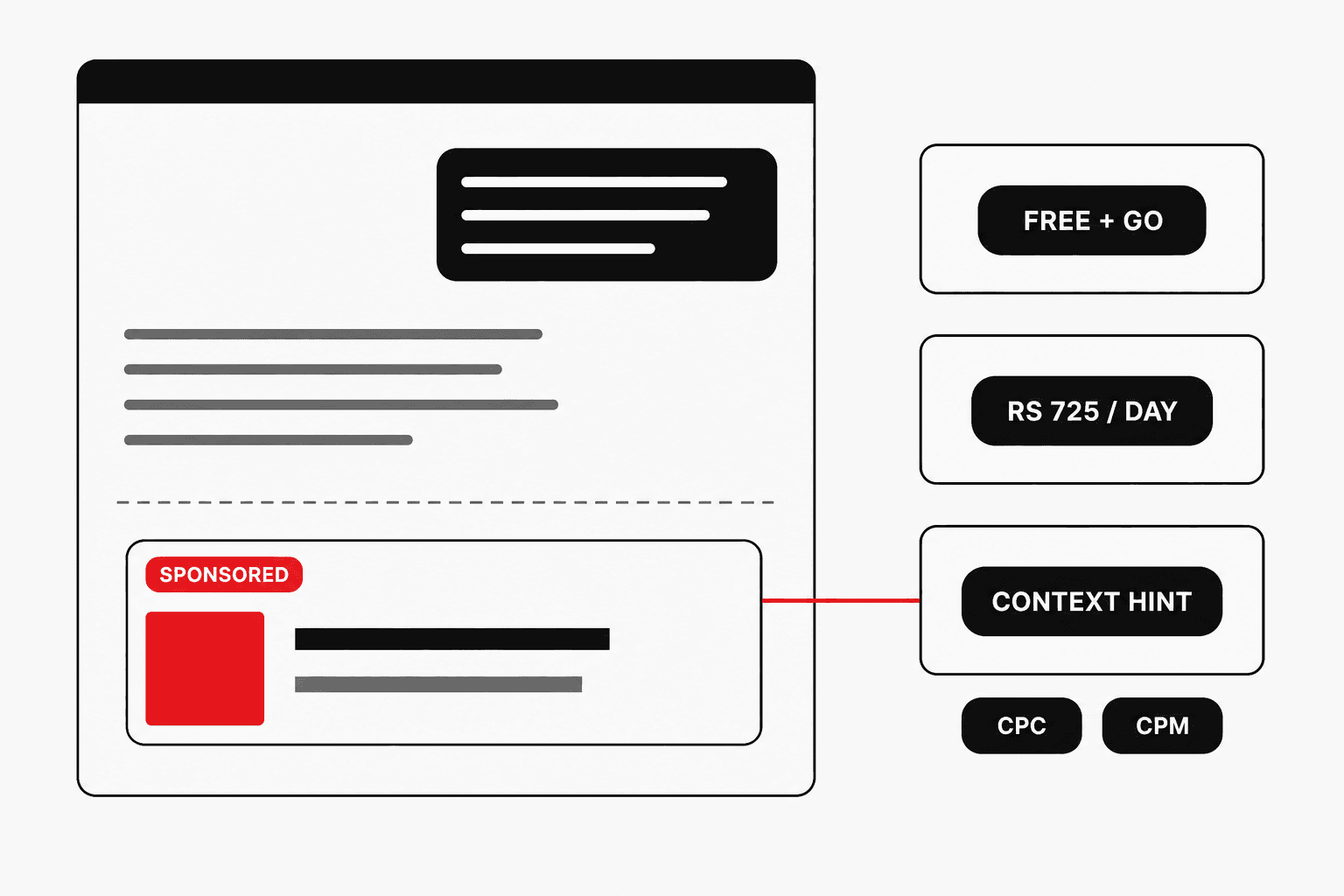
ChatGPT Ads are sponsored cards that appear below a ChatGPT answer, shown only to logged-in adults on the Free and Go plans, and bought through OpenAI's Ads Manager on an impression, click or conversion objective.
Three boundaries define the audience. Plus, Pro, Business, Enterprise and Edu subscribers never see ads. Users identified or estimated to be under 18 are excluded. And no ads appear next to conversations about personal health, mental health or politics, regardless of the user's plan. In India the ad-supported Go plan was priced at Rs 399 a month as of September 2026, so the audience is large but skewed away from the highest-spending paid tier.
Advertisers do not receive chats, memories, names or contact details. Reporting is aggregated campaign data: impressions, clicks and the conversions your own pixel records.
How ChatGPT Ads Reached India
The product went from a closed US test to a self-serve channel in India in under seven months.
The milestones, with sources:
- 9 February 2026. OpenAI begins testing ads in ChatGPT in the United States, restricted to large brands and agency partners.
- 5 May 2026. Self-serve Ads Manager opens to US advertisers, with a measurement pixel and Conversions API.
- 27 to 29 August 2026. Ads go live for eligible users in India. Business Standard and exchange4media reported the launch on 27 August; Relevant Audience dated first delivery to 29 August. OpenAI named WPP and Omnicom as its first Indian agency partners.
- 31 August 2026. OpenAI reports that its advertising business reached a USD 1 billion annualised revenue run rate in under 200 days.
- 4 September 2026. Self-serve buying is reported open to Indian advertisers, billed in rupees with a Rs 725 daily minimum.
- 21 October 2026. OpenAI says ads are available in 89 countries and that more than 100,000 advertisers have run campaigns since launch. That count is cumulative, not active advertisers.
- 26 October 2026. A multi-image format, four to six square images linking to one landing page, enters open beta.
How ChatGPT Ads Work
The ad unit
A ChatGPT ad is a single sponsored card below the generated answer. It carries your brand name and favicon, a headline of up to 50 characters, a description of up to 100 characters, a square image and one destination URL. OpenAI's own bulk-upload guidance recommends far shorter copy, around 16 to 24 characters for the headline and 32 to 48 for the description, because the card truncates well before the caps (Strike Social spec summary, documented as of 29 October 2026). The card never appears inside the answer and never replaces part of it.
Context hints instead of keywords
This is the biggest mental shift for anyone coming from Google Ads. You do not bid on what a user types. At the ad group level you write context hints: short descriptions of the conversations and situations where your product belongs. OpenAI is explicit that they are not exact-match keywords and do not guarantee delivery in any given conversation. Up to 2,000 can sit in one ad group.
The practical difference looks like this. A keyword marketer writes "crm for small business". A context hint reads "sales team outgrowing spreadsheets and losing deals in follow-up". The second describes why someone is asking, which is what the system matches against. There is no negative-keyword equivalent, so you control relevance by tightening the hint, the card copy and the landing page.
Objectives, bidding and the auction
Three objectives exist: Reach (billed per thousand impressions), Clicks (billed per click) and Conversions, which bids toward a tracked pixel event and needs working measurement first. Delivery runs through a relevance-weighted auction, so how well your card and landing page match the conversation counts alongside your bid. A well-matched advertiser can outrank a higher bidder.
Bidding is changing quickly. The setup flow in September offered Maximize results or a manual maximum bid; Relevant Audience reported that from 9 November 2026 new campaigns use Target CPA and Target CPC in place of the old maximum bids. Check the options in your own account before planning around either.
ChatGPT Ads vs Google Ads
| Dimension | ChatGPT Ads | Google Search Ads |
|---|---|---|
| Targeting unit | Context hints describing situations; no negatives | Keywords with match types, plus negative keywords |
| Audience | Logged-in adults on Free and Go plans only | Anyone searching on Google |
| Ad format | One card: 50-character headline, 100-character description, square image | Responsive search ad: up to 15 headlines and 4 descriptions, plus assets |
| Placement | Below the answer, labelled, never inside it | Above and below organic results |
| Bidding | Reach, Clicks, Conversions; target bidding rolling out from November 2026 | Mature Smart Bidding suite including target CPA and target ROAS |
| Measurement | Pixel and Conversions API since May 2026; aggregated reporting | Full conversion tracking, GA4 integration, years of attribution tooling |
| India floor | Rs 725 a day | No platform minimum |
The honest reading: ChatGPT Ads is a genuine new channel with a narrower audience, a smaller creative surface and a younger measurement stack than paid search. Fund it as a test, not as a replacement for a working paid media programme.
What ChatGPT Ads Cost in India
There are two costs: media paid to OpenAI and a management fee paid to whoever runs the account. The media side, as of November 2026:
| Cost item | Figure | Source and date |
|---|---|---|
| Minimum daily budget, India | Rs 725 (about Rs 22,000 a month) | OpenAI minimum campaign spend table, reported by Relevant Audience on 31 Aug 2026 |
| Default daily budget in the setup wizard | Rs 2,900 | upGrowth setup guide, 8 Sep 2026 |
| Maximum spend on any one day | Up to 2x the daily budget, about 7x across seven days | upGrowth setup guide, 8 Sep 2026 |
| Early India CPM, one Clicks campaign in metros | Rs 581 | upGrowth setup guide, 8 Sep 2026 |
| Early India CPC, same campaign | Rs 13.67 at a 4.25% CTR | upGrowth setup guide, 8 Sep 2026 |
| US invite-only pilot CPM, estimated | About USD 60 | upGrowth estimate, Sep 2026 |
Those Indian CPM and CPC figures come from a single campaign in an auction that was days old. For context, Rs 13.67 is cheaper than most Indian service-category Google Search clicks in our Google Ads cost in India benchmark, but auction prices rise as advertisers arrive. Plan with a range, not a point.
The number that decides whether the channel works is cost per lead, so run the maths before you spend.
The sensitive input is conversion rate, not CPC. A card that drives curious clicks to a generic homepage can double the cost per lead without the auction price moving at all. Also plan for six to eight weeks before judging results: a relevance-weighted auction needs time to score your card and page, and the Conversions objective needs conversion volume before it can bid usefully.
How to Set Up Your First ChatGPT Ads Campaign
The flow below follows upGrowth's Indian setup walkthrough (published 8 September 2026, modified 29 October 2026). Menu names change often, so expect small differences.
- Sign in at ads.openai.com with the OpenAI account that should own the ad account. Indian accounts are billed in rupees.
- Clear the required tasks on the Overview screen, starting with billing. Unresolved tasks stop delivery and leave campaigns at "Not serving".
- Install the pixel or Conversions API under Tools, then Conversions, and confirm events fire before you choose the Conversions objective.
- Create the campaign. Name it, pick Reach, Clicks or Conversions, set the daily budget (the wizard pre-fills Rs 2,900; the floor is Rs 725), the schedule and the locations. Start on Clicks if conversion tracking is not yet verified.
- Build one ad group per buyer situation. Set the bid strategy, write the context hints and set a destination URL that matches that situation, not your homepage.
- Write the card. A headline inside 50 characters, a description inside 100, a square image. Automatic text customisation was switched on by default in the September flow; turn it off if your category needs control over wording.
- Review and publish. Ads go through policy review before they serve.
What Advertisers Cannot Do
Two limits matter most. First, advertisers cannot pay to change the answer: OpenAI states that ads do not influence what ChatGPT says, and the card is labelled and separated from the response. Whether your brand is named inside the answer is a separate discipline, covered in our guides to answer engine optimisation and how to rank on ChatGPT.
Second, some categories are out. Political advertising is not permitted; adult content, gambling, tobacco, recreational drugs and weapons are excluded; health and financial services face stricter verification. OpenAI updated its ad policies on 10 September 2026, so check the live policy before you build anything in a regulated category.
Planning a ChatGPT Ads test for an Indian brand? We map the buyer situations, build the ad groups and landing pages, and put measurement in place before the first rupee of media. See our ChatGPT Ads agency service
Frequently Asked Questions
How much do ChatGPT Ads cost in India?
There are two costs. Media spend starts at a minimum daily budget of Rs 725 for advertisers billed in rupees, roughly Rs 22,000 a month at the floor, and the Ads Manager setup wizard pre-fills Rs 2,900 a day. The only published Indian campaign data so far, a single Clicks campaign reported by upGrowth on 8 September 2026, paid a Rs 581 CPM and a Rs 13.67 CPC at a 4.25 percent click-through rate. Treat that as one early data point in a thin auction, not a benchmark. Agency management is scoped and billed separately, with GST on the fee.
Can Indian businesses buy ChatGPT Ads themselves?
Yes. Ads reached Indian ChatGPT users in the last week of August 2026, first sold through OpenAI's own sales team and launch agency partners WPP and Omnicom. Self-serve buying for Indian advertisers was reported to open on 4 September 2026, and as of November 2026 India is listed as a supported self-serve market in beta, billed in rupees, at ads.openai.com.
Who sees ChatGPT Ads?
Logged-in adults on the ChatGPT Free and Go plans. Plus, Pro, Business, Enterprise and Edu subscribers do not see ads, users identified or estimated to be under 18 are excluded, and no ads are shown next to conversations about personal health, mental health or politics, whatever the user's plan.
What are context hints in ChatGPT Ads?
Context hints are short descriptions of the conversations, needs or situations where your product is relevant, set at the ad group level. OpenAI says they are not exact-match keywords and do not guarantee delivery in any particular conversation. Up to 2,000 can be added per ad group. Hints written as buyer situations, such as a sales team outgrowing spreadsheets, tend to work better than product nouns, and there is no negative-keyword equivalent.
How are ChatGPT Ads different from Google Ads?
Google Ads targets the words a user types, with match types and negative keywords, and shows ads to anyone who searches. ChatGPT Ads target described situations through context hints, show only to Free and Go users, and serve one sponsored card below the answer with a 50-character headline and 100-character description, against the 15 headlines and 4 descriptions a Google responsive search ad can carry. Google also has a far more mature bidding and measurement stack.
Can paying for ChatGPT Ads change what ChatGPT says about my brand?
No. OpenAI states that ads do not influence ChatGPT's answers. The sponsored card sits below the response, carries an ad label and is visually separate. Whether your brand is named inside the answer itself depends on organic AI visibility, which is the work of answer engine optimisation, not ad spend.
Which businesses cannot advertise on ChatGPT?
Political advertising is not permitted. Adult content, gambling, tobacco, recreational drugs, weapons and other illegal or dangerous goods are excluded, and health and financial services advertisers face stricter eligibility checks and verification. OpenAI updated its ad policies on 10 September 2026, so check the current policy page before you plan a campaign in a regulated category.
Sources
- OpenAI, Ads in ChatGPT: the basics and ad policies, consulted November 2026.
- PPC Land, Advertisers in 26 more countries gain ChatGPT ads, bringing the total to 89, 21 October 2026.
- Relevant Audience, ChatGPT ads reach 41 markets, and India opens with no self-serve buying, 31 August 2026 (minimum spend table and the 9 November bidding change).
- exchange4media, ChatGPT Ads just hit $1bn run rate. Now comes the price test in India, September 2026.
- upGrowth, ChatGPT Ads Manager setup guide for India, 8 September 2026, modified 29 October 2026 (setup flow, wizard budget, early CPM and CPC).
- Strike Social, The complete list of ChatGPT ad specs (2026 update), specs as documented on 29 October 2026.
- eCorpIT, ChatGPT ads in India: what is live and what is unconfirmed, 7 November 2026 (India self-serve status, context hint limit, 10 September policy update).

Aditya Kathotia
Founder & CEO
CEO of Nico Digital and founder of Digital Polo, Aditya Kathotia is a trailblazer in digital marketing. He's powered 500+ brands through transformative strategies, enabling clients worldwide to grow revenue exponentially. Aditya's work has been featured on Entrepreneur, Economic Times, Hubspot, Business.com, Clutch, and more.
More in Performance Marketing
- Google Ads Transparency Center: Competitor Research Guide
- Facebook Ads Cost in India (2026): CPM, CPC and CPL by Industry
- YouTube Ads Cost in India (2026): CPV and CPM by Format
- Google Ads vs Facebook Ads: Where to Put Your Budget
- B2B Lead Generation Companies in India: Outbound vs Inbound
- Best PPC Agencies in India: The 2026 Vetted List