

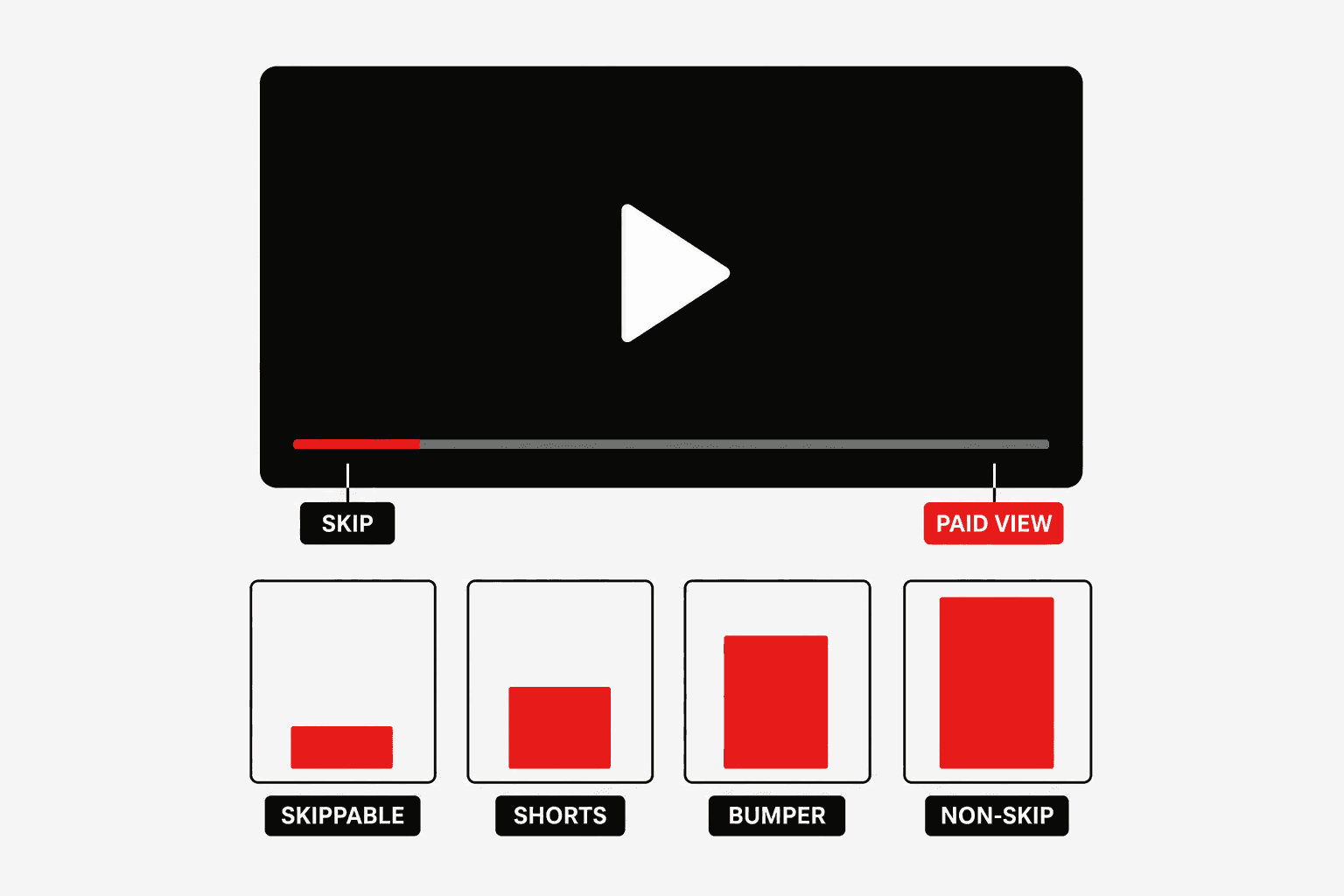
₹0.50 to ₹3 per view. That is the published 2026 range for a skippable YouTube ad in India, and you pay it only when a viewer watches 30 seconds, finishes a shorter ad or clicks (The Media Ant, 2026; The Mediaverse, September 2026). Every viewer who skips at five seconds saw your logo for free. A bumper, by contrast, cannot be skipped and is bought per thousand impressions at ₹250 to ₹900 (Mega Digital, June 2026; The Mediaverse, September 2026).
Those two prices are the whole structure of YouTube advertising cost. Formats you can skip are priced on attention. Formats you cannot skip are priced on reach. Audience, industry and season move you up or down inside those bands.
The platform is worth the planning: India is YouTube's largest advertising audience in the world at 518 million reachable users as of April 2026, more than twice the United States (DataReportal via Statista, April 2026). This guide gives you the sourced CPV and CPM ranges by format, the minimums that actually apply, a worked view-to-lead model and the levers that decide where in the range you land.
How YouTube Charges: Views, Impressions and the 30-Second Rule
Google Ads defines the billing rules precisely, and they matter more than any benchmark (Google Ads Help, About video ad formats and About CPV bidding, accessed November 2026):
- Skippable in-stream. Skippable after five seconds. On CPV bidding you pay at 30 seconds, at the end of a shorter ad, or on interaction, whichever comes first. On Target CPM, Target CPA or Maximize conversions you pay per impression instead.
- Non-skippable in-stream. 15 to 60 seconds depending on campaign subtype, bought on Target CPM. Nobody can skip.
- Bumper. Six seconds, non-skippable, Target CPM.
- In-feed video. Appears in Search, Home and Watch Next feeds. You pay when someone clicks the thumbnail, or in Video views campaigns when an autoplay runs at least 10 seconds.
- Shorts. A view is counted at 10 seconds, at the end of a shorter ad, or on a click, like or share. One view is charged per impression.
- Masthead. Reservation only, booked through a Google sales representative on CPM or cost per hour.
With Target CPV you set the average you are willing to pay per view; Google bids above and below it to hit the average. The old Maximum CPV strategy has been replaced for new campaigns.
YouTube Ads Cost Benchmarks by Format, India 2026
The table compiles every India-specific rupee range we could source from 2026 publications, plus Google's billing rule for each line. Where no India figure is published, the cell says so.
| Format or buy | Billing unit | Published India range (₹) | Source and date |
|---|---|---|---|
| Skippable in-stream | CPV (30 s, completion or interaction) | 0.50 to 3 per view; 2 to 3 average; 0.25 to 1.50 at the low end | The Media Ant, 2026; The Mediaverse, Sep 2026; Mega Digital, Jun 2026; Shout OTB, Sep 2026 |
| Non-skippable in-stream | Target CPM | 400 to 900 per 1,000; 500 to 900 | The Mediaverse, Sep 2026; Mega Digital, Jun 2026 |
| Bumper (6 s) | Target CPM | 250 to 400 per 1,000; 400 to 900 | Mega Digital, Jun 2026; The Mediaverse, Sep 2026 |
| Shorts ads | CPV at 10 s or Target CPM | 350 to 450 per 1,000 | Mega Digital, Jun 2026 |
| In-feed video | Pay per click or 10 s autoplay | CPC 5 to 25; 2 to 30 | Atomcomm, 2026; Deepak Singh Marketing, Sep 2026 |
| Display and companion | CPM | 100 to 300 per 1,000 | Mega Digital, Jun 2026 |
| Connected TV (CTV) | CPV or CPM | About 1 per view; 10 to 100 per 1,000 typical, 500 and above premium; ₹10,000 minimum billing | The Media Ant, 2026 |
| Masthead (reservation) | Fixed daily or CPM | ₹12,00,000 minimum billing for a one-day placement | The Media Ant, 2026 |
| Broad reach buy (any format) | CPM | 40 to 150 per 1,000; 50 to 250 | The Media Ant, 2026; Atomcomm, 2026 |
| Practical starting budget | Media per day | 500 floor; 1,000 to 3,000 for a 7 to 14 day test | The Media Ant, 2026; Mega Digital, Jun 2026; The Mediaverse, Sep 2026 |
| Agency management fee | Per month, excluding media | 15,000 to 75,000 market-wide | The Mediaverse, Sep 2026 |
Download the table as CSV, with a source column for every row.
Two sources disagree on bumpers, ₹250 to ₹400 against ₹400 to ₹900, and we show both. The honest reading is that bumpers on broad audiences in Tier-2 markets sit near the bottom and bumpers on narrow metro audiences in Q4 sit near the top. The same logic applies to every CPM line.
Audience and Industry: What Moves You Inside the Range
No published India dataset splits YouTube CPV by audience type, so we will not invent one. What the sources agree on qualitatively is consistent: narrow in-market and custom-intent audiences cost more per view than broad affinity audiences because more advertisers compete for them; Tier-1 metros cost more than Tier-2 and Tier-3 cities; and remarketing to people who already watched or visited is usually cheaper per view and far better per lead (Shout OTB, September 2026; Deepak Singh Marketing, September 2026).
On industry, the only published breakdown is global, not Indian, and we use it only for the ratios between sectors (Owlclaw benchmarks via Mega Digital, June 2026): finance and insurance $0.030 per view, technology and SaaS $0.025, healthcare $0.022, real estate $0.020, education $0.018, ecommerce and retail $0.015. Finance pays twice what ecommerce pays for the same view. Apply that 2x spread to the Indian ₹0.50 to ₹3 band and you have a reasonable expectation: ecommerce and FMCG near the bottom, lenders and insurers near the top. It is the same customer-value logic that sets Google Search CPCs in India and Meta CPMs.
From Views to Leads: The Working Model
A view is not a customer. The cost that decides whether YouTube pays for itself is cost per lead, and it is three multiplications away from the CPV.
Paid views = Budget ÷ CPV Leads = Paid views × click-through rate × landing-page conversion rate Cost per lead = Budget ÷ Leads
Take a ₹60,000 monthly test on skippable in-stream at a ₹1.50 CPV. That buys 40,000 paid views. Assume, and treat these as assumptions to replace with your own data, that 1 percent of paid viewers click and 5 percent of clickers submit a form: 400 clicks, 20 leads, ₹3,000 per lead. Now improve the creative so 2 percent click and tighten the landing page to 10 percent: 800 clicks, 80 leads, ₹750 per lead. The CPV did not move. The lead fell 75 percent in price on the creative and the page.
Lead forms inside the platform change the model again. One published Indian education campaign reports roughly ₹76 per lead across about ₹50 lakh of spend and 66,300 leads using Google's lead-form extensions (Deepak Singh Marketing, September 2026). That is campaign-specific and the author says so, but it shows where the number goes when the form sits one tap from the video.
Minimum Budgets and What a Test Really Costs
Google Ads has no hard minimum for YouTube campaigns (The Media Ant, 2026). The published practical floors are consistent: about ₹500 a day to run at all, and ₹1,000 to ₹3,000 a day for 7 to 14 days to gather enough data to optimise (The Media Ant, 2026; Mega Digital, June 2026; The Mediaverse, September 2026). In monthly terms:
- Small test: ₹15,000 to ₹25,000 a month on one skippable campaign with two creatives (Shout OTB, September 2026). Enough to learn CPV and view rate, not enough to judge leads.
- Growing business: ₹30,000 to ₹90,000 a month, the ₹1,000 to ₹3,000 a day band. Enough for skippable plus a bumper or Shorts line and a remarketing audience.
- Established brand: ₹1,00,000 a month and above, where non-skippables, CTV and multi-format reach campaigns start to make sense.
- Reservation: a one-day Masthead carries about ₹12,00,000 minimum billing in India through media marketplaces, and CTV buys start at ₹10,000 (The Media Ant, 2026).
Agency management is a separate line at a published ₹15,000 to ₹75,000 a month (The Mediaverse, September 2026), and video production is a third. Budget all three separately or the media gets starved to pay the other two.
How to Pay the Low End of the Range
1. Make the first five seconds do the targeting. Viewers who leave before 30 seconds cost nothing, so a hook that holds the right people and bores the wrong ones lowers your CPV. Our guide to AI tools for YouTube video production covers fast hook iteration.
2. Match the format to the job. Bumpers buy guaranteed six-second reach; skippable CPV buys attention and remarketing lists; Shorts reach the under-30 feed. A non-skippable bought for leads pays the wrong price for the wrong unit.
3. Start broad in Tier-2 before narrowing in metros. Let the creative qualify a broad audience, then build custom-intent and remarketing segments from the people who watched.
4. Set Target CPV from the model, not the benchmark. Work out the CPV you can afford from your target cost per lead.
5. Keep cold reach out of Q4 unless you sell festive products. October to December auction pressure raises every CPM on Google and Meta alike.
6. Measure the view-through, not just the click. Most YouTube-assisted conversions happen later on search or direct; read the channel through attribution, and if branding is the goal, set that metric up front (see performance marketing vs branding).
Method and Sources
Billing rules are from Google Ads Help (About video ad formats, About CPV bidding, About Video views; accessed November 2026). India ranges come from public 2026 sources: The Media Ant (2026), Mega Digital (June 5), The Mediaverse (September 10), Shout OTB (September 3), Deepak Singh Marketing (September 19) and Atomcomm (2026). The industry CPV ratios are global Owlclaw benchmarks via Mega Digital, not India data. Reach is DataReportal via Statista (April 2026). No India source publishes a sample size, so where two disagree we show both. Demand: Google Ads Keyword Planner via DataForSEO, India, October 2026 (about 720 monthly searches for "youtube advertising cost", 210 for "youtube ads cost in india").
Frequently Asked Questions
How much do YouTube ads cost in India in 2026?
Google sells YouTube ads through an auction, so there is no price list, but published 2026 benchmarks for India are consistent. Skippable in-stream ads cost ₹0.50 to ₹3 per view, and you only pay when someone watches 30 seconds, finishes a shorter ad or interacts. Non-skippable in-stream ads cost ₹400 to ₹900 per 1,000 impressions, bumpers ₹250 to ₹900 per 1,000 and Shorts ads about ₹350 to ₹450 per 1,000. Clicks from in-feed video ads run ₹2 to ₹30. Google Ads has no minimum spend; the published practical floor is about ₹500 a day, with ₹1,000 to ₹3,000 a day recommended for a two-week test.
What is the cost per view (CPV) for YouTube ads in India?
Published 2026 ranges for skippable in-stream ads in India sit between ₹0.25 and ₹3 per view, with most guides clustering at ₹0.50 to ₹3 and one putting the average near ₹2. A view is only charged when the viewer watches 30 seconds, finishes an ad shorter than 30 seconds or clicks; skips before that are free. Shorts and in-feed views are counted at 10 seconds. You set a Target CPV, the average you are willing to pay, and individual views clear above or below it. Narrow audiences, Tier-1 metros and finance or real-estate advertisers sit at the top of the range.
What is the minimum budget for YouTube ads in India?
Google Ads sets no hard minimum for YouTube campaigns. The practical floor published across India guides is about ₹500 a day, and ₹1,000 to ₹3,000 a day for 7 to 14 days is the common recommendation for a test that produces enough data to optimise, which is ₹30,000 to ₹90,000 a month of media. Reservation formats differ: a one-day YouTube Masthead in India carries a minimum billing of about ₹12,00,000 through media marketplaces, and connected-TV buys start around ₹10,000. Agency management fees are separate and run ₹15,000 to ₹75,000 a month market-wide.
Are bumper ads or skippable ads cheaper on YouTube?
They are priced on different units, so compare them per 1,000 impressions. Bumpers are six-second non-skippable ads bought on Target CPM at ₹250 to ₹900 per 1,000 impressions in India. Skippable in-stream ads are bought on CPV at ₹0.50 to ₹3 per view, but you only pay for viewers who watch 30 seconds or interact. If 30 percent of viewers reach the paid threshold at a ₹1.50 CPV, the effective CPM is ₹450, inside the bumper range. Skippable is cheaper when your creative holds attention; bumpers are cheaper when you need guaranteed reach for a six-second message.
How many views does ₹50,000 buy on YouTube in India?
At the published skippable CPV range of ₹0.50 to ₹3, ₹50,000 buys roughly 16,700 to 1,00,000 paid views, and because skips before 30 seconds are free, the number of people who saw the first five seconds is several times higher. On bumpers at ₹250 to ₹900 per 1,000 impressions, the same ₹50,000 buys 55,000 to 2,00,000 guaranteed six-second impressions. Paid views suit consideration and remarketing lists; impressions suit reach.
Do YouTube ads work for lead generation in India, and at what cost per lead?
Yes, but the cost per lead depends more on the funnel than the CPV. Leads equal views multiplied by click-through rate multiplied by landing-page conversion rate. At a ₹1.50 CPV, a 1 percent click rate and a 5 percent conversion rate, a lead costs ₹3,000; at 2 percent and 10 percent the same views produce a ₹750 lead. One published Indian education campaign reports about ₹76 per lead across ₹50 lakh of spend using lead forms rather than landing pages, which shows how far the number moves when the form sits inside the platform. Use YouTube to build remarketing audiences cheaply, then convert them on search and Meta.
Want a YouTube cost model built on your funnel, not a benchmark? We size the CPV you can afford from your target cost per lead, pick the format for the job, and run video alongside search and Meta so every view is measured through to revenue. Talk to our paid media team

Aditya Kathotia
Founder & CEO
CEO of Nico Digital and founder of Digital Polo, Aditya Kathotia is a trailblazer in digital marketing. He's powered 500+ brands through transformative strategies, enabling clients worldwide to grow revenue exponentially. Aditya's work has been featured on Entrepreneur, Economic Times, Hubspot, Business.com, Clutch, and more. Join Aditya Kathotia's orbit on LinkedIn to gain exclusive access to his treasure trove of niche-specific marketing secrets and insights.
More in Performance Marketing
- ChatGPT Ads in India: How They Work, Costs and Setup
- Google Ads Transparency Center: Competitor Research Guide
- Facebook Ads Cost in India (2026): CPM, CPC and CPL by Industry
- Google Ads vs Facebook Ads: Where to Put Your Budget
- B2B Lead Generation Companies in India: Outbound vs Inbound
- Best PPC Agencies in India: The 2026 Vetted List