

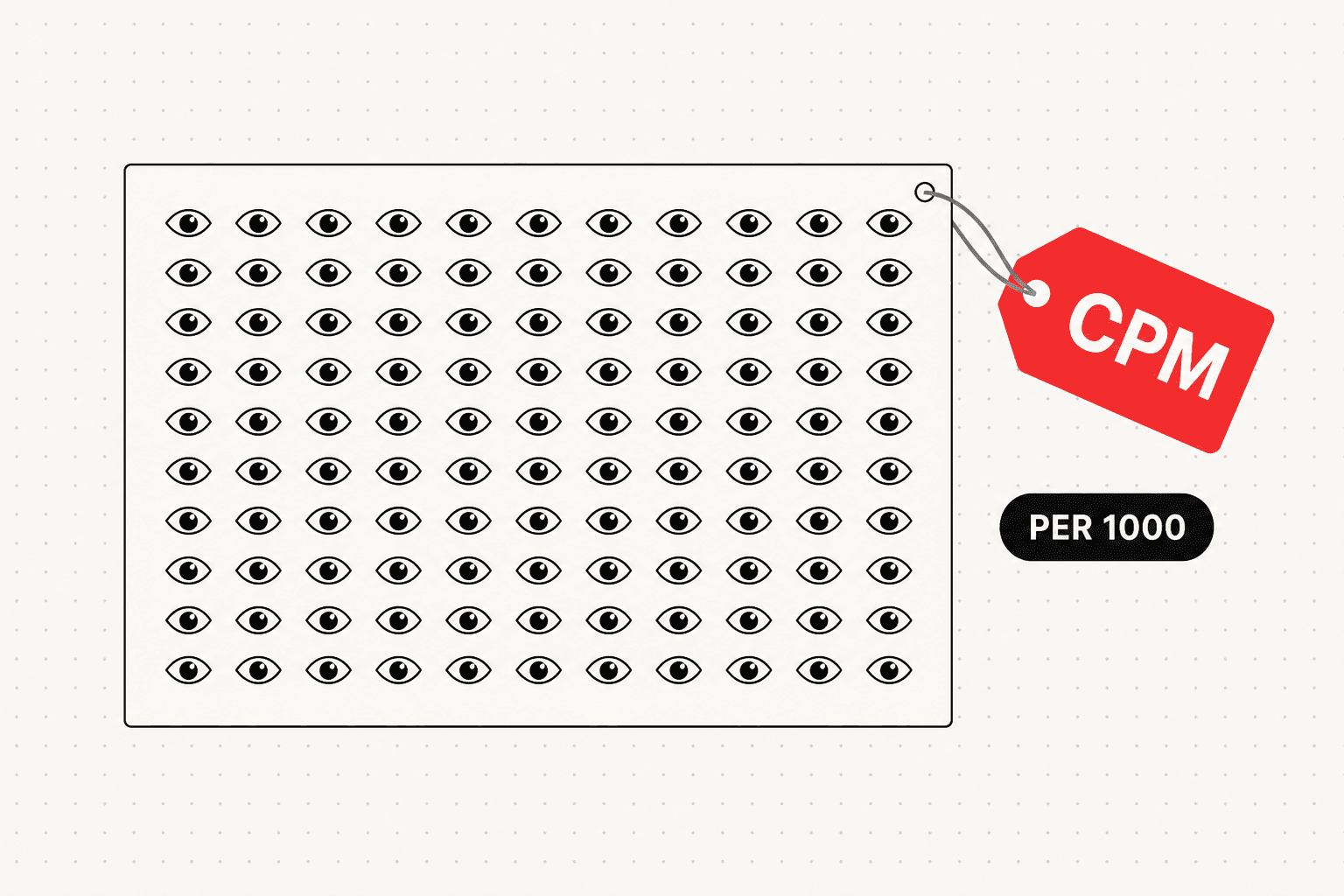
CPM means cost per mille: the price you pay for 1,000 impressions of an ad. "Mille" is Latin for thousand, which is why the M stands for a thousand rather than a million. An impression is one display of your ad on someone's screen, whether or not they click.
CPM = (Total cost ÷ Impressions) x 1,000
Spend ₹30,000 and get 2,50,000 impressions, and your CPM is ₹120. Every 1,000 times your ad appeared cost you ₹120.
CPM is the default pricing unit for Meta, YouTube, display, connected TV and most programmatic buying, and it sits underneath even the campaigns you think of as pay per click. Knowing how it converts into a cost per click and a cost per customer is what turns a CPM from a media number into a business number.
CPM vs CPC vs CPA vs CPV
Four pricing units cover almost all digital advertising. They differ in what you pay for and who carries the risk if the ad does not work.
| Unit | You pay for | Formula | Who carries the risk | Typical India range |
|---|---|---|---|---|
| CPM (cost per mille) | 1,000 impressions | Cost ÷ impressions x 1,000 | You: you pay even if nobody clicks | Meta ₹60 to ₹280 blended (published 2026 ranges) |
| CPC (cost per click) | One click | Cost ÷ clicks | Shared: you pay for visits, not outcomes | Google Search ₹3 to ₹460 by industry |
| CPA (cost per acquisition) | One lead, sale or sign-up | Cost ÷ conversions | The platform's algorithm, in theory | Meta ecommerce CPA ₹180 to ₹450 |
| CPV (cost per view) | One video view | Cost ÷ views | Shared: you pay for attention, not action | YouTube skippable ₹0.50 to ₹3 per view |
Sources: Meta CPM and CPA from our Facebook ads cost in India benchmarks (Paid Media World, January 2026; upGrowth, September 2026; Scalify Labs, November 2026). Google CPC from our Google Ads cost in India benchmarks (Google Keyword Planner, November 2026). YouTube CPV from our YouTube ads cost in India guide (The Media Ant, 2026; The Mediaverse, September 2026).
One variant is worth knowing. On Google display and video campaigns you will see vCPM, viewable CPM, where you pay only for impressions that met a viewability threshold. On Meta you will see CPM reported even when you optimise for clicks or purchases, because Meta bills on impressions by default and uses your goal only to decide who sees the ad.
How to Convert Between CPM, CPC and CPA
The units are not separate worlds. They are one chain, linked by two rates you can read in any ads dashboard: click-through rate (CTR) and conversion rate.
CPM = CPC x CTR x 1,000 CPC = CPM ÷ (CTR x 1,000) CPA = CPC ÷ Conversion rate
Worked example. A D2C brand runs a Meta campaign at a ₹120 CPM. Its ads get a 1.5 percent CTR, so 1,000 impressions produce 15 clicks.
- CPC = ₹120 ÷ (0.015 x 1,000) = ₹120 ÷ 15 = ₹8
- Its product page converts 2 percent of visitors, so CPA = ₹8 ÷ 0.02 = ₹400
- Check it the other way: CPM = ₹8 x 0.015 x 1,000 = ₹120
Now improve only the creative so CTR rises to 3 percent. The CPM stays ₹120, but 1,000 impressions now produce 30 clicks. CPC falls to ₹4 and CPA to ₹200. Nothing changed in the auction. This is why judging a campaign on CPM alone misleads: a ₹200 CPM with a 4 percent CTR beats a ₹100 CPM with a 1 percent CTR on cost per click (₹5 against ₹10).
The same arithmetic plans reach. A ₹50,000 budget at a ₹120 CPM buys about 4,16,700 impressions (₹50,000 ÷ ₹120 x 1,000). Divide by your planned frequency to estimate how many people you will reach.
Average CPM in India by Platform
CPM varies more by platform and audience than by anything else. These are published India ranges for 2026, drawn from the cost guides linked above and the sources they cite.
| Platform and buy | CPM (₹ per 1,000) | Source |
|---|---|---|
| Meta, broad 18 to 55 India-wide audience | 15 to 35 | Scalify Labs, Nov 2026 |
| Meta, blended typical account | 60 to 280 | Nico Digital synthesis of published industry ranges, Nov 2026 |
| Meta, B2B SaaS audiences | 280 to 550 | Paid Media World, Jan 2026 |
| YouTube, broad reach buy (any format) | 40 to 150 | The Media Ant, 2026 |
| YouTube, display and companion | 100 to 300 | Mega Digital, Jun 2026 |
| YouTube, bumper (6 seconds) | 250 to 900 | Mega Digital, Jun 2026; The Mediaverse, Sep 2026 |
| YouTube, Shorts | 350 to 450 | Mega Digital, Jun 2026 |
| YouTube, non-skippable in-stream | 400 to 900 | The Mediaverse, Sep 2026; Mega Digital, Jun 2026 |
| 500 to 3,500 | upGrowth, Nov 2026 |
The Meta rows come from the Facebook ads cost benchmarks linked above, which also break CPM down by audience type and industry; the YouTube rows come from the YouTube ads cost guide, which covers CPV by format.
Three patterns explain the spread. Narrow audiences cost more than broad ones, because more advertisers compete for fewer people. Unskippable formats cost more than skippable ones, because every impression is a guaranteed watch. And season matters: published India data shows Meta CPMs rising 40 to 80 percent from October to December, with January to March typically the cheapest quarter (Scalify Labs, November 2026).
When to Buy on CPM
CPM is the right unit when being seen is the job:
- Awareness and launches. You want as many of the right people as possible to see the product. Clicks are a bonus, not the goal.
- Reach and frequency planning. Fixed-CPM reservations and reach campaigns let you plan how many people see the ad and how often.
- Video that works without a click. A six-second bumper can land a message that never needs a visit.
- Retargeting warm audiences. Small, warm pools convert well, and on Meta they sit at the low end of the range (₹25 to ₹70 for video viewers and engagers, Scalify Labs, November 2026).
Buy on CPC or a conversion goal when the visit or the sale is the only thing you value: search, lead generation, and ecommerce prospecting with clean conversion tracking. Even then, read your CPM weekly. A rising CPM with a steady CTR means competition is heating up; a steady CPM with a falling CTR means your creative is tiring.
Frequently Asked Questions
What does CPM mean in advertising?
CPM stands for cost per mille, mille being Latin for thousand. It is the price an advertiser pays for 1,000 impressions of an ad, where an impression is one display of the ad on a screen. A ₹120 CPM means every 1,000 times the ad is shown costs ₹120, whether or not anyone clicks.
How do you calculate CPM?
Divide the total cost by the number of impressions and multiply by 1,000. CPM = (cost ÷ impressions) x 1,000. Spending ₹30,000 for 2,50,000 impressions gives a CPM of ₹120. To plan reach, reverse it: impressions = budget ÷ CPM x 1,000.
What is the difference between CPM and CPC?
CPM charges for impressions, CPC for clicks. With CPM you pay whether or not anyone clicks, so you carry the risk of weak creative. With CPC you pay only when someone clicks. They are linked by click-through rate: CPM = CPC x CTR x 1,000, so a ₹8 CPC at a 1.5 percent CTR is a ₹120 CPM.
What is a good CPM in India?
It depends on the platform and audience. Published 2026 India ranges put Meta at roughly ₹60 to ₹280 blended, with broad audiences as low as ₹15 to ₹35, YouTube non-skippable ads at ₹400 to ₹900 and LinkedIn at ₹500 to ₹3,500. A good CPM is one that produces a profitable cost per acquisition, not simply the lowest number.
Why is my CPM going up?
Usually more advertisers are competing for the same audience, the audience is narrow, or the creative is weak, so the platform charges more to show it. Published India data shows Meta CPMs rising 40 to 80 percent in October to December around Dussehra, Diwali and year-end sales, with January to March typically the cheapest quarter.
When should I choose CPM bidding over CPC?
Choose CPM when the goal is to be seen: brand awareness, launches, reach and frequency, or video that tells the story without a click. Choose CPC or a conversion-based bid when you want traffic, leads or sales and only value the visit. Most platforms now bill by impression while optimising for the result you pick.
Paying for impressions without knowing what they turn into? We plan paid media across Google, Meta, YouTube and LinkedIn backwards from your target cost per acquisition, so every CPM is judged on the customers it buys. See how we run multi-platform PPC.

Aditya Kathotia
Founder & CEO
CEO of Nico Digital and founder of Digital Polo, Aditya Kathotia is a trailblazer in digital marketing. He's powered 500+ brands through transformative strategies, enabling clients worldwide to grow revenue exponentially. Aditya's work has been featured on Entrepreneur, Economic Times, Hubspot, Business.com, Clutch, and more. Join Aditya Kathotia's orbit on LinkedIn to gain exclusive access to his treasure trove of niche-specific marketing secrets and insights.
More in Performance Marketing
- Meta Ads Library: How to Research Competitor Ads in India
- UTM Parameters: How to Tag Links and Read Them in GA4
- What Is ROAS? Meaning, Formula and Good ROAS in India
- What Is SEM? Search Engine Marketing Explained for India
- Paid Advertising Platforms in India: 12 Compared by Cost and Fit
- ChatGPT Ads in India: How They Work, Costs and Setup