

Most teams asking "technical SEO vs on-page SEO" are really asking a budget question: where should the next rupee, hour, or hire go to move rankings fastest? It is a fair question, and the honest answer is uncomfortable - because the framing itself is slightly wrong.
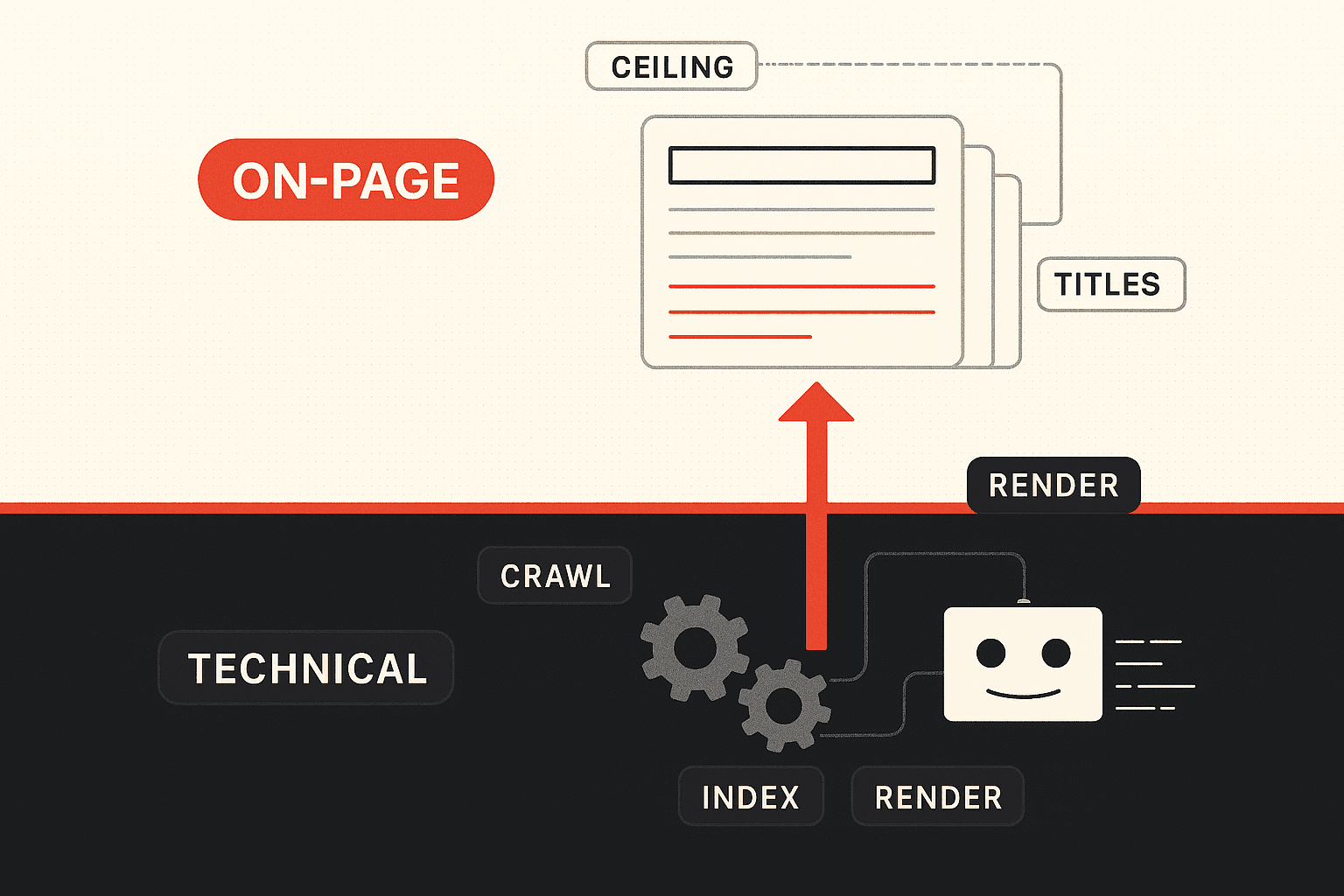
Technical SEO and on-page SEO are not competitors fighting for the same slot. They are different layers of the same system. One sets the ceiling on what is possible; the other determines how close you get to that ceiling on any given query. Treating them as an either/or is how sites end up with beautifully optimised content that never indexes, or flawless technical infrastructure serving thin pages that no one searches for.
This piece does three things. It draws the line between the two cleanly, so you stop conflating them. It gives you a decisive answer to "what matters more" - not a consultant's "it depends," but an actual decision framework. And it hands you a diagnostic to find the layer that is genuinely capping your site right now, so you can spend where it counts.
The Short Answer
Technical SEO and on-page SEO solve different problems and you need both, but they are not equally urgent at all times. Technical SEO is the infrastructure that lets search engines crawl, render, index, and trust your site - it sets a hard ceiling on your rankings. On-page SEO is the relevance and quality of each page - it determines how high you climb under that ceiling for a specific query.
The practical verdict: fix technical issues that block crawling, indexing, or rendering first, because they cap everything else. Once the technical baseline is sound - which it already is on most modern sites - on-page and content work becomes the higher-leverage investment. The right answer is not "pick one," it is "find your current bottleneck and fix that layer."
What Each One Actually Is
The fastest way to stop confusing the two is to remember what question each one answers.
Technical SEO answers: "Can search engines access, render, and trust this site?" It is the plumbing. If the plumbing leaks, nothing else in the house works, no matter how nice the furniture is.
On-page SEO answers: "Is this specific page the best available answer to the query?" It is the furniture and the layout. It only matters once the plumbing works.
Here is how the responsibilities split in practice.
| Dimension | Technical SEO | On-Page SEO |
|---|---|---|
| Core question | Can Google crawl, render, index, trust the site? | Is this page the best answer to the query? |
| Scope | Site-wide infrastructure | Page-by-page relevance |
| Typical owners | Engineering, dev, SEO architect | Content, editorial, SEO strategist |
| Key signals | Crawlability, indexation, site speed, Core Web Vitals, mobile rendering, canonical logic, XML sitemaps, robots directives, HTTPS, site architecture, JavaScript rendering | Title tags, meta descriptions, heading hierarchy, content depth, keyword and intent match, internal links, image alt text, structured data, readability |
| Failure mode | Pages never get fairly evaluated | Pages get evaluated and lose on merit |
| When it bites | Silently, site-wide, all at once | Query by query, page by page |
| Sets the ceiling? | Yes | No - it climbs toward the ceiling |
Notice that structured data appears on both sides. That is not an error. Schema markup is implemented technically but exists to communicate on-page meaning, which is exactly why the two disciplines are best understood as layers that touch, not walls that divide. Our technical SEO services and content marketing services are run as one connected motion for this reason.
Is On-Page SEO the Same as Technical SEO?
No - and this is the single most common confusion, so it is worth settling directly.
They feel similar because both happen "on your own website" (as opposed to off-page SEO, which happens elsewhere). But the overlap stops there. On-page SEO is about the content and meaning a human or a crawler reads on the page. Technical SEO is about whether a crawler can reach, render, and index that page at all, and whether the site is structured so signals flow correctly.
A useful test: ask whether the task would survive a copy-paste of the page into a blank, perfectly configured site.
- If the task still matters after the paste - the title, the headings, the depth of the answer, the internal links, the keyword targeting - it is on-page.
- If the task became irrelevant because the new site already handles it - crawl budget, canonical tags, sitemap generation, render path, server response times - it is technical.
That single test resolves almost every "which bucket is this?" argument a team has.
The Four Types of SEO - and Where These Two Sit
"Technical vs on-page" is a narrow framing of a bigger picture. Most practitioners split SEO into four types, and seeing the full stack makes the relationship obvious.
The order is not decorative. Off-page SEO - the authority you earn from link building and digital PR - only converts into rankings once the page it points to is technically accessible and on-page relevant. Answer engine optimisation, the layer most teams are racing to win in 2026, sits at the top precisely because it assumes everything below it already works. You cannot be cited by ChatGPT if Google cannot index the page, and you will not be cited if the page does not answer the question cleanly. The whole stack inherits the weakness of its lowest broken layer.
So What Matters More? The Honest Answer
Here is the answer most articles dodge.
Technical SEO matters more when it is broken. On-page SEO matters more when technical is fine. And on the majority of real sites today, technical is mostly fine.
That second sentence is the part people miss. Modern frameworks, mature CMS platforms, and managed hosting have quietly solved most of the technical problems that used to dominate SEO checklists a decade ago. HTTPS is default. Mobile rendering is default. Sitemaps generate automatically. For a well-built site, "technical SEO" often comes down to a handful of recurring issues - render-blocking JavaScript, indexation bloat, internal link gaps, Core Web Vitals on specific templates - rather than a foundational rebuild.
Which means for most established businesses, the marginal rupee is better spent on on-page and content than on yet another technical audit. The pages that win in 2026 win on depth, intent match, originality, and entity coverage - all on-page disciplines. We see this constantly: a site with clean infrastructure and mediocre content is leaving far more on the table than a site with great content and two fixable technical bugs.
But - and this is the load-bearing exception - when technical SEO is broken, it is the only thing that matters, because it caps everything. A retailer whose product pages render via client-side JavaScript that Googlebot times out on does not have a content problem. They have a rendering problem masquerading as a content problem, and no amount of copywriting will fix it. This is why we always start an engagement with a technical SEO audit before recommending where the budget should go. You cannot prioritise honestly until you know which layer is bleeding.
The Diagnostic: Which Layer Is Bottlenecking You
Stop guessing. Run this diagnostic and let the symptoms tell you where to spend. The principle is simple: work bottom-up, and only move up a layer once the one below it is clean.
Step 1 - Is technical the bottleneck?
Open Google Search Console and check four things. Indexation: compare submitted pages to indexed pages in the Pages report - a large, unexplained gap is a technical red flag. Crawl: look at Crawl Stats and, on larger sites, log files to see whether Googlebot is wasting budget on junk URLs or never reaching important pages. Rendering: run key templates through URL Inspection and confirm Google sees your full content, not an empty JavaScript shell. Speed: check whether Core Web Vitals pass on your money templates.
If any of those fail, technical is your bottleneck and nothing else should jump the queue. Common culprits we find: faceted navigation creating crawl traps, orphan pages with no internal links, slow templates, and duplicate URLs splitting ranking signals.
Step 2 - Is on-page the bottleneck?
If the technical layer is clean, the question becomes whether each page deserves to rank. Pull your target queries and look honestly: does the page match the intent behind the search, or just contain the keyword? Is it genuinely deeper, clearer, and more useful than what sits at ranks one to three today? Are the title, headings, and internal links doing their job, or are you stuck on page two because the content is almost-but-not-quite good enough?
This is where most established sites have the biggest, cheapest gains - and where our SEO services spend the majority of their effort. On-page wins compound: a stronger page earns more links, gets refreshed less often, and is more likely to be cited by AI engines.
Step 3 - Both clean, still not ranking?
If pages index cleanly, render fully, load fast, and are genuinely best-in-class on intent and depth, yet still do not rank - the bottleneck has moved off your site. That is an authority problem, solved by earning links and brand signals, not by more on-page tweaks. Spending more on technical or on-page at this stage is polishing a car that already runs; the constraint is somewhere else entirely.
A Worked Example
A B2B SaaS company came to us convinced they had a "content problem." Rankings were flat despite a steady publishing cadence. The instinct was to write more and optimise harder - a pure on-page response.
The audit told a different story. Their blog ran on a setup where article content loaded via client-side JavaScript, and the server returned a near-empty HTML shell. Googlebot was indexing the pages but rendering almost no body content, so every post was being evaluated as thin. No amount of on-page optimisation could fix a page Google could barely read. This was a textbook case of a technical bottleneck wearing an on-page costume.
The fix was server-side rendering for the blog template - a technical change. Within two crawl cycles, the existing content (which was actually good) started ranking, because for the first time Google could see it. Then, and only then, the on-page work they had wanted to do from the start began to pay off, because it was finally operating under a ceiling that had been lifted.
The lesson is the whole point of this article: they spent months on the wrong layer because they never diagnosed which one was broken. The bottleneck, not the discipline you prefer, decides where the next hour goes.
Common Mistakes Teams Make
- Treating it as either/or. The two are layers, not rivals. The question is sequence and bottleneck, never "which one do we believe in."
- Endless technical audits on a technically healthy site. If indexation, rendering, and Core Web Vitals are clean, a fifth audit will not find the gold. The gold is in content and intent.
- Pouring on-page effort into pages Google cannot fully render. Always confirm the page renders for crawlers before you optimise its copy.
- Ignoring internal links. Internal linking sits in the seam between technical (architecture, crawl paths) and on-page (relevance, anchor context) - and it is one of the most under-used levers on both sides. Keyword cannibalisation and orphan pages both trace back to weak internal linking.
- Forgetting that content decays. A page that ranked last year can slide as competitors improve. On-page is not "set and forget" - it needs a content decay refresh discipline.
- Optimising for Google only, while AI search shifts the rules. Increasingly, the page also needs to be cleanly extractable by AI engines, which rewards plain answers and structured data.
Tools and KPIs for Each Layer
You cannot manage what you do not measure. Each layer has its own instruments.
| Technical SEO | On-Page SEO | |
|---|---|---|
| Diagnostic tools | Google Search Console (Pages, Crawl Stats), Screaming Frog, log file analysers, PageSpeed Insights, Lighthouse, Rich Results Test | Search Console (Performance), keyword and SERP tools, content scoring tools, manual intent analysis |
| Leading KPIs | Index coverage ratio, crawl efficiency, Core Web Vitals pass rate, render parity, valid structured data | Rankings for target queries, click-through rate, time on page, content depth vs competitors |
| Lagging KPIs | Indexed pages, crawl budget on priority URLs | Organic traffic, conversions from organic, assisted revenue |
The single most useful instrument across both is Search Console - it is the only place you see how Google actually treats your site, rather than how you assume it does. Start every diagnosis there.
Where AI Search Changes the Calculus
The "technical vs on-page" balance shifts slightly in the AI-search era, and it is worth being precise about how.
Technical fundamentals become table stakes, not a differentiator. AI crawlers like GPTBot and PerplexityBot need fast, server-rendered, well-structured HTML to ingest your content - so the same technical hygiene that helps Google helps them. But once that baseline is met, technical work offers diminishing returns for AI visibility.
The bigger lever for getting cited in AI answers is fundamentally on-page: stating answers plainly and early, covering entities thoroughly, backing claims with evidence, and structuring content so a machine can extract a clean, quotable passage. Schema markup helps machines trust and parse your claims. In other words, AI search tilts the weighting toward on-page and content quality, once the technical floor is in place. Our AI SEO services treat the technical layer as a prerequisite and put the real strategic effort into the extractable, evidence-backed content that AI engines actually cite.
How to Sequence the Work
Putting it all together, here is the order of operations that consistently produces the best return:
- Run a technical audit first. Not because technical always wins, but because you cannot prioritise honestly until you know whether the foundation holds. A focused SEO audit answers this in days, not months.
- Fix any blocking technical issues immediately. Crawl, index, render, and speed problems on key templates cap everything and must clear first.
- Once the technical baseline is sound, shift the bulk of investment to on-page and content - intent match, depth, originality, internal links, and structured data. For most established sites, this is where the largest gains live.
- Layer in off-page authority once your pages genuinely deserve to rank, through links and brand-building.
- Optimise for AI citation in parallel with on-page work, since the disciplines overlap heavily.
The teams that win are not the ones who pick a side in "technical vs on-page." They are the ones who diagnose which layer is currently capping them, fix that, and move up the stack with discipline.
If you are not sure which layer is holding your site back, that is exactly the question a proper audit answers. We are happy to take a look - a conversation with our team or a structured technical and on-page audit will tell you where your next hour of SEO effort actually belongs, instead of where you assume it does.

Aditya Kathotia
Founder & CEO
CEO of Nico Digital and founder of Digital Polo, Aditya Kathotia is a trailblazer in digital marketing. He's powered 500+ brands through transformative strategies, enabling clients worldwide to grow revenue exponentially. Aditya's work has been featured on Entrepreneur, Economic Times, Hubspot, Business.com, Clutch, and more. Join Aditya Kathotia's orbit on LinkedIn to gain exclusive access to his treasure trove of niche-specific marketing secrets and insights.