

The question every marketing team is asking right now: if ChatGPT can write content, research topics, and generate ideas, do we still need an SEO specialist? Here is the honest breakdown - what it can genuinely do, where it falls short, and what the gap actually costs you.
ChatGPT has become a standard tool in most marketing workflows. That is not a bad thing. Used correctly, it accelerates real work. Used as a replacement for SEO strategy, it creates a specific kind of problem: content that looks professional, passes a superficial review, and generates no traffic.
Understanding which is which requires being specific about what SEO actually involves.
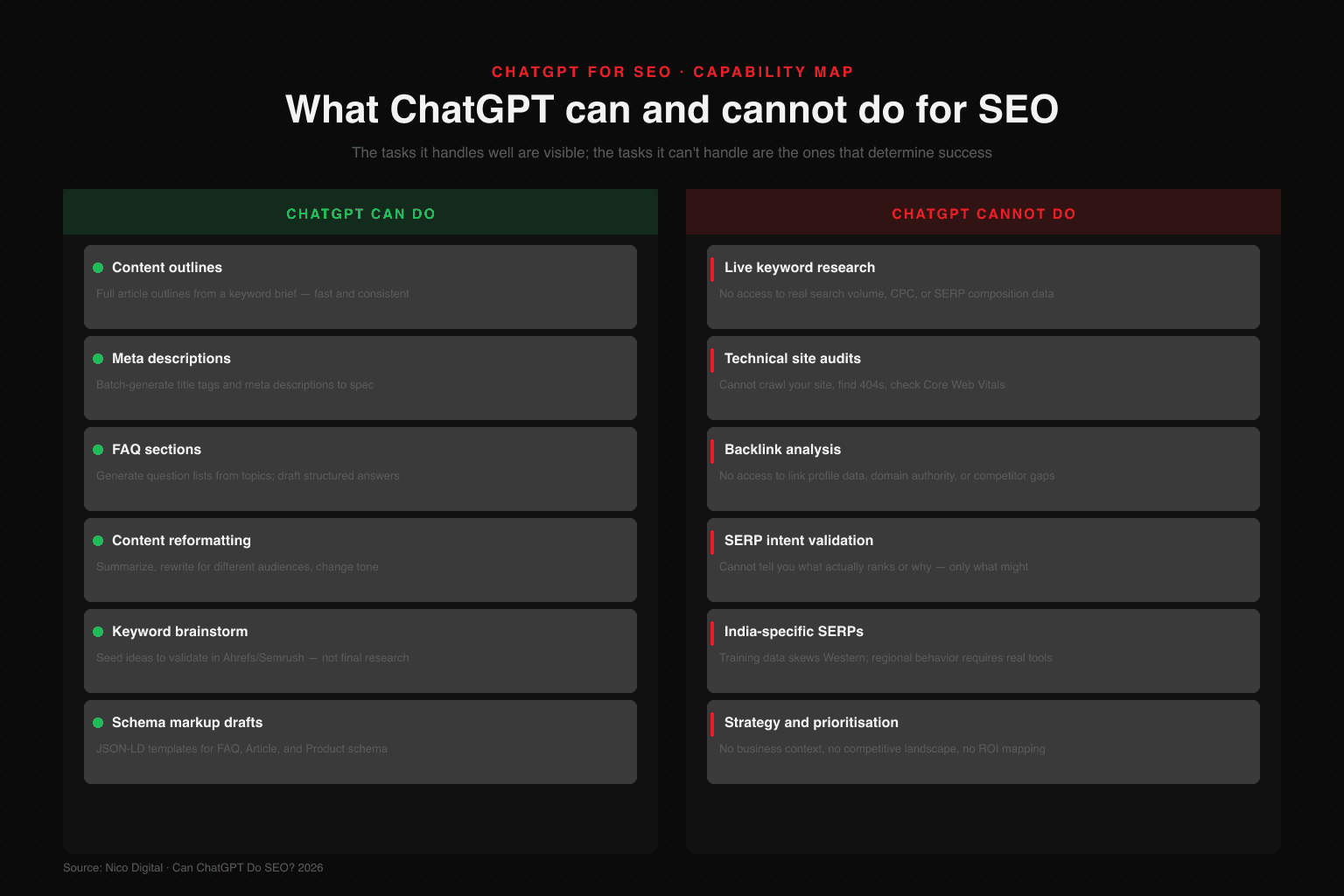
What ChatGPT Can and Cannot Do for SEO: The Real Breakdown
ChatGPT can handle a meaningful subset of SEO tasks well. It cannot handle the subset that determines whether a campaign actually works. The distinction matters because the tasks AI handles well tend to be the visible, output-producing ones - the kind that generate the feeling of momentum - while the tasks it cannot handle are the invisible strategic ones that determine whether any of that output converts to rankings and revenue.
Is your SEO workflow heavy on AI output but light on strategic direction? Get a free AI-readiness audit - we'll tell you exactly where ChatGPT is helping and where it's quietly costing you rankings. Request Your Free Audit →
What ChatGPT CAN Do for SEO
Write Meta Descriptions and Title Tags
This is one of ChatGPT's genuine strengths. Given a page's topic, target keyword, and approximate content summary, it can produce on-brand, appropriately-length meta descriptions and title tag variants quickly. It is a reliable first draft tool here, and iterating with it is fast.
Generate Content Outlines
ChatGPT can produce detailed outlines for blog posts and landing pages based on a keyword and a few parameters. The outlines are coherent and often structurally sound. They need review - the model does not know your specific audience's actual questions, the SERP intent nuances, or what your competitors are already covering - but as a starting framework they are useful.
Brainstorm Keyword Ideas
Ask ChatGPT for keyword variations around a topic and it will generate a useful list. These should be treated as hypotheses, not validated data - the model cannot tell you actual search volume, competition scores, or SERP composition. Every keyword from a ChatGPT brainstorm needs validation in a real keyword research tool before being actioned.
Write FAQ Content
Frequently asked questions sections, schema-optimised FAQ blocks, and voice-search-friendly answer paragraphs are tasks where ChatGPT performs well. The format is predictable, the requirements are clear, and the output can be high quality with good prompting.
Rewrite Existing Content for Clarity
Passing an existing piece of content to ChatGPT with a brief to simplify, tighten, or restructure it often produces genuinely improved output. This is a useful editing assist, particularly for technical content that needs to become more accessible.
What ChatGPT CANNOT Do for SEO
Access Real-Time Search Data
ChatGPT's training data has a cutoff. It cannot tell you what is actually ranking today, what featured snippets look like, what PAA questions are appearing, or how a SERP has shifted in the past three months. SEO strategy built on stale SERP data is not real strategy - it is guesswork wearing a confident face.
Analyse Competitor Backlink Profiles
Understanding why a competitor ranks requires examining their link profile: who links to them, from what types of content, over what time period. ChatGPT has no access to this data. Backlink analysis requires tools like Ahrefs or Semrush and the expertise to interpret what the data means for your specific campaign.
Run Technical Site Audits
Technical SEO - crawlability issues, Core Web Vitals failures, canonicalisation errors, JavaScript rendering problems, indexation gaps - requires crawling your actual site with specialist tools. ChatGPT can explain what these issues are. It cannot identify which ones your site has.
Understand India-Specific SERP Dynamics
This is a critical gap for Indian marketers. Indian SERPs behave differently from global averages. Regional language searches, Hinglish content, Google India's local pack behavior, and the dominance of specific local publishers in certain categories are all factors that require live SERP analysis, not AI-generated content based on global training data.
A brand targeting "dentist near me in Pune" versus "dentist in Pune" gets meaningfully different SERP experiences. ChatGPT cannot distinguish these nuances or tell you which local intent signals Google is weighting in your specific city or category.
Replace Strategic Keyword-to-Revenue Mapping
The highest-value SEO work is mapping keywords to commercial outcomes: understanding which queries indicate high purchase intent, which indicate research intent that needs nurturing, and which categories of keywords can realistically be owned given your current domain authority and budget.
This requires real data, competitive analysis, and strategic judgment. ChatGPT can discuss the concepts but cannot execute the analysis. That is why professional SEO services India teams bring market-contextual judgment that no AI tool can replicate.
The Real Risk of ChatGPT-Only SEO
Generic, Undifferentiated Content
ChatGPT produces content that sounds reasonable and reads well. The problem is that it is producing similar-sounding content for every company that gives it similar briefs. If your SEO strategy is "use ChatGPT to write blog posts at scale," you are producing the same content as your competitors who had the same idea.
Google's systems are increasingly good at identifying undifferentiated AI content - and E-E-A-T signals are explicitly about the experience and expertise that AI cannot fake.
No SERP-Based Keyword Validation
A keyword that sounds logical is not the same as a keyword people are actually searching. An outline that looks comprehensive may be missing the angle that the actual SERP rewards. Without grounding content in live SERP analysis, you are writing into a void.
Factual Errors in E-E-A-T-Sensitive Content
In health, finance, legal, and similar categories, ChatGPT's tendency to confidently state inaccurate information is not just a quality problem - it is a ranking risk. Google explicitly evaluates medical, financial, and legal content against higher accuracy standards. A confident-sounding factual error in this content can tank trust signals across your entire domain.
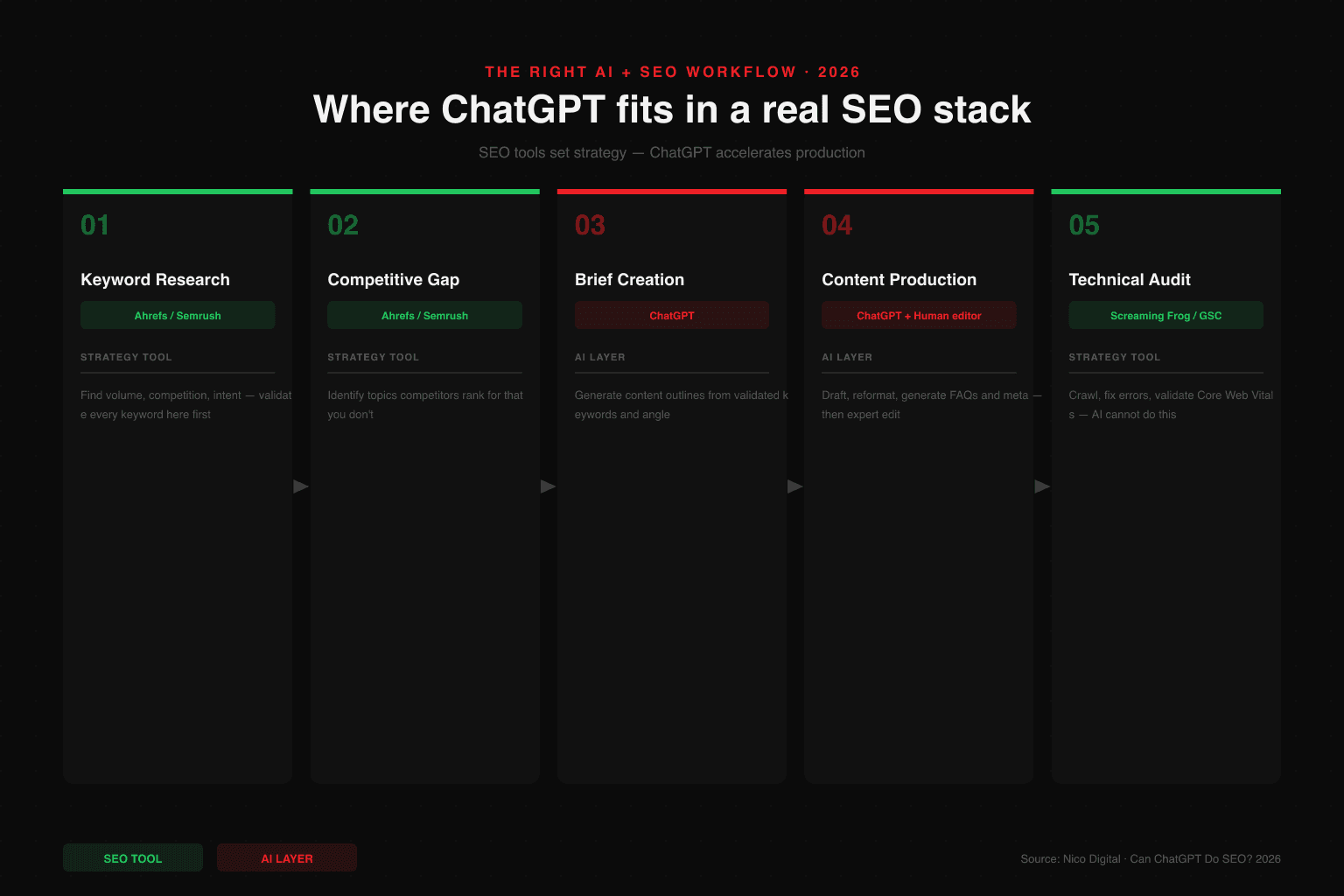
The Right Way to Use AI for SEO
AI for Speed, Humans for Strategy
The teams using AI well in 2026 are the ones that have clearly separated the tasks. AI handles first drafts, structural variations, meta copy, FAQ generation, and content reformatting. Humans handle keyword strategy, competitive analysis, content differentiation, link acquisition, and quality review.
This division of labour produces more output at higher quality than either approach alone. The mistake is letting the speed of AI production crowd out the strategic work - producing more content faster while moving no rankings.
How We Use AI at Nico Digital
Our approach integrates AI as a production accelerant, not a strategy replacement. Every piece of content starts with real SERP analysis, keyword validation, and a content brief that reflects actual competitive gaps. AI helps us produce and iterate faster within that framework. The judgment about what to write, why it will rank, and how to differentiate it from what is already on the SERP stays with our strategists.
A specialist SEO agency brings the strategic infrastructure - technical auditing, link acquisition, and authority-building - that AI tools simply cannot execute independently.
The result is content that reads like it was produced efficiently and performs like it was built on solid strategy - because it was.
Frequently Asked Questions
Can ChatGPT write SEO content that ranks?
ChatGPT can produce content that is structurally sound and readable, but ranking content requires more than good writing. It requires keyword validation from live tools, competitive differentiation, SERP intent alignment, and E-E-A-T signals. ChatGPT can accelerate the drafting phase but cannot replace the strategic inputs that determine whether content earns rankings.
Is AI-generated content bad for SEO?
AI-generated content is not inherently penalized by Google - but thin, undifferentiated content is. The distinction is whether the content provides genuine expertise and value that users cannot easily find elsewhere. AI-generated content that has been edited, grounded in real data, and reviewed by an expert can rank. AI-generated content published without strategic input consistently underperforms.
Does ChatGPT affect Google rankings directly?
No. ChatGPT is a content production tool, not a ranking factor. Whether content produced with ChatGPT's assistance ranks depends entirely on the quality of the strategic inputs, the differentiation of the final output, and the technical and authority signals of the publishing domain - not on whether ChatGPT was involved.
How do Indian SEO agencies use ChatGPT in their process?
The agencies using ChatGPT effectively treat it as a production accelerant within a human-led strategy process. They use it for drafting, reformatting, and scaling content production - while keeping keyword research, competitive analysis, SERP intent mapping, and quality review with experienced practitioners who understand Indian market dynamics.
Bottom Line
ChatGPT is a legitimate productivity tool for specific SEO tasks. It is not a strategy. The teams winning with AI in 2026 are using it to go faster inside a framework built by people who understand what actually moves rankings - live SERP data, competitive analysis, market-specific insight, and the strategic judgment to connect keywords to revenue.
If your current SEO workflow is heavy on AI-generated output but light on strategic direction, our AI-integrated SEO services are built to close that gap.
Get a free AI-readiness audit of your SEO workflow. We'll tell you exactly where ChatGPT is helping - and where it's quietly costing you rankings. Request Your Free Audit →

Aditya Kathotia
Founder & CEO
CEO of Nico Digital and founder of Digital Polo, Aditya Kathotia is a trailblazer in digital marketing. He's powered 500+ brands through transformative strategies, enabling clients worldwide to grow revenue exponentially. Aditya's work has been featured on Entrepreneur, Economic Times, Hubspot, Business.com, Clutch, and more. Join Aditya Kathotia's orbit on LinkedIn to gain exclusive access to his treasure trove of niche-specific marketing secrets and insights.