

How commercially minded brands systematically convert customer voices into a compounding acquisition and retention asset.
Most brands treat user-generated content as a content hack. Post a hashtag. Repost a customer photo. Call it community marketing. That framing is costing them revenue.
UGC, when structured correctly, is not supplemental content. It is the credibility layer that either validates or undermines every other dollar you spend on paid acquisition, SEO, and brand.
Prospects are already looking for it before they convert. The question is whether you have architected a system to produce it reliably, distribute it at scale, and measure its downstream effect on the pipeline.
This article is about building that system, not running a one-off campaign.
What User-Generated Content Actually Is
User-generated content is any content created by someone outside your organization that references your brand, product, or service. Reviews, testimonials, social posts, unboxing videos, comparison articles, forum threads, and community screenshots all fall under UGC.
The narrow version most brands operate with is social UGC: reposts, hashtag campaigns, customer photos. That is the visible surface. The commercially significant layer runs deeper.
Consider where buyers actually look before they purchase. Research consistently shows that the majority of B2C and B2B buyers check third-party reviews before converting, often consulting multiple sources. They are not looking for your brand messaging. They are looking for confirmation from people who have no incentive to lie.
The real UGC asset is not the Instagram post. It is the review that appears when a prospect searches "[your product] review" or "[competitor] vs [your brand]" at 11 pm before making a decision.
That content lives on Google, on Reddit, on G2, on Trustpilot, on Amazon. It ranks. It persists. It converts or disqualifies at a moment you have no visibility into.
Building a UGC strategy without accounting for this search-intent layer is building half a system.
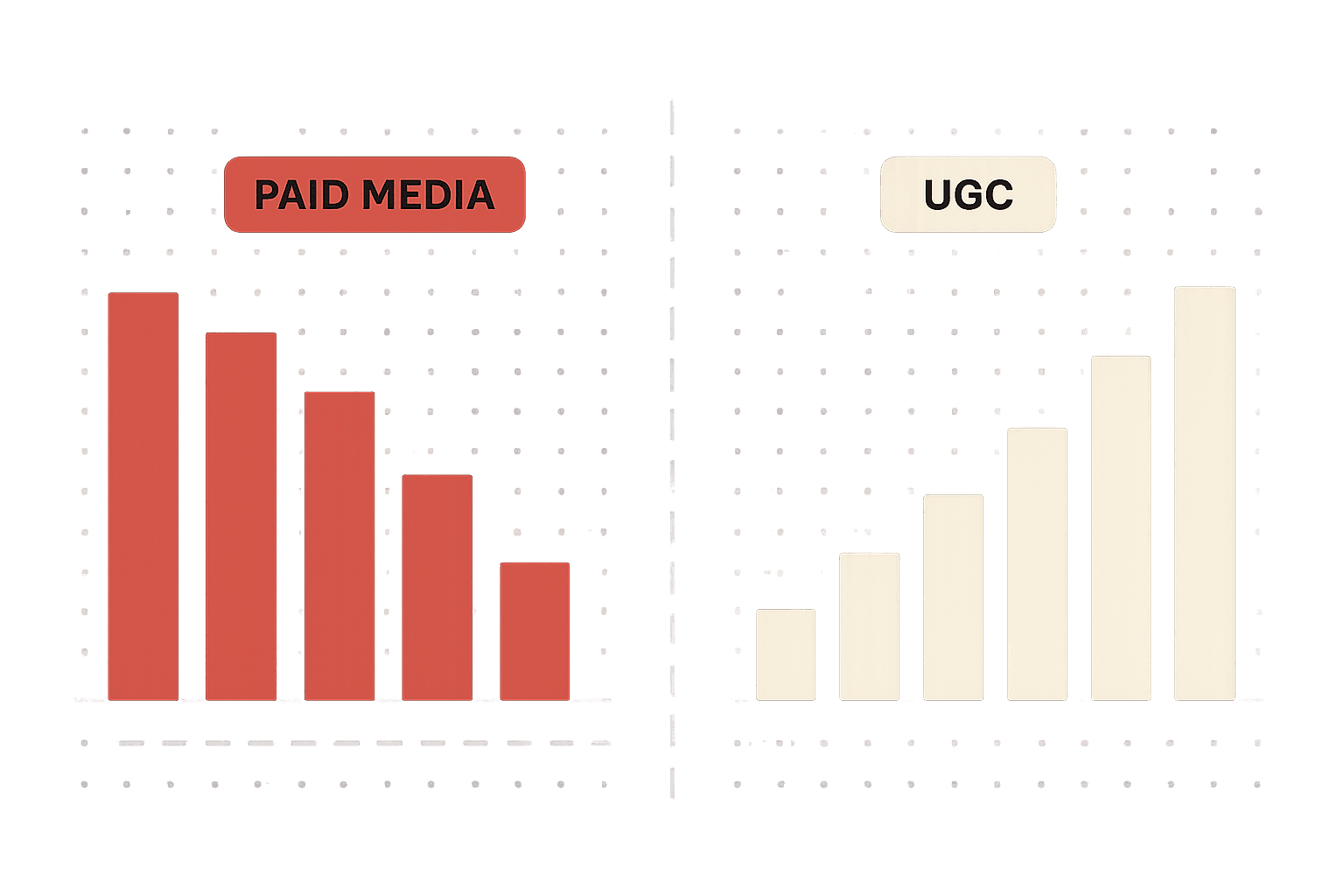
The Commercial Case: Why UGC Compounds Where Paid Media Decays
Paid acquisition delivers predictable volume with a predictable ceiling. Increase budget, increase impressions. Stop spending, stop acquiring. The economics are linear and, in most categories, increasingly expensive.
UGC operates on different economics entirely:
- A review written three years ago can generate qualified traffic today.
- A Reddit thread comparing your product to a competitor does not depreciate.
- Customer testimonials embedded on a landing page contribute to conversion rate improvement that persists indefinitely.
The Trust Deficit in Modern Acquisition
Buyer scepticism has hardened over the last decade. Consumer trust in brand-produced advertising continues to erode, while trust in peer recommendations and independent reviews remains comparatively high.
Brands that understand this dynamic do not view UGC as a cost-reduction play. They view it as the mechanism that makes their paid media more efficient and their organic rankings more defensible. For brands investing in ecommerce SEO, a product page with 200 substantive reviews converts at a different rate than one with three.
Retention, Not Just Acquisition
When customers create content about your brand, they are not just creating marketing collateral - they are deepening their own commitment to you. The act of articulating why something worked, recommending it to others, or sharing a positive experience reinforces the purchase decision and increases lifetime value. One study cited a 54% improvement in retention for businesses with high customer advocacy rates. The mechanism is real.

The UGC Formats That Drive Organic Revenue (Ranked by Commercial Impact)
Not all UGC is equal from a search and revenue perspective. Here is how to think about prioritization.
1. Product and Service Reviews on High-Authority Platforms
Reviews on Google, Amazon, Trustpilot, G2, Capterra, and similar platforms generate indexed content that ranks for high-intent queries. "[Brand] reviews," "[Product] alternatives," "is [service] worth it" - these are decision-stage searches with direct revenue implications.
The mistake most brands make here is passive accumulation. The brands with defensible review profiles treat review generation as an operational system: post-purchase email sequences triggered 7-10 days after delivery for physical goods (or 3-5 days post-use for digital products), in-app prompts, support follow-ups, and proactive outreach to power users.
2. Long-Form Community Content (Reddit, Forums, Niche Communities)
Reddit threads and forum discussions are increasingly visible in Google results, particularly since Google's algorithm updates have prioritized authentic community content. A well-populated thread where real users discuss your product's performance in specific use cases can drive qualified traffic for years.
You cannot manufacture this, but you can encourage it by participating transparently in relevant communities and making it easy for customers to share their experiences in the places they already spend time.
3. Social Proof on Conversion-Critical Pages
Customer testimonials, user photos, and verified purchase reviews embedded on product pages, landing pages, and comparison pages are not social features - they are conversion assets. What matters is specificity and relevance. A testimonial that says "great product" does not move conversion rates. A testimonial that describes a specific problem, explains how the product solved it, and mentions a measurable outcome does. Collect accordingly.
4. Video Testimonials and Unboxing Content
Video UGC delivers higher trust signals than text because it is harder to fake and easier to relate to. For categories where the product experience or transformation is visual, customer-created video content embedded on key pages can meaningfully shift conversion rates. Most customers will not produce video unprompted - incentivizing video reviews or running structured campaigns in the 30-60 day post-purchase window generates more than you expect.
5. Branded Hashtag Campaigns
These have real value, primarily for brand awareness and community building. Brands serious about maximizing reach across platforms often combine hashtag campaigns with a broader social media marketing India strategy to ensure consistent distribution and audience growth.
They are the format most commonly overweighted in UGC strategies relative to their direct commercial impact. Run them, measure them honestly, and do not let them crowd out the higher-intent formats above.
Want us to assess where your UGC library has the biggest commercial gaps? - Get a free UGC audit → We'll identify which formats and platforms are most underbuilt for your category and show you where the highest-leverage collection and deployment opportunities are.
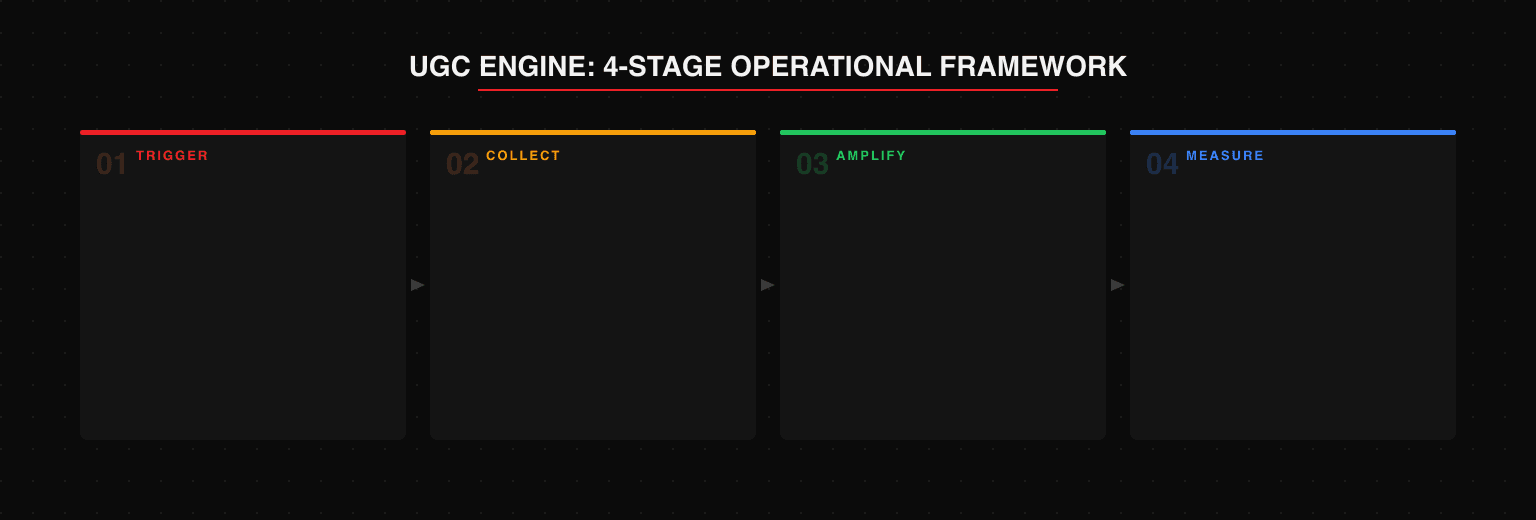
Building a UGC Engine: The Operational Framework
A strategy without operational infrastructure is a document. The brands generating compounding returns from UGC have systematized the inputs, not just the outputs.
Step 1: Map UGC to the Buyer Journey
Different formats serve different stages:
- Reviews and community content function in awareness and consideration.
- Testimonials and case studies function in evaluation and decision-making.
- Retention-stage UGC, where existing customers see content from peers who look like them, contributes to expansion and churn reduction.
Before running any campaign, map out which UGC format is underdeveloped at each stage and prioritize accordingly. Most brands are weakest in the evaluation stage, where a competitor comparison or detailed testimonial from a use case that matches the prospect's context could shift the decision.
Step 2: Create Frictionless Collection Infrastructure
The primary reason brands have thin UGC profiles is not customer unwillingness - it is friction. Your collection infrastructure should include:
- a post-purchase review request sequence triggered at the optimal post-use window for your product category (best practice: 7-10 days after delivery for physical goods, 3-5 days post-use for digital products),
- an in-app or on-platform prompt for digital products,
- a direct outreach process for high-value customers, and
- a simple intake for customers who want to share video or long-form testimonials.
Timing and simplicity convert better than high incentives. A well-timed, low-friction request outperforms a high-incentive request buried in an email with seven other competing elements.
Step 3: Curate and Deploy Strategically
Collection is the input. Deployment is the value. Most brands collect UGC and then underutilize it.
Organize your UGC library by use case, customer segment, industry vertical, and outcome. When a prospect in a specific category is evaluating your tool for a specific workflow, the most valuable testimonial is not the most enthusiastic one - it is the one from a customer in the same category who solved the same problem.
Deploy curated content on product pages, relevant landing pages, email sequences, paid social creative, and sales enablement materials. The same piece of content, deployed in the right context at the right stage, has materially different conversion impact.
The most underutilized UGC deployment channel is paid social. Customer-created content in ad formats routinely outperforms brand-produced creative on cost-per-click and conversion rate metrics. If you are running paid acquisition without testing UGC-based creatives, you are likely overpaying for performance.
Step 4: Moderate, Respond, and Amplify
How you respond to UGC is itself a trust signal. Brands that respond thoughtfully to both positive and negative reviews communicate operational seriousness. Negative reviews, handled well, can convert fence-sitters more effectively than positive reviews - a prospect who sees a critical review met with a specific, non-defensive resolution is seeing evidence of operational competence.
Always obtain explicit permission before repurposing customer content. This is a legal requirement in many jurisdictions and an ethical baseline regardless.
UGC Tools for Indian Brands
Indian brands at different stages have different tool needs:
For collection and display (mid-market): Taggbox and EmbedSocial aggregate social UGC from Instagram, YouTube, and other platforms and embed it on product pages. Yotpo specializes in review collection and display, integrating well with Shopify and WooCommerce.
For review generation on a budget: A combination of Google Reviews, Justdial, and a manual Instagram repost workflow handles the basics for early-stage brands before investing in dedicated platforms.
For UGC ads: Tools like Billo or testimonial.to make it easier to request, collect, and format customer video content for paid social creative.
For analytics: Track UGC impact through GA4 conversion path analysis - segment visitors who interacted with UGC elements versus those who did not, and compare conversion rates. The delta justifies further investment.
What Execution Looks Like: Three Indian Brand Examples
Nykaa: Hashtag to Community Infrastructure
Nykaa's #MyNykaaLook campaign transformed customer makeup photos into a continuous stream of authentic social proof. Rather than treating the hashtag as a campaign, Nykaa built infrastructure to surface the best UGC on product pages, in email campaigns, and in paid social creative. The result was a UGC library that grew organically while serving multiple commercial functions simultaneously. For a brand competing in a crowded beauty market, the authentic customer demonstration content provided trust signals that no amount of brand-produced advertising could replicate.
Mamaearth: Reviews as SEO Infrastructure
Mamaearth built a review generation system that treats post-purchase review requests as a core operational function, not an afterthought. Their product pages on Amazon and their own site consistently carry high review volumes that rank for decision-stage queries like "[product name] review" and "[product name] side effects." This review coverage is a significant part of why Mamaearth holds strong organic visibility in the Indian skincare category without relying exclusively on paid acquisition.
Boat: Community Content as Product Proof
Boat's approach to UGC centers on the fact that audio product performance is genuinely hard to communicate through brand claims alone. By building communities where customers share their setup photos, audio quality opinions, and comparison experiences, Boat generates authentic product proof in environments where skeptical buyers do their research. That community content ranks on Google, influences forum discussions, and provides creative assets that the paid social team uses for retargeting campaigns.
GoPro: Turning Customer Content into Product Proof
GoPro understood early that their product's value proposition could not be communicated through brand-produced content at the level of authenticity customers needed. The GoPro Awards program created a systematic incentive for customers to produce high-quality content that simultaneously served as product proof and marketing material. The result was a content library that demonstrated product performance in real conditions, produced at scale, with zero production budget beyond the award incentives.
Measuring UGC Impact: The Metrics That Connect to Revenue
Measuring UGC through vanity metrics - shares, likes, and total volume - is how you build a program that looks active but generates no discernible business impact.
Acquisition-Side Metrics
Track conversion rate differential between landing pages with and without substantive UGC. Track organic rank movement for review-intent queries against target keywords. Monitor brand search volume as a proxy for awareness and advocacy lift. Measure cost-per-acquisition in paid channels when using UGC creative versus brand-produced creative.
Retention-Side Metrics
Segment your customer base by UGC creators versus non-creators and compare LTV, churn rate, and net promoter score across cohorts. The delta is usually significant enough to justify meaningful investment in UGC activation.
SEO-Specific Metrics
Monitor rankings for high-intent review and comparison queries in your category. Track page-level metrics like time-on-page and scroll depth for product pages with embedded UGC versus those without. These behavioral signals influence organic performance independent of link equity. For AI search surfaces, authentic customer content is increasingly what gets cited in AI Overviews - making UGC a signal for E-E-A-T and AI search visibility simultaneously.
Where UGC Programs Fail: The Mistakes Worth Avoiding
Prioritizing volume over specificity. A hundred generic five-star reviews contribute less to conversion than ten detailed testimonials from customers who match your highest-value segments.
Running campaigns without collection infrastructure. A hashtag campaign that generates content during its active period but has no system for ongoing collection leaves a gap in your content supply. Build the infrastructure before the campaign.
Treating UGC as a social media function. The highest-value UGC deployment is often on product pages, comparison pages, and in paid media creative - not only in social distribution.
Ignoring the search layer. If your brand has thin review coverage on the platforms that rank for decision-stage queries in your category, that is a revenue problem. The prospect making a final decision is looking for third-party confirmation. If they cannot find it for your brand, they find it for a competitor.
Skipping permission. Always obtain explicit permission before repurposing customer content. Reposting without consent is a reputational risk that no content value justifies.
Frequently Asked Questions
What tools can Indian brands use to collect and display UGC?
Taggbox and EmbedSocial aggregate social UGC and embed it on product pages. Yotpo and Okendo specialize in review collection and display with Shopify integration. For brands on tighter budgets, Google Reviews, Justdial, and a manual Instagram repost workflow cover the essentials. For video UGC, Billo makes it easy to request and collect customer video testimonials at scale.
Do you need customer permission to repost their content on Instagram?
Yes, always. Reposting without explicit written permission violates Meta's terms and creates legal and reputational risk. Best practice: comment on the post requesting permission and confirm in writing before reposting. For paid ad use, a signed release or clear campaign terms covering ad use are required.
What is the difference between UGC and influencer marketing?
UGC is content created organically by real customers, typically without compensation. Influencer marketing involves a paid or gifted relationship for content creation. UGC carries higher trust because audiences know it is unpaid. Influencer content offers more editorial control and predictable distribution. The most effective programs use influencers to seed UGC creation and then amplify the authentic customer content through paid channels.
How long does it take to build a strong UGC library for a new brand?
With a systematic collection infrastructure - post-purchase review requests, in-packaging prompts, a clearly promoted hashtag - most brands see their first meaningful UGC volume within 60-90 days. A defensible library with 100+ substantive reviews and 50+ visual UGC assets typically takes 6-12 months. Brands in high-frequency Indian categories like fashion, beauty, and food typically build this faster than low-frequency categories.
The Compounding Return Begins with Infrastructure
The brands generating measurable revenue from user-generated content share a common characteristic: they built systems before campaigns. They invested in collection infrastructure, curated strategically for deployment, measured downstream impact, and iterated based on data.
The brands generating durable returns from UGC started earlier than their competitors - not because the technology was different, but because they treated content from customers as a compounding asset, not a campaign tactic. The review you earn today should be working for you in three years. The testimonial collected from your best customer should be visible to a prospect evaluating your product tomorrow.
Building an effective UGC system starts with clarity: identify where your current UGC is weakest compared to competitors, focus on the platforms and formats that drive the most commercial impact in your category, and make the operational changes needed to produce consistent, high-quality content at scale.
Ready to Build a UGC Engine for Your Brand?
If you want to assess where your UGC gaps are and what an operational system looks like for your category, a structured review is the fastest way to find out.

Aditya Kathotia
Founder & CEO
CEO of Nico Digital and founder of Digital Polo, Aditya Kathotia is a trailblazer in digital marketing. He's powered 500+ brands through transformative strategies, enabling clients worldwide to grow revenue exponentially. Aditya's work has been featured on Entrepreneur, Economic Times, Hubspot, Business.com, Clutch, and more. Join Aditya Kathotia's orbit on LinkedIn to gain exclusive access to his treasure trove of niche-specific marketing secrets and insights.