

The Challenge
When Wakefit entered the Indian market, the mattress and home furniture space was dominated by legacy brands with decades of offline presence - Sleepwell, Duroflex, Nilkamal - and well-funded e-commerce platforms like Pepperfry, Urban Ladder, and IKEA. The question was clear: how does a digitally-native D2C brand build organic dominance against incumbents with 10x the budget?
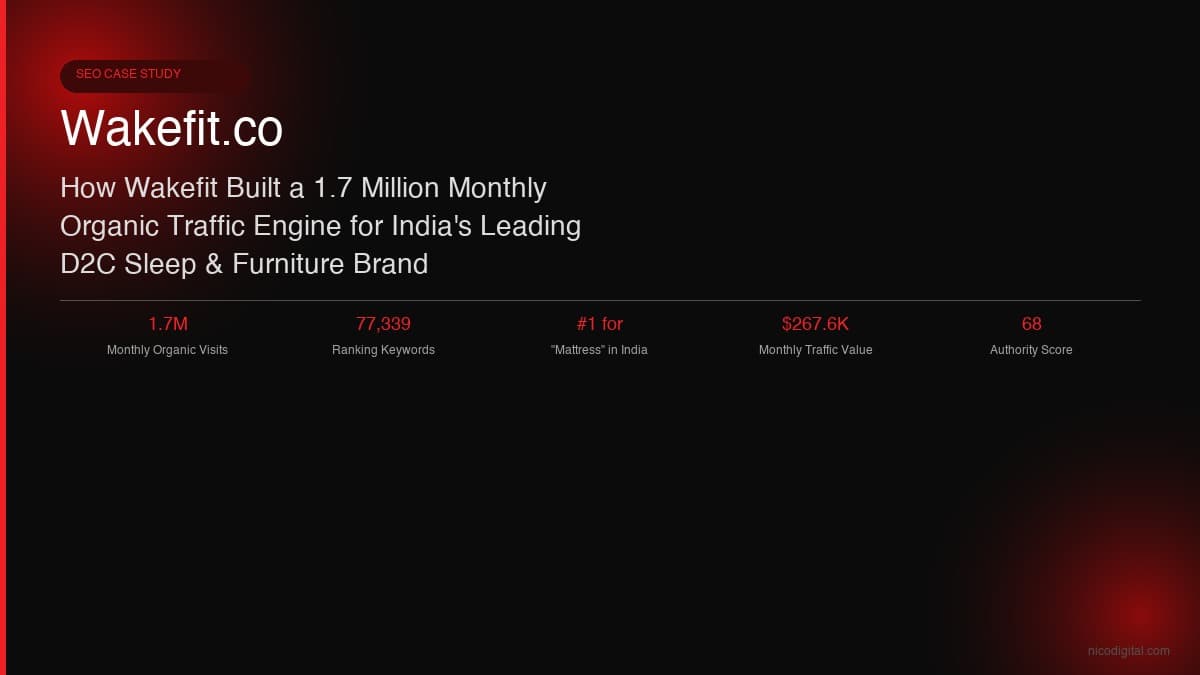
The answer was a meticulously designed SEO engine that combined brand-building, technical precision, content strategy, and relentless category expansion. This case study walks through every tactic deployed, backed by live performance data, so you can see exactly how each strategy contributed to building a 1.7 million monthly visit organic traffic machine.
The Scoreboard - Where Wakefit Stands Today
Before breaking down the strategy, here is where Wakefit stands right now.
Wakefit.co - Domain Overview
Domain Overview
| Metric | Value |
|---|---|
| Authority Score | 68 (Industry Leader tier) |
| Monthly Organic Traffic (India) | 1,700,000 visits/month |
| Total Site Visits (Worldwide) | 2,600,000 visits/month |
| Organic Keywords (India) | 77,339 |
| Referring Domains | 3,518 |
| Total Backlinks | 51,900 |
| Traffic Cost Value | $267,600/month |
| Branded Traffic | 723,700/month |
| Non-Branded Traffic | 950,100/month |
AI Search Visibility
Wakefit is already being actively cited by AI chatbots and Google's AI features - the next frontier of organic traffic:
AI Search Visibility - wakefit.co
With an AI Visibility Score of 74 in India, when Indian users ask AI about mattresses, furniture, or sleep health, Wakefit's pages are being referenced and cited. With 5,500 total AI mentions and 4,000 cited pages globally, this positions Wakefit ahead of every competitor in the AI-powered search era.
Traffic Analytics Deep Dive
| Metric | Value |
|---|---|
| Total Visits | 2,600,000/month |
| Unique Visitors | 1,800,000/month |
| Pages per Visit | 3.4 |
| Avg. Session Duration | 7 min 45 sec |
| Desktop vs Mobile | 18.11% / 81.89% |
Device split insight: 82% of traffic comes from mobile devices. Any SEO strategy for the Indian e-commerce market must be mobile-first. Interestingly, desktop dominates the small US traffic segment (72.92% desktop), revealing different device behaviours across markets.
Geographic Distribution
| Country | Traffic Share | Visits | Mobile % |
|---|---|---|---|
| India | 97.33% | 2,600,000 | 83.09% |
| United States | 0.96% | 25,500 | 27.08% |
| Saudi Arabia | 0.24% | 6,300 | 84.89% |
| Sweden | 0.21% | 5,600 | 82.64% |
| Germany | 0.20% | 5,400 | 45.97% |
Wakefit is a domestic powerhouse. 97.33% of all traffic comes from India, confirming the SEO strategy is laser-focused on the Indian market.
Traffic Source Breakdown
| Source | Share |
|---|---|
| Direct / Self-referral | 82.92% |
| Google (organic + paid) | 12.22% |
| Google Ads (paid) | 0.69% |
| YouTube | 0.61% |
| Affiliate tracking | 0.58% |
The 82.92% direct traffic number is the headline. This means 4 out of 5 visitors type "wakefit.co" directly or have it bookmarked. This level of brand recall is the result of sustained brand-building campaigns - the Sleep Internship, IPO press, offline stores - not just SEO. Brand-building and SEO are not separate strategies. They compound each other.
The Keyword Strategy - What They Rank For and Why
The keyword portfolio was designed with a four-layer intent architecture. Each layer serves a different business objective, and the balance between them reveals the strategic thinking behind the growth.
Keyword Intent Distribution
Keyword Intent Distribution - wakefit.co
| Intent Type | % of Keywords | Keyword Count | Traffic |
|---|---|---|---|
| Commercial | 37.7% | 36,600 | 907,000 |
| Informational | 32.9% | 31,900 | 170,800 |
| Transactional | 23.0% | 22,300 | 687,600 |
| Navigational | 6.4% | 6,200 | 688,800 |
The critical insight: Commercial keywords (37.7%) drive the most traffic at 907K visits, but navigational keywords (only 6.4% of the portfolio) drive 688,800 visits - disproportionately high. The brand name alone generates nearly as much traffic as all transactional keywords combined. That's the flywheel: brand campaigns → branded search → SEO captures the click → conversion.
The Top 20 Keywords - The Revenue Engine
| Keyword | Position | Volume | Traffic | Ranking URL |
|---|---|---|---|---|
| wakefit | #1 | 450,000 | 360,000 | wakefit.co/ |
| mattress | #1 | 301,000 | 141,500 | /mattress |
| matress (misspelling) | #1 | 301,000 | 141,500 | /mattress |
| wakefit mattress | #1 | 165,000 | 132,000 | wakefit.co/ |
| wakefit near me | - | 27,100 | 21,700 | /furniture-store/indore/... |
| wakefit store near me | - | 22,200 | 17,800 | /furniture-store/new-delhi/... |
| sofa cum bed | #2 | 201,000 | 18,100 | /sofa-set/sofa-cum-bed |
| wardrobe | #2 | 201,000 | 18,100 | /wardrobes |
| wake fit | #1 | 18,100 | 14,500 | wakefit.co/ |
| study table | #8 | 450,000 | 13,500 | /study-tables |
| wakefit sofa | #1 | 14,800 | 11,800 | /sofa-set |
| wakefit bed | #1 | 14,800 | 11,800 | /bed |
| furniture shop near me | #4 | 201,000 | 10,100 | /furniture-store |
| sofacum bed | #4 | 201,000 | 10,100 | /sofa-set/sofa-cum-bed |
| sofa set | #8 | 368,000 | 9,200 | /sofa-set |
| bean bag | #5 | 165,000 | 8,300 | /seating/bean-bags |
| yoga mat deals | #9 | 2,700,000 | 8,200 | /floor-furnishing/yoga-mat |
| wakefit chair | #1 | 9,900 | 7,900 | /chair |
| queen size mattress | #1 | 14,800 | 7,000 | /mattress/queen-size-mattress |
| pillow | #4 | 135,000 | 6,800 | /pillows-and-cushions/sleeping-pillow |
What This Keyword Data Reveals
Lesson 1: Own your category head term. Wakefit ranks #1 for "mattress" (301K monthly searches) in India. This single keyword drives 141,500 visits per month. For any D2C brand, ranking #1 for the generic category term is the ultimate SEO prize - achieved through domain authority (68), dedicated category page optimisation (/mattress), and massive backlink volume.
Lesson 2: Capture misspellings. "Matress" (one 't') has the same 301K volume as "mattress" - and Wakefit ranks #1 for both. Google treats them as near-synonyms and serves the same /mattress page. By building the strongest page for "mattress," they automatically capture the misspelling variant.
Lesson 3: Expand horizontally into adjacent categories. Wakefit started as a mattress company but now ranks for "sofa cum bed" (#2, 201K vol), "wardrobe" (#2, 201K vol), "study table" (#8, 450K vol), "sofa set" (#8, 368K vol), "bean bag" (#5, 165K vol), and "pillow" (#4, 135K vol). Each category page targets a massive search volume keyword. Once you've built domain authority in one category, expand into related categories and your authority carries over.
Lesson 4: Build local SEO for physical stores. "Wakefit near me" and "wakefit store near me" combine for 49,300 monthly volume. These lead to city-specific store pages. With 100+ physical stores, each one generates compounding local search traffic.
Lesson 5: Informational content as a traffic entry point. "Yoga mat deals" (2.7M volume!) at position 9 brings 8,200 visits. The /mattress-size-guide page alone drives 19,200 visits with 609 keywords. These informational pages build topical authority and funnel users toward commercial pages.
Page Architecture - The Traffic Engine
Every page on wakefit.co was built with a specific role in the organic traffic engine. The site uses a hub-and-spoke architecture where each product category has a single, authoritative page targeting the generic head term.
Top 15 Pages by Organic Traffic (K visits/month)
Top Pages by Organic Traffic
| URL | Traffic | Traffic % | Keywords |
|---|---|---|---|
| wakefit.co/ | 528,900 | 31.59% | 12,116 |
| /mattress | 314,300 | 18.77% | 2,350 |
| /sofa-set | 44,500 | 2.66% | 2,535 |
| /sofa-set/sofa-cum-bed | 44,100 | 2.63% | 797 |
| /study-tables | 38,200 | 2.28% | 1,617 |
| /wardrobes | 34,700 | 2.07% | 3,324 |
| /office-chairs | 32,600 | 1.94% | 950 |
| /bed | 29,800 | 1.77% | 2,200 |
| /furniture-store/indore/Vijay-Nagar | 24,400 | 1.45% | 5 |
| /mattress-size-guide | 19,200 | 1.14% | 609 |
| /furniture-store/new-delhi/Kirti-Nagar | 18,700 | 1.11% | 6 |
| /tv-units | 17,900 | 1.06% | 1,800 |
| /medical-pillows/cervical-pillow | 15,300 | 0.91% | 367 |
| /furniture-store | 14,700 | 0.88% | 3,000 |
| /seating/bean-bags | 14,100 | 0.84% | 266 |
Total organic pages indexed: 2,932
The Five-Tier Page Model
| Tier | URL Pattern | Purpose | Example |
|---|---|---|---|
| Homepage | / | Brand search capture hub | wakefit.co/ (12,116 keywords) |
| Category | /category | Generic head term targeting | /mattress (314K traffic) |
| Sub-Category | /category/sub-type | Long-tail keyword targeting | /sofa-set/sofa-cum-bed |
| Local Store | /furniture-store/city/area | Local SEO + near me queries | /furniture-store/indore/... |
| Guide/Pillar | /topic-guide | Topical authority + info traffic | /mattress-size-guide |
- Tier 1 - Homepage (31.6% of all organic traffic): Captures all branded search. Ranks for 12,116 keywords. This single page generates 528,900 monthly organic visits.
- Tier 2 - Category Pages: One authoritative page per product category: /mattress (18.77%), /sofa-set (2.66%), /study-tables (2.28%), /wardrobes (2.07%), /office-chairs (1.94%), /bed (1.77%), /tv-units (1.06%). This is the "money page" model: one page per category, heavily interlinked and keyword-optimised.
- Tier 3 - Sub-Category/Product Pages: Deeper pages targeting long-tail keywords with strong commercial intent - users who know exactly what they want.
- Tier 4 - Local Store Pages (fastest growing): City-specific pages powered by Google Business Profile optimisation. The Indore Vijay Nagar page grew +22,500 traffic in a single month. With 100+ stores and expanding, this is a compounding local SEO engine.
- Tier 5 - Informational/Guide Pages: Pages like /mattress-size-guide (19,200 monthly traffic, 609 keywords) build topical authority and funnel users toward purchase pages.
The Horizontal Expansion Play
Wakefit started as a mattress company. Today, their organic traffic comes from mattresses, sofa sets, beds, study tables, wardrobes, office chairs, TV units, bean bags, pillows, yoga mats, cervical pillows, wall clocks, and more.
Each expansion into a new category was deliberate: identify high-volume generic terms (50K+ monthly searches), build a dedicated category page, and leverage the domain's existing Authority Score of 68 to rank quickly. This is a compounding advantage - the more categories you rank for, the stronger your overall domain becomes.
The Backlink Profile - How Authority Was Built
Backlink Profile - wakefit.co
Backlink Overview
| Metric | Value |
|---|---|
| Total Backlinks | 51,900 |
| Referring Domains | 3,518 |
| Authority Score | 68 (Industry Leader) |
| Follow Links | 77% (40,100) |
| NoFollow Links | 23% (11,800) |
| Text Links | 61% (31,700) |
| Image Links | 38% (20,200) |
Backlink Quality Distribution
Referring Domains by Authority Score Range
Green = high-authority domains (AS 71-100) that carry the most SEO weight
| Authority Score Range | Referring Domains | % |
|---|---|---|
| 91-100 (Elite) | 15 | <1% |
| 81-90 (Very High) | 11 | <1% |
| 71-80 (High) | 26 | <1% |
| 61-70 | 31 | <1% |
| 51-60 | 47 | 1% |
| 41-50 | 105 | 3% |
| 31-40 | 163 | 5% |
| 21-30 | 293 | 9% |
| 11-20 | 325 | 9% |
| 0-10 | 2,500 | 71% |
71% of referring domains have an Authority Score of 0-10 - typical for any site with significant scale. The critical numbers are at the top: 15 domains with AS 91-100 (Amazon, Flipkart, Bloomberg), 11 domains with AS 81-90, and 26 with AS 71-80. These 52 premium domains do the heavy lifting for authority. A single link from a DA 90+ domain is worth more than thousands of low-authority links.
Anchor Text Profile
| Anchor Text | Backlinks | Domains | What It Reveals |
|---|---|---|---|
| view website | 12,545 | 2 | Google Business Profile links |
| shop premium beds online at wakefit... | 6,661 | 1 | Sitewide affiliate/partner link |
| shop stylish sofa set - up to 41% off | 5,878 | 1 | Sitewide affiliate/partner link |
| wakefit.co | 5,673 | 447 | Clean branded anchor (healthy) |
| Empty Anchor | 2,883 | 105 | Image links without alt text |
| wakefit | 1,642 | 636 | Brand name (most diverse domain spread) |
| how often should you change your bed sheets | 278 | 18 | Content marketing backlinks |
| how to choose the best pillow for neck pain | 217 | 56 | Content marketing backlinks |
| www.wakefit.co | 206 | 104 | URL as anchor (natural pattern) |
| queen size bed | 131 | 13 | Product keyword anchor |
The profile is overwhelmingly branded - "wakefit.co" + "wakefit" + "www.wakefit.co" together account for ~7,700 backlinks from ~1,241 unique domains. This is a very healthy ratio with no over-optimisation of commercial anchors that might trigger a Google penalty.
The Backlink Timeline - The IPO Effect
The inflection point: Wakefit filed for IPO in December 2025, raising approximately INR 1,289 Cr. This generated coverage from Bloomberg, Business Standard, YourStory, Inc42, The Ken, and Economic Times. Each article = a high-authority editorial backlink. The backlink count jumped from ~29K to ~52K in just two months - an 18,000-link spike from a single business event.
- March-June 2025: Steady at ~29,000 backlinks
- July-October 2025: Gradual climb to ~34,000
- November-December 2025: Massive spike to ~52,000 (+18,000 backlinks in 2 months)
- January 2026: Stabilised at ~51,900
Referring Domain Geography
| Country | Referring Domains | % |
|---|---|---|
| United States | 1,239 | 34% |
| India | 252 | 7% |
| Singapore | 221 | 6% |
| United Kingdom | 193 | 5% |
| France | 87 | 2% |
| Germany | 63 | 2% |
34% of referring domains are from the US, despite 97.33% of traffic coming from India. Tech and business publications (TechCrunch, Bloomberg, Crunchbase, ProductHunt) are predominantly US-based. These US domains provide authority transfer even though the traffic they send is minimal - Google's authority model is global, not geo-restricted.
Referring Domain Categories
| Category | Referring Domains | % |
|---|---|---|
| Online Services | 444 | 13% |
| Mass Media | 195 | 6% |
| Information Technology | 161 | 5% |
| Education | 83 | 2% |
| Finance | 76 | 2% |
The Mass Media (195 domains) and Finance (76 domains) categories directly correspond to earned media coverage from news and financial publications. These are editorial links that cannot be bought or faked - the most valuable backlink category for authority building.
Link-Building Channels
- Earned media and PR: The IPO filing alone generated ~18,000 new backlinks in Nov-Dec 2025. Editorial links from Bloomberg, Business Standard, Inc42, YourStory, The Ken, and Economic Times form the backbone of the domain's authority.
- Marketplace brand pages: Official brand store pages on Amazon.in, Flipkart, and Pepperfry - each a dofollow link from a DA 90+ domain with product-name anchor text.
- Affiliate network: Active programme via CueLinks (1.89% commission) and Trackier, generating review-site backlinks with product keyword anchors.
- Content marketing links: Blog posts like "How to choose the best pillow for neck pain" earn links from 56 unique domains each. Each article builds topical authority.
- Business intelligence profiles: Crunchbase, PitchBook, Tracxn, LinkedIn, and 100+ directory listings provide diverse branded backlinks from authoritative platforms.
SERP Feature Ownership - Beyond the Blue Links
Beyond traditional organic rankings, Wakefit appears in multiple Google SERP feature types - each one increasing visibility and click-through rate beyond the standard blue links.
SERP Features Currently Owned - wakefit.co
SERP Features Currently Owned
| SERP Feature | Keywords Where Wakefit Appears |
|---|---|
| Sitelinks | 17,700 |
| Image Results | 14,800 |
| Image Pack | 1,900 |
| People Also Ask (PAA) | 1,800 |
| AI Overview | 405 |
| Local Pack | 59 |
| Featured Snippets | 10 |
| Knowledge Panel | 8 |
Untapped SERP Feature Opportunities
| SERP Feature | Keywords (Opportunity) |
|---|---|
| Related Searches | 76,700 |
| Video | 73,400 |
| Image | 65,500 |
| Image Pack | 48,300 |
| Sitelinks | 47,300 |
| Popular Products | 45,700 |
| People Also Ask | 31,100 |
| Video Carousel | 25,200 |
| Local Pack | 15,100 |
| AI Overview | 8,400 |
| Knowledge Panel | 5,400 |
| Featured Snippets | 552 |
The massive opportunity: Wakefit only owns 10 featured snippets but there are 552 keywords where a featured snippet exists and doesn't point to Wakefit. They appear in People Also Ask for 1,800 keywords but are missing from 31,100 PAA opportunities. Video carousels (25,200 missed keywords) represent a YouTube content gap. Popular Products (45,700 keywords) can be captured through Google Merchant Centre and product schema optimisation.
The Competitive Landscape
Competitive Landscape - Estimated Organic Traffic (thousands/month)
Organic Competitor Comparison
| Domain | Keyword Overlap | Total Keywords | Traffic | Traffic Cost |
|---|---|---|---|---|
| wakefit.co | - | 77,339 | 1,700,000 | $267,600 |
| urbanladder.com | 47% | 65,600 | 1,100,000 | $68,810 |
| woodenstreet.com | 36% | 154,900 | 2,200,000 | $247,980 |
| pepperfry.com | 36% | 111,400 | 1,100,000 | $114,610 |
| homecentre.in | 29% | 95,100 | 1,600,000 | $141,140 |
| nilkamalfurniture.com | 39% | 73,100 | 1,000,000 | $96,030 |
| ikea.com | 23% | 438,900 | 4,200,000 | $5,770,000 |
| royaloakindia.com | 39% | 53,700 | 530,700 | $46,550 |
| thesleepcompany.in | 26% | 27,200 | 554,300 | $98,770 |
| mysleepwell.com | 17% | 75,600 | 472,100 | $48,310 |
| duroflexworld.com | 22% | 19,000 | 374,500 | $40,970 |
| mysleepyhead.com (SleepyCat) | 22% | 12,900 | 179,100 | $17,580 |
| damroindia.com | 20% | 22,900 | 174,200 | $9,100 |
Competitive Positioning Analysis
Against furniture generalists, Woodenstreet (2.2M traffic) and IKEA (4.2M) have more total traffic, but they're full-range furniture companies with 154K and 438K keywords respectively. Wakefit competes with a tighter keyword portfolio (77K keywords) but generates $267,600 in traffic value - higher efficiency per keyword than most competitors.
Against mattress-only D2C competitors, Wakefit dominates absolutely:
- The Sleep Company: 554K traffic - Wakefit has 3.1x more
- Sleepwell: 472K traffic - Wakefit has 3.6x more
- Duroflex: 374K traffic - Wakefit has 4.5x more
- SleepyCat: 179K traffic - Wakefit has 9.5x more
Wakefit's strategy of expanding beyond mattresses into furniture means they compete at both the "mattress D2C" level (where they dominate) and the "online furniture" level (where they're competitive with much larger, older brands). This dual positioning creates a compounding advantage that is extremely difficult for any single competitor to replicate.
The Strategy - How This Was Built
Here is a detailed breakdown of the seven core strategies driving Wakefit's organic dominance, with the evidence behind each.
Strategy 1: Category Page Domination
What was done: Created a one-page-per-category architecture (/mattress, /sofa-set, /bed, /wardrobes, /study-tables, /office-chairs, /tv-units) where each category page targets the generic head term.
Evidence: /mattress alone ranks for 2,350 keywords and drives 314,300 monthly traffic. They rank #1 for "mattress" and "matress" simultaneously.
Why it works: By consolidating all mattress-related content under a single authoritative category URL, link equity and keyword relevance are concentrated. Google sees one ultra-strong page rather than many diluted pages.
The takeaway: Identify 5-10 head terms in your category (100K+ search volume). Build one comprehensive category page per term. Do not split into multiple thin pages.
Strategy 2: The Branded Search Flywheel
What was done: Invested heavily in offline brand-building (Sleep Internship campaign, 100+ physical stores, IPO publicity) which creates branded search demand. SEO then captures those searches.
Evidence: Branded traffic = 723,700/month. "Wakefit" alone drives 360K visits (21.50% of all organic traffic). The Sleep Internship campaign generated a 150% increase in branded search volume.
Why it works: Branded search is the easiest traffic to convert. It also sends strong signals to Google: high CTR, low bounce rate, return visits - all of which boost overall domain authority.
The takeaway: Invest in brand awareness through viral campaigns, offline presence, and PR. Every 10% increase in branded search volume lifts organic traffic across all pages.
Strategy 3: Horizontal Category Expansion
What was done: Started as a mattress company, then systematically expanded into sofa sets, beds, study tables, wardrobes, office chairs, TV units, bean bags, pillows, yoga mats, wall clocks, and more.
Evidence: They rank in the top 10 for "sofa cum bed" (201K vol), "wardrobe" (201K vol), "study table" (450K vol), "sofa set" (368K vol), "bean bag" (165K vol), and "pillow" (135K vol).
Why it works: Once domain authority is established in one vertical, expanding into adjacent categories leverages that authority. Each new category page immediately starts with the advantage of a 68 AS domain.
The takeaway: Map all adjacent product categories with 50K+ search volume. Launch category pages in order of volume, starting closest to your existing authority.
Strategy 4: Local SEO Through Physical Stores
What was done: Created city-specific store pages (e.g., /furniture-store/indore/Vijay-Nagar) linked to Google Business Profile listings.
Evidence: The Indore store page grew +22,500 traffic in one month. The New Delhi Kirti Nagar page grew +17,900. These pages rank for "wakefit near me" (27.1K vol) and "wakefit store near me" (22.2K vol) - the fastest-growing pages on the entire site.
Why it works: Local SEO targets users with immediate purchase intent. "Near me" searches have the highest conversion rate of any keyword type. Each physical store creates a GBP listing that links back to the store page, creating a reciprocal authority loop.
The takeaway: If you have physical locations, create a store locator page with individual city/area pages. Optimise each GBP listing. This is high-ROI, low-effort SEO.
Strategy 5: Content-Driven Backlink Acquisition
What was done: Created informational content that naturally earns links. Blog posts like "How often should you change your bed sheets" and "How to choose the best pillow for neck pain" were distributed and picked up by other sites.
Evidence: The anchor text "how often should you be changing your bed sheets" has 278 backlinks from 18 domains. "How to choose the best pillow for neck pain" has 217 backlinks from 56 domains.
Why it works: Informational content solves real problems, making it naturally shareable and linkable. The keyword in the anchor text passes topical relevance to the overall domain.
The takeaway: Identify the top 10 questions your customers ask before purchasing. Create comprehensive guide pages (2,000-4,000 words) targeting those questions. Include original data or tools to make them link-worthy.
Strategy 6: PR-Driven Authority Building
What was done: Generated major press coverage through funding announcements, IPO filing (December 2025), revenue milestones, and viral campaigns like the Sleep Internship.
Evidence: Backlink count jumped from ~29K to ~52K between October-December 2025. Mass Media accounts for 195 referring domains. Finance accounts for 76 referring domains. Earned links from Bloomberg, Business Standard, YourStory, Inc42, The Ken, and Economic Times.
Why it works: Each piece of press coverage is an editorial link from a high-DA domain. These are the links Google values most - they cannot be bought, faked, or replicated easily.
The takeaway: Time your PR pushes for maximum SEO impact. Coordinate funding announcements, product launches, and milestone press releases. Every press hit = a permanent backlink.
Strategy 7: Affiliate Network as Link Building
What was done: Built an active affiliate programme (via CueLinks at 1.89% commission, Trackier, VigLink) that incentivises review sites and bloggers to link to their products.
Evidence: Anchor texts "shop premium beds online at wakefit..." (6,661 backlinks), "buy it now" (162 backlinks), and "queen size bed" (131 backlinks) are all affiliate-driven.
Why it works: Affiliate links drive both revenue and SEO value. Even if some are nofollow, the volume and diversity of referring domains contribute to authority signals.
The takeaway: Launch an affiliate programme with competitive commissions (2-5%). Provide affiliates with optimised landing pages and tracking. Target niche bloggers in your vertical specifically.
90-Day Implementation Roadmap
For brands looking to build a similar organic engine, here's how to sequence the work:
Weeks 1-2: Foundation
- Audit your URL structure. Ensure you have one clean category page per product type. No URL parameters, no ID numbers, no duplicate pages. This is non-negotiable.
- Identify your top 20 target keywords. Find the highest-volume generic terms in your categories. For each, check if the leading competitor's page is thin, outdated, or poorly optimised - that's your opening.
- Set up tracking. Rank tracking for your top 50 keywords, backlink monitoring, and Core Web Vitals dashboard.
Weeks 3-4: Content Sprint
- Publish 5 pillar guide pages (2,500-4,000 words each) targeting informational keywords where competitors have weak or outdated content. Example targets: "best mattress for back pain 2026," "mattress buying guide India," "sofa set buying guide."
- Add FAQ sections to all category pages. Format questions as H3 tags, answers in 40-50 words. This targets People Also Ask snippets (there are 31,100+ PAA opportunities in this market).
Weeks 5-8: Authority Building
- Launch a PR campaign. Announce a funding milestone, product launch, or newsworthy brand campaign. Target 15-20 Indian tech/business publications. Aim for 30+ editorial backlinks from DA 60+ domains.
- Create comparison content. Publish "[Your Brand] vs [Competitor]" pages targeting comparison keywords.
- Launch an affiliate programme with 3-5% commission. Reach out to 20 niche review bloggers in your space.
Weeks 9-12: Scale & Optimise
- Expand into adjacent categories. Each page should target a 50K+ volume keyword.
- Technical SEO audit. Ensure all Core Web Vitals are "Good." Implement Product, FAQ, and BreadcrumbList schema on all pages. Implement lazy loading and WebP images.
- Build local SEO (if you have stores). Create individual store pages, optimise GBP listings. Wakefit's fastest-growing traffic is from local pages - proven, high-ROI territory.
- Invest in video content. There are 73,400 video SERP features and 25,200 video carousel keywords where current competitors are absent. A YouTube strategy targeting product reviews, buying guides, and comparisons is a wide-open growth channel.
Traffic, keyword, and backlink figures in this case study are based on industry-standard SEO analytics methodologies.

Aditya Kathotia
Founder & CEO
CEO of Nico Digital and founder of Digital Polo, Aditya Kathotia is a trailblazer in digital marketing. He's powered 500+ brands through transformative strategies, enabling clients worldwide to grow revenue exponentially. Aditya's work has been featured on Entrepreneur, Economic Times, Hubspot, Business.com, Clutch, and more.