

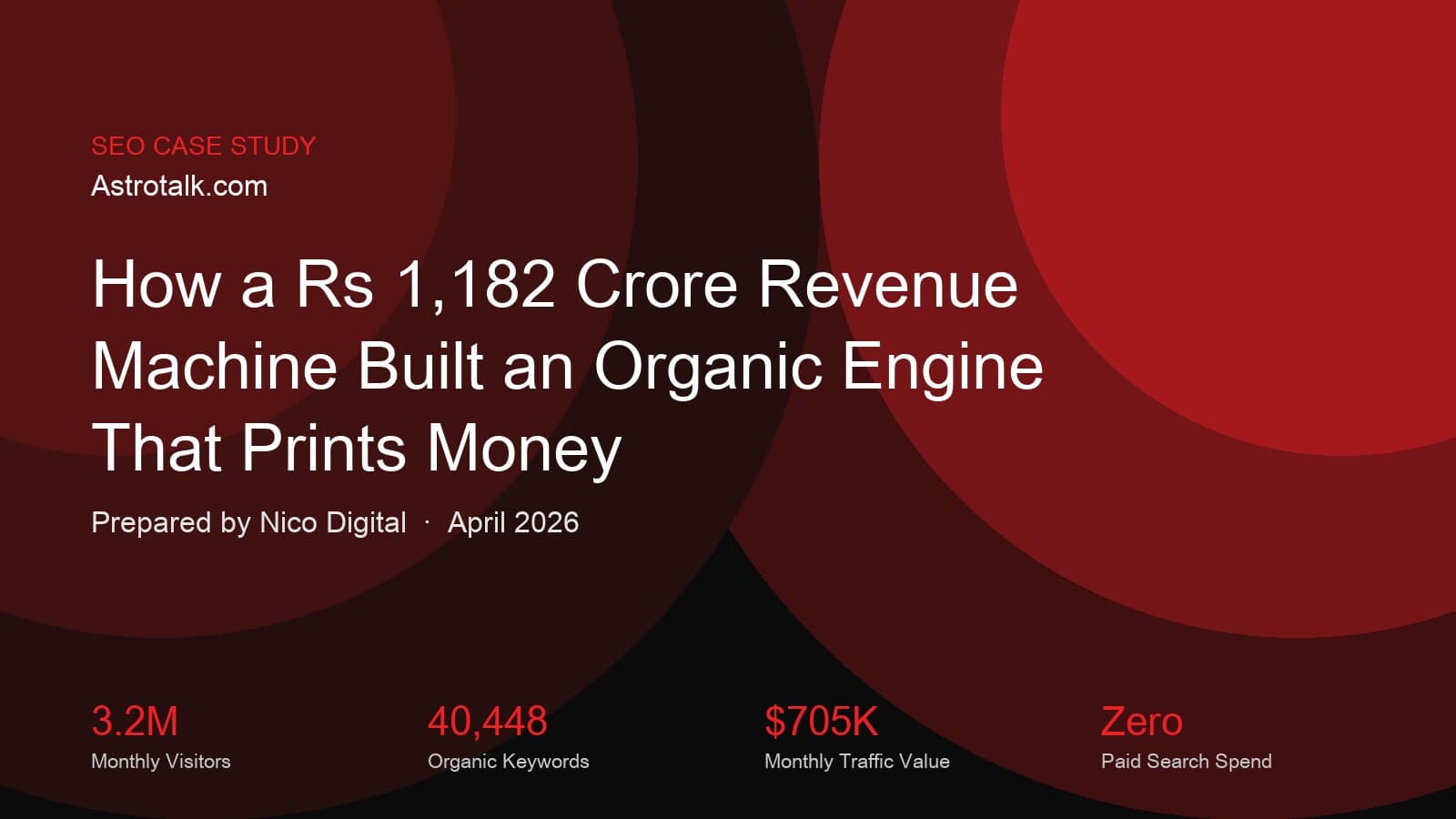
Every SEO case study about Astrotalk gets it wrong. They praise the tactics - 40,000 keywords, programmatic SEO, the genius of the love calculator - and miss everything that actually matters.
Here's what most analyses don't tell you: Astrotalk doesn't have the most organic traffic in its category. AstroSage pulls 2.5x more. But Astrotalk is the only one doing ₹1,182 crore (~$140M) in revenue. The only one that's profitable. The only one heading toward a billion-dollar IPO.
The key insight: Astrotalk's competitive advantage isn't a content strategy - it's 41,000 astrologers who simultaneously serve as service providers, content creators, E-E-A-T signals, and automatic SEO page generators. No competitor can replicate this without first building a comparable marketplace.
Astrotalk.com - Domain Overview
The Traffic Audit - What the Numbers Actually Reveal
Traffic Sources and What They Tell You About Moats
77% organic search plus 22% direct equals 99% of traffic from either Google rankings or direct brand recall. What does 22% direct traffic mean for a site that does zero email marketing and almost no social? It means one in five visitors already knows the brand before they arrive. That's not SEO - that's brand gravity.
Traffic Source Mix - astrotalk.com
99% of traffic is either organic or direct - the signature of a brand-led engine.
Geographic Distribution - The Most Underrated Dataset
Astrotalk captures 47% of its global web traffic from high-ARPU nations (US, UK, Canada). AstroSage has 2.5x more total traffic - but Astrotalk has 9.4x more high-ARPU traffic. This is the Indian diaspora play: NRIs paying in currencies worth 80x the rupee, spending $3-5/minute on consultations that cost ₹20/minute domestically.
Geographic Distribution - Monthly Visits (K)
47% of traffic from high-ARPU nations (US + Canada + UK) - the diaspora arbitrage.
Engagement Metrics
On the 78% bounce rate: most analyses apologise for this number. The real insight is that the website is designed to do one thing - make the brand memorable in a single interaction. A user reads their horoscope, sees the "First Chat FREE" banner, and leaves. They bounced - but they also learned that Astrotalk exists and their first chat is free. When a life crisis hits three weeks later, they download the app directly. The website is the billboard. The app is the store.
| Metric | Value | What It Signals |
|---|---|---|
| Avg. Session Duration | 6 min 49 sec | High-engagement tool interactions |
| Bounce Rate | 78.32% | Intentional - website is awareness, app is conversion |
| Mobile Traffic | 86.32% | Mobile-first architecture is non-negotiable |
| Pages per Visit | 1.77 | Single-purpose visit model by design |
The Full Competitor Landscape
Competitive Landscape - Monthly Visits (thousands)
Less traffic than AstroSage - but 10-20x more revenue. Monetisable traffic wins.
The punchline: Astrotalk generates 10-20x more revenue than any competitor despite not having the most traffic, highest authority score, or most pages per visit. Because traffic isn't the game. Monetisable traffic in the right geographies, at the right life moments, funnelled to the right product - that's the game.
Six Strategies - And the Deeper Logic Underneath Each One
Strategy #1: Programmatic SEO - The Genius Isn't Where You Think
Every case study praises the calculators. Here's the deeper read: Astrotalk's tools run a two-tier strategy, each tier serving a completely different business function.
Tier A - Brand Awareness Tools. The Love Calculator drives 381K visits/month - performance marketing disguised as SEO. 381K brand impressions per month from a page that costs nothing to maintain. The equivalent in display ads would cost $20,000-40,000/month.
Tier B - Life Event Tools. Kundli Matching and Free Kundli target users at active life moments - marriage planning, birth chart analysis. These users have real intent. They're making life decisions. They're the ones who convert to paid consultations.
Two-Tier Tool Strategy - Monthly Traffic (K)
Both tiers feed each other. Tier A drives domain authority through massive traffic volume. That authority helps Tier B pages rank higher for competitive, monetisable keywords. Tier B generates revenue. The revenue funds the platform that hosts Tier A. It's a subsidy loop that looks like a content strategy.
Strategy #2: Topical Authority - 17 Clusters So That 4 Would Dominate
Here's what nobody says about topical authority: most of the 17 clusters don't drive significant traffic individually. Sports Astrology, Mythological Tales, Current Affairs - these probably get modest search volume on their own. Their real function isn't traffic. It's authority signalling.
When Google evaluates whether Astrotalk should rank #1 for "Aries horoscope today," it sees thousands of pages covering every adjacent topic. The conclusion: "This domain is the definitive authority on astrology." Astrotalk built 3-4 traffic drivers surrounded by an authority fortress of 13 supporting clusters.
| Category | Content Type | SEO Function |
|---|---|---|
| Daily Horoscope | Time-sensitive, zodiac-specific | Recurring traffic, freshness signals |
| Compatibility | Pair-based (Aries + Leo, etc.) | Combinatorial content scaling |
| Kundli / Calculators | Birth chart tools | Tier B conversion, tool authority |
| Vedic Astrology | Deep educational content | Topical authority, E-E-A-T |
| Sports / Entertainment | Match predictions, celebrity charts | Authority signals, not traffic |
| Mantras / Mythology | Prayer, cultural stories | Long-session engagement, breadth |
Strategy #3: Multi-Language SEO - The Arbitrage Is Real, But the Moat Is Deeper
"Aaj ka rashifal" - 823,000 monthly searches. The single highest-volume keyword in their entire portfolio. Astrotalk targets it with a dedicated Hindi subdirectory generating 250,000+ monthly visits. But the deeper insight goes further:
Each language subdirectory feeds a specific supply pool. Hindi users match with Hindi-speaking astrologers. Kannada users match with Kannada-speaking astrologers. The SEO strategy is synchronised with the marketplace's supply architecture. Any competitor can translate content into Hindi - but unless they have Hindi-speaking astrologers to service those users, the traffic doesn't monetise.
| Hindi Page | Keywords | Monthly Traffic |
|---|---|---|
| /hi/rashifal/aaj-ka-rashifal | 412 | 121,589 |
| /hi/aaj-ka-panchang | 532 | 26,018 |
| /hi/kundli-milan-matching | 988 | 21,606 |
| /hi/rashifal/kumbh | 235 | 22,197 |
| /hi/freekundali | 507 | 16,021 |
| /hi/aaj-ka-love-rashifal | 86 | 11,491 |
Strategy #4: Combinatorial Content - 144 Pages From One Template
URL structure: /compatibility/{sign1}/{sign2} → 12 signs × 12 signs = 144 unique pages. 100,000+ monthly visits from 144 URL permutations.
The principle: Astrotalk treats content as a combinatorial problem, not an editorial problem. Where most brands ask "what blog post should we write next?", Astrotalk asks "what are all the valid intersections of our topic dimensions?" - then systematically generates every permutation. The marginal cost of page 145 in a compatibility grid is zero. The marginal cost of blog post 145 is a writer, an editor, and a publishing workflow.
Strategy #5: Astrologer Profile Pages - The Most Defensible Strategy
This is the most important SEO strategy Astrotalk has, and it gets the least attention.
Each profile at /best-astrologer/{name} includes: name, photo, specialisations, ratings, reviews, pricing, languages, and direct "Chat" / "Call" CTAs. There are 21,000+ such pages - and every new astrologer who joins creates one automatically.
- Genuinely unique content at scale - every profile has a different person, different reviews, different credentials.
- Impossible to replicate without the marketplace - you cannot fabricate 21,000 profiles with real reviews and real ratings. That requires years and hundreds of crores.
- Self-scaling - zero marginal content cost. The SEO footprint expands automatically as the business grows.
- Bottom-of-funnel targeting - captures high-intent long-tail queries: "best astrologer for marriage problems," " astrologer reviews."
This is the Justdial / Practo / Zillow playbook applied to astrology. The supply side of a marketplace is, simultaneously, the largest and most defensible SEO asset a company can build.
Strategy #6: Internal Linking as Equity Distribution
Astrotalk's internal linking is architecturally deliberate - not editorial. The navigation mega-menu links to all 19+ calculators. The footer connects 50+ key pages. Every blog post embeds contextual links to "chat with astrologer" and "free kundli." Systematic link equity distribution ensures every tool page receives authority from every other page on the site.
Keyword Intelligence - What the Data Layer Tells You
Keyword Portfolio Overview
| Metric | Value |
|---|---|
| Total Organic Keywords | 40,448 |
| Keywords in Position #1 | 675 |
| Keywords in Position 2-3 | 2,189 |
| Keywords in Position 4-10 | 5,754 |
| Total Top-10 Keywords | 8,618 |
| New Keywords (recent period) | 14,999 (+37% of portfolio) |
Intent Distribution - And What It Really Tells You
83% informational keywords looks like "top-of-funnel content marketing." That's the surface take. The deeper truth: Astrotalk has decoupled intent capture from conversion. Most SEO strategies rank for transactional keywords and convert on the same page. Astrotalk ranks for informational keywords and converts on a completely different platform - the mobile app. The website captures intent. The app captures revenue.
Keyword Intent Distribution
Intent capture decoupled from conversion - website captures, app converts.
Top 10 Keywords by Estimated Traffic
| # | Keyword | Search Vol | Position | Est. Traffic |
|---|---|---|---|---|
| 1 | astrotalk | 368,000 | #1 | 111,872 |
| 2 | astrologer | 368,000 | #1 | 111,872 |
| 3 | kundali / kundli | 450,000 | #2 | 72,900 |
| 4 | name calculator for love | 673,000 | #3 | 65,483 |
| 5 | love calculator with names | 673,000 | #4 | 44,351 |
| 6 | matchmaking kundli | 368,000 | #3 | 35,806 |
| 7 | love calculator | 450,000 | #4 | 29,655 |
| 8 | aaj ka rashifal | 823,000 | #8 | 16,213 |
| 9 | sage astro (competitor brand) | 450,000 | #7 | 21,105 |
| 10 | kundali matching | 368,000 | #5 | 17,259 |
Five Things Nobody Else Has Noticed
- Branded search is a self-reinforcing moat. "Astrotalk" generates 368,000 monthly searches - 48% of all organic traffic. Every branded search tells Google "this entity is important," lifting rankings for every other page on the domain.
- The Love Calculator does brand-building at SEO economics. 381K visits/month = 381K brand impressions. At a $0.05 CPM equivalent, that's $19K/month of free brand advertising - with compounding value as those users become future conversion candidates.
- They're capturing competitor branded traffic. Ranking #7 for "sage astro" (an AstroSage brand term) means Google considers Astrotalk a valid alternative to competitors. This only happens when both brands are seen as category peers.
- Hindi keyword variations create multiplicative capture. "Aaj ka rashifal" and its diacritical variant are separate 823K-volume keywords. Most competitors don't optimise for Romanised Hindi variants. Astrotalk does.
- 14,999 new keywords in one period. 37% of their total portfolio as new additions. This is the signature of a programmatic strategy that hasn't plateaued - as they add languages, tools, and profiles, the keyword surface expands automatically.
AEO - How They Engineered 106K Featured Snippets
Historical data shows Astrotalk holds 106,000+ keywords with featured snippets - the signature of a system, not individual page optimisation.
Featured snippets compound. Once Google awards you the answer for one question in a topic cluster, it's statistically more likely to award you snippets for related questions. Astrotalk's 106K snippet keywords didn't come from optimising 106K individual pages - they came from winning initial snippets in core clusters that then cascaded to hundreds of related queries.
| Tactic | Implementation | Why It Works |
|---|---|---|
| Question-based architecture | H2 headers phrased as questions, followed by 2-3 sentence answers | Maps to People Also Ask and snippet extraction targets |
| Calculator output pages | Tool result pages are snippet-proof - users must visit to generate their report | Structurally better CTR economics than content-first SEO |
| Conversational FAQ sections | Blog footers include FAQ content in exact voice/AI assistant formats | Captures snippets AND positions for AI citation |
| Web stories | Mobile-first carousel format launched before competitors | 86% mobile traffic - dedicated carousel placement |
| Daily freshness signals | Horoscope pages updated daily for every zodiac sign | Google favours recently updated content for time-sensitive queries |
GEO - The AI Search Opportunity
Astrotalk currently receives modest AI referral traffic (~1,134 visits/month across ChatGPT, Perplexity, Gemini). But they've built the foundational assets that position them to capture this wave as AI search scales - before most brands know what GEO is.
AI Search Visibility - Monthly Referrals
GEO is the untapped wave - SSR + schema + Wikipedia = highest-ROI next move.
The GEO opportunity map:
- Server-side rendering (SSR). Astrotalk's Angular site doesn't render JS for AI crawlers. Implementing SSR (Angular Universal or Next.js) would unlock all calculator and horoscope content for AI indexing - the single highest-ROI technical change available.
- Comprehensive schema markup. Deploying FAQPage, HowTo, Article, Person, and Organization schema across all pages gives AI models structured data to extract and cite. Table stakes for GEO in 2026.
- Wikipedia article creation. With ₹1,182 Cr revenue, $30M+ funding, and IPO plans, Astrotalk clearly meets Wikipedia's notability criteria. A Wikipedia article seeds accurate brand representation in every AI model's training data.
- Author entity pages for top astrologers. Canonical pages with credentials and expertise for top astrologers give AI models structured expert entities to cite - strengthening E-E-A-T signals across Google and AI systems.
- AI-native platform presence. A branded ChatGPT GPT for daily horoscope delivery, or a Perplexity partnership for astrology content distribution - active distribution inside AI platforms, not just passive crawling.
The Real Engine - Why Content Is the Visible Layer
The most important insight in this entire case study: Astrotalk's content machine isn't a marketing function. It's a byproduct of the marketplace. Every new astrologer is simultaneously a service provider, a content creator, an SEO page generator, an E-E-A-T signal, and a retention mechanism. With 41,000+ astrologers, they have a pool of subject matter experts that no competitor can match without building a comparable marketplace.
| Tier | Type | Examples | Scale |
|---|---|---|---|
| Tier 1 | Programmatic (Automated) | Horoscopes, compatibility, calculators, numerology, nakshatra, astrologer profiles | 21,500+ pages, growing automatically |
| Tier 2 | Editorial Blog (Human-Written) | Posts across 17 categories by named astrologers, trending topics, planetary transits | Multiple posts/week, E-E-A-T compliant |
| Tier 3 | User-Generated (Dynamic) | Astrologer profiles with real reviews and ratings, AstroMall product pages | 41,000+ astrologers generating UGC |
The Conversion Architecture - ₹0 Paid Search → ₹1,182 Cr Revenue
Business Model
| Revenue Stream | Share | Mechanism |
|---|---|---|
| 1-on-1 Consultations | ~85-90% | Pay-per-minute (₹5-₹200+/min), chat (65%) + call (35%), ~20% commission |
| AstroMall / Store | ~10-15% | Gemstones, rudrakshas, ritual items (300+ SKUs), ₹200 Cr ARR (CY2025) |
Financial Growth
Revenue & Profit Growth - Astrotalk (INR Crore)
10.4x revenue growth in 3 years. Profitable while scaling.
Unit Economics
Unit Economics - Astrotalk
The 80% repeat revenue is what makes the model work. Every person who discovers Astrotalk through organic search - even if they don't convert immediately - is a potential lifetime customer worth ₹5,000-10,000+ in revenue. The 3.2M monthly organic visitors aren't 3.2M potential one-time transactions. They're 3.2M entries into a retention funnel.
What's Actually Replicable - And How
| Framework | The Principle | How to Apply |
|---|---|---|
| Tool-first SEO | Build free tools that answer search queries → embed brand → convert downstream | Start with ONE tool targeting the highest-volume informational query in your niche. Make it genuinely useful. Embed your brand and CTA. |
| Two-tier traffic architecture | Tier A drives volume and authority; Tier B drives revenue. Both are essential. | Identify Tier A (high volume, casual intent) and Tier B (high intent, conversion) keywords. Build different page types for each. |
| Combinatorial content scaling | One template × N variables = N rankable pages - when each serves a genuine user need | Find two dimensions you can cross (Product × Use Case, City × Service). Validate each permutation has real search volume. |
| Multi-language arbitrage | Same content in an underserved language = same demand at a fraction of the competition | Only works when your conversion funnel supports the language. Don't build unless you can service those users end-to-end. |
| Authority through width | Build 15 clusters to signal authority. Focus traffic expectations on 3-4. | Build 3-4 core clusters deep (20-30 pages each). Build 10-12 support clusters wide (5-10 pages each). |
| Supply-side content moat | When platform participants automatically create content that drives organic growth, you've built a moat no tactic can replicate | Design profile templates that are SEO-optimised from day one. Every new supply-side participant = a new rankable page. |
The Playbook - Sequenced, Honest, With the Parts Nobody Tells You
Phase 1 - Foundation (Month 1-2)
- Find your "Kundli Matching" - the one free tool your audience desperately searches for at a critical life moment.
- Map the keyword universe: cluster by intent, identify Tier A (brand awareness) and Tier B (revenue-driving) keywords.
- Build the combinatorial matrix: find two dimensions you can cross to create 50-100+ pages from one template.
- Set up subdirectories for non-English languages - but only if your service delivery supports those languages.
Phase 2 - Content Architecture (Month 2-4)
- Build 3-5 free tools spanning both Tier A and Tier B - each generating dynamic, indexable output.
- Build your core clusters (3-4) deep - 20-30 pages per cluster, comprehensive coverage.
- Build your support clusters (10-12) wide - 5-10 pages per cluster, signalling breadth.
- Implement architectural internal linking - into nav, footer, templates, and category structure. Not editorial.
Phase 3 - Scale and Compound (Month 4-8)
- Deploy combinatorial pages - compatibility grids, location matrices, variant pages.
- Launch daily/weekly refreshed content if your niche supports time-sensitive queries.
- Start building the supply side. Each new provider profile = a new rankable page with unique, indexable content.
- Expand language coverage - match SEO expansion to service delivery expansion.
Phase 4 - Optimise and Defend (Month 8-12)
- Optimise for featured snippets: restructure top pages with H2 questions → 2-3 sentence answers → expanded detail.
- Deploy comprehensive schema markup - FAQPage, HowTo, Article, Person, Organization across all pages.
- Build entity signals - press coverage, Wikipedia article (if you meet notability), directory listings.
- Build for GEO - ensure all content is server-side rendered, structured for AI extraction, and citation-friendly.
Investment Required
| Component | Estimated Cost |
|---|---|
| SEO tools | $100-300/month |
| Content writers (3-5 posts/week) | $1,000-3,000/month |
| Tool development (one-time per tool) | $2,000-10,000 |
| Template development (one-time) | $1,000-5,000 |
| Technical SEO implementation | $500-2,000/month |
| Total initial investment | $5,000-20,000 |
| Ongoing monthly cost | $2,000-5,000 |
The Bottom Line
Astrotalk didn't build an SEO strategy. They built a revenue machine that generates organic traffic as a natural byproduct.
- A marketplace of 41,000 astrologers that simultaneously creates service delivery, content, E-E-A-T signals, and 21,000+ automatically generated SEO pages.
- A brand with 368K monthly branded searches that compounds organic rankings for every other keyword.
- A retention engine - 80% repeat buyer revenue - that makes every organic visitor worth 5-10x the first-session value.
- A dual-engine model where performance marketing builds the brand and SEO captures the demand the brand creates.
- A geographic arbitrage - 47% high-ARPU country traffic - that makes smaller traffic numbers generate larger revenue.
The company ranks for 40,448 keywords, holds 675 Position #1 rankings, and generates over $705K/month in organic traffic value - all while spending zero on paid search for the website.
This wasn't luck. It was a system. Not the one everyone talks about. A deeper one. And now you have the blueprint.

Aditya Kathotia
Founder & CEO
CEO of Nico Digital and founder of Digital Polo, Aditya Kathotia is a trailblazer in digital marketing. He's powered 500+ brands through transformative strategies, enabling clients worldwide to grow revenue exponentially. Aditya's work has been featured on Entrepreneur, Economic Times, Hubspot, Business.com, Clutch, and more.