

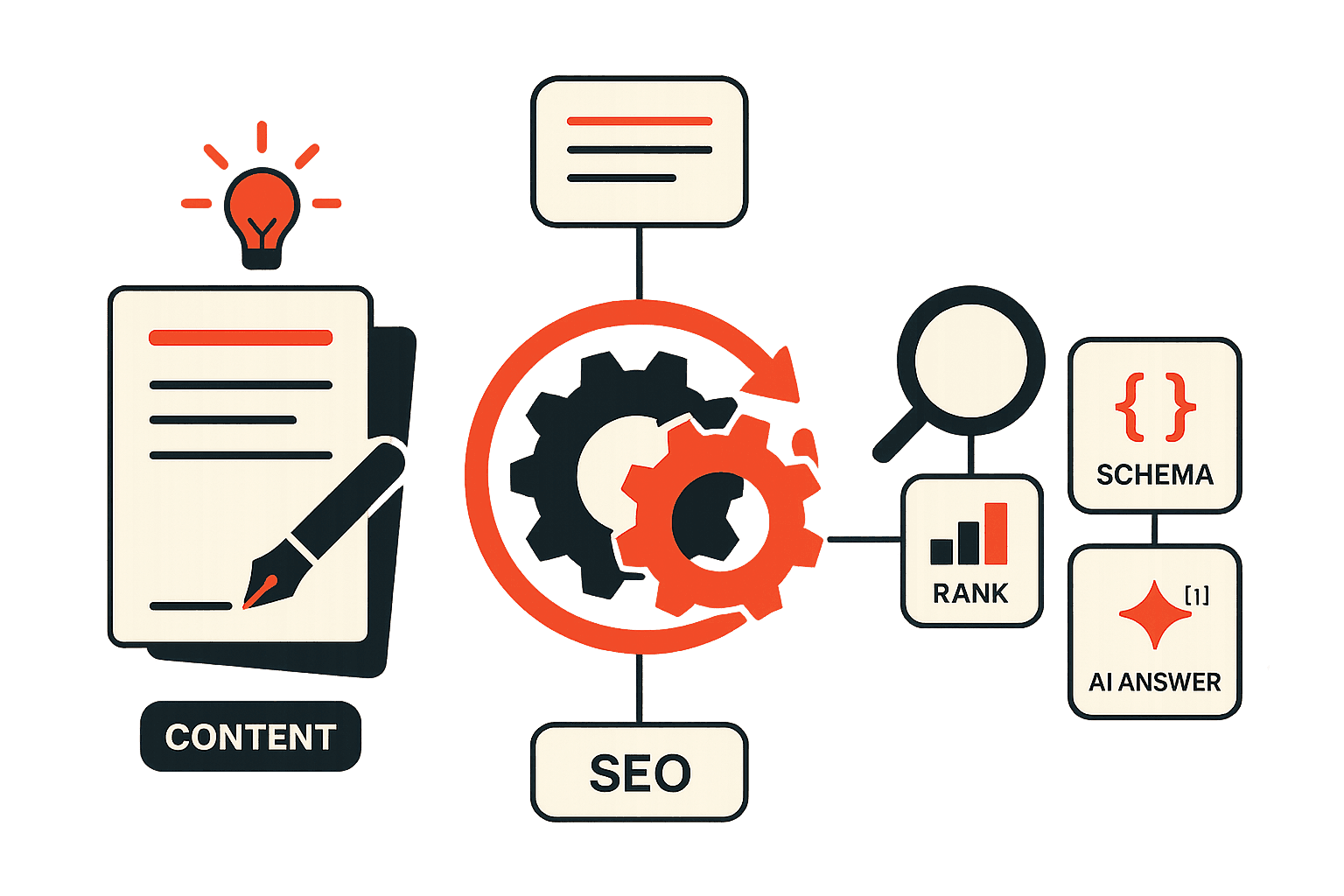
Every quarter we sit in a planning meeting where someone asks a version of the same question: should the budget go into SEO or into content marketing. It sounds like a resource allocation question. It is actually a symptom, and the symptom tells you almost everything about why the organic programme is underperforming.
The question only gets asked in companies where the two functions have been separated - different owners, different budget lines, different reporting. And separation is expensive in a very specific way. Content gets published on topics nobody searches for. SEO recommendations arrive after the article is written, when the only remaining options are cosmetic. Internal linking belongs to nobody. Refresh never gets scheduled because it does not count as new output. And at the end of the quarter two decks land on the same executive's desk with two different numbers describing the same traffic.
The businesses that compound organic revenue do not resolve the SEO versus content marketing debate. They stop having it. This piece is the operating model that replaces the argument: what each discipline genuinely owns, where the overlap actually sits, the failure modes that appear when you split them, how to allocate budget by stage, the shared scorecard, and why AI search has made the separation more costly than at any previous point.
The short answer
SEO and content marketing are not alternatives. SEO is the distribution system - how a page gets crawled, understood, structured, linked and trusted. Content marketing is the substance - what the page actually says and whether a human would choose to read it. Roughly 70 percent of the day-to-day work belongs to both: keyword and question research, topic planning, briefs, on-page structure, internal linking and refresh. Investing in one without the other produces the two most common failure states in organic growth - content nobody can find, or a well-optimised site with nothing worth finding. The correct question is not which to fund, but how to run them as one function with one scorecard.
Why the "versus" question exists at all
The framing is a historical accident, and it is worth understanding because it explains why the argument is so persistent.
SEO as a job function predates content marketing as a job function by roughly a decade. Through the 2000s, SEO was largely a technical and off-site practice - meta tags, directory submissions, anchor text, link acquisition - and the content on the page was treated as raw material to be manipulated rather than as the product. Content marketing then arrived as an explicit reaction to that era, positioning itself as the discipline that cares about the audience rather than the algorithm. The two grew up defining themselves against each other.
That origin story left three residues that still shape how companies organise.
Different hiring pipelines. SEO specialists came from technical and analytics backgrounds. Content marketers came from journalism, brand and communications. They read different publications, use different tools and, crucially, describe good work using vocabularies that barely intersect.
Different agency structures. Most agencies sold them as separate line items because they were staffed as separate teams. Clients inherited that separation and reproduced it internally, which is why so many in-house org charts still have an SEO manager and a content manager who do not share a calendar.
Different definitions of success. SEO reported rankings and sessions. Content marketing reported engagement, shares and pipeline influence. Both sets of numbers were real. Neither told the executive whether the organic programme was working.
None of these are reasons to keep the split. They are just explanations for why it exists.
What SEO actually owns
Strip away the overlap for a moment. There is a substantial body of SEO work that has nothing to do with content, and any company that decides to fund only content marketing is quietly deciding not to do any of it.
Crawl and index control. Which pages search systems are allowed to reach, which they are told to ignore, how crawl budget is spent on a large site, and whether the pages you care about are actually in the index. On a catalogue of any size this is a permanent job, not a project.
Site architecture and technical health. URL structure, depth from the homepage, pagination, faceted navigation, redirect chains, status codes, Core Web Vitals and rendering. These determine whether content has a chance before a single word is read. Our technical SEO services exist precisely because this layer decays silently while everyone is looking at the content calendar.
Canonicalisation and duplication management. Deciding which version of a page is the authoritative one, and preventing the site from competing with itself. This is the discipline behind a keyword cannibalisation audit, and it is invisible until you measure it.
Structured data. Schema markup that lets search systems and AI assistants parse entities, relationships, authorship and answers rather than guessing at them from prose.
Off-site authority. Earning citations and links from sources search systems already trust. This is where link building and digital PR live, and it is the part of the programme content production genuinely cannot substitute for.
What content marketing actually owns
The reverse is equally true. There is a substantial body of content marketing work that search will never reward directly and that an SEO-only budget will never fund.
Point of view. The argument a brand is willing to make that its competitors are not. This is the single hardest thing to produce and the single most defensible asset in a market where anyone can generate competent prose in seconds.
Original research and proprietary data. Surveys, benchmarks, aggregated client results, teardowns. This is the material that earns citations rather than requesting them, and it is the reason original data is now the most reliable input to link acquisition.
Non-search distribution. Email, newsletter, community, LinkedIn, podcasts, video. Channels where the audience arrives because of the brand rather than because of a query.
Sales enablement. Comparison pages, objection-handling assets, case studies, one-pagers. Material that never ranks and never needs to, because its job is to close a deal that is already in motion.
Editorial judgment. Deciding what is worth publishing at all. The most valuable output of a good content function is frequently a decision not to publish something - a judgement no keyword tool will ever produce.
Where the overlap actually sits
Here is the part most comparison articles skip, and it is the part that determines how you should staff and budget. The two exclusive territories above are real but comparatively small. The majority of the work that moves organic revenue sits in a shared middle that belongs cleanly to neither discipline.
Look at the middle column and ask a simple diagnostic question about your own organisation: for each of those eight items, who is accountable? In most companies that have separated the two functions, the honest answer for at least five of them is nobody. That is the real cost of the versus framing. It is not that one discipline gets underfunded. It is that the most valuable column gets orphaned.
Where they genuinely differ
The overlap is large, but the differences are real and worth stating precisely, because they determine which discipline should lead a given decision.
| Dimension | SEO leads | Content marketing leads |
|---|---|---|
| Primary question | Can this be found and understood? | Is this worth reading? |
| Time horizon | Compounding, 3 to 12 months | Mixed - some assets convert immediately |
| Main input | Demand data and site diagnostics | Audience insight and subject expertise |
| Failure mode | Technically perfect pages nobody wants | Excellent pages nobody encounters |
| Ceiling | Limited by what exists to optimise | Limited by discoverability |
| Attribution | Query-level, reasonably clean | Multi-touch, frequently dark |
| Scales by | Systems and templates | Judgment and expertise |
Read the failure-mode row twice. Those two failure states are the ones organisations actually experience, and each is produced by funding one discipline without the other. A business that fixes its technical foundation, builds a clean architecture and publishes thin material gets a well-engineered site with no traffic. A business that invests in beautiful editorial with no demand research and no structural work gets a library nobody reads. Both are expensive. Both are avoidable.
The seven failure modes of separating them
These are the specific, repeatable symptoms we find when we audit a programme where the two functions report separately. If you recognise three or more, the structure is the problem, not the people.
1. Content targets demand that does not exist. Topics get chosen in editorial meetings from intuition, competitor envy or executive requests. Nobody checks whether anyone searches for the topic, what the intent behind the query is, or whether the SERP is already owned. Six months later the blog has forty posts and a flat traffic line.
2. SEO arrives too late to matter. The article is written, designed and scheduled. Then it goes to SEO for review, where the only remaining interventions are the title tag, a meta description and a few injected keywords. The decisions that mattered - the angle, the question set, the structure - were made weeks earlier without any demand input.
3. Internal linking is nobody's job. Writers do not link because it is not in the brief. SEO does not link because they do not touch the CMS. New posts ship orphaned, old posts never receive equity from new ones, and the site never develops the hub structure that carries authority.
4. Refresh never gets scheduled. Content teams are measured on new output. Updating an existing post does not count. Meanwhile the pages that already rank slowly lose position to fresher competitors, which is why a content decay audit reliably finds more recoverable traffic than the new-content pipeline produces.
5. The site competes with itself. Two teams commissioning content against overlapping question sets produce near-duplicate pages that split signals across URLs. Nobody notices because neither team is looking at the same query in both dashboards.
6. Conversion is an afterthought. SEO optimises for sessions. Content optimises for engagement. Neither is accountable for what happens after the read, so calls to action are generic, mid-page conversion paths are absent, and the highest-intent pages get the same treatment as the top-of-funnel ones.
7. The numbers contradict each other. The most visible symptom. Two decks, two definitions of an organic session, two attribution windows, two stories. Executives respond to this exactly as you would expect - by trusting neither, and by treating the entire organic programme as unmeasurable.
Every one of these is a structural failure rather than a skill failure. Hiring better writers or a stronger technical SEO fixes none of them.
AI search has made the separation more expensive
This is the part that has changed most in the last two years, and it is the strongest argument available for merging the functions now rather than eventually.
Classic search ranked documents. You could, with some effort, separate the work of making a document good from the work of making it rank, because ranking was substantially a function of authority and keyword targeting applied to a finished artefact. Answer engines do not work that way. ChatGPT, Perplexity, Google AI Overviews and Gemini extract passages, synthesise them and attribute a subset of sources. What gets extracted is decided at the passage level.
The properties that make a passage extractable are simultaneously editorial and technical:
- A direct answer stated early, before the context and the caveats. An editorial decision with a structural consequence.
- Clean heading hierarchy where each heading is a question a real person asks and the text underneath answers exactly that question.
- Specific, falsifiable claims rather than hedged generalities. Models preferentially surface concrete statements because vague ones are not worth quoting.
- Defensible original data that exists nowhere else, which is the only durable reason for a model to cite you rather than a larger competitor.
- Consistent entity naming so that the brand, the people and the services resolve to stable entities across the site.
- Structured data that removes ambiguity about what the page is and who wrote it.
Notice that three of those six are editorial judgments and three are technical implementations, and that no page satisfies the set unless both were considered at the same time by the same process. This is why we treat answer engine optimisation as a single workflow rather than an SEO service applied to finished content, and why the distinction between SEO, AEO and GEO is more useful as a description of surfaces than as a description of teams.
There is also a hard commercial consequence. When we audited fifty D2C brands for AI visibility, the brands that were invisible to assistants were rarely the ones with weak content or weak technical SEO in isolation. They were the ones where the two had been done separately - strong pages that no model could parse, or well-structured pages with nothing specific enough to quote. The gap between ranking on Google and being cited by ChatGPT is largely a gap between integrated and separated workflows.
The unified operating model
Replace the two-team structure with one funnel and five stages. Specialists still exist. Ownership changes.
Stage 1 - Demand and question mapping. Owned jointly. Start from what the market actually asks: search volume, question clusters, People Also Ask, sales call transcripts, support tickets and the prompts customers type into assistants. The output is a ranked question set, not a keyword list. This is also where you decide what not to cover, which is why thin coverage is a strategy rather than an oversight.
Stage 2 - Cluster architecture. SEO leads. Decide which questions become pillar pages, which become supporting posts, which become service pages and which become a section of an existing page rather than a new URL. Define the internal linking structure before anything is written. This is the single highest-leverage hour in the entire process and the one most often skipped.
Stage 3 - Brief and production. Content leads, with a structural specification embedded in the brief. The brief should carry the target question, the required answer format, the heading skeleton, the internal links to include, the schema type and the specific original insight that justifies the page existing. If a brief cannot name the original insight, the page should not be commissioned. Our content marketing services are built around that brief format for exactly this reason.
Stage 4 - Structure, schema and publication. SEO leads. Answer blocks, heading validation, structured data, internal link insertion in both directions, image handling and indexation. Nothing publishes without both a demand justification and a structural pass.
Stage 5 - Measure, refresh, promote. Owned jointly on a fixed cadence. Every quarter, review decay, review cannibalisation, review AI citation presence, and promote the assets worth promoting. Refresh work should be a scheduled percentage of capacity, not what happens when the calendar has a gap.
The rule that makes this hold: one person is accountable for organic revenue. Not for SEO. Not for content. For the number that both disciplines exist to move.
How to split the budget
Budget by stage, not by department. The correct weighting changes substantially as a site matures, and the most common allocation mistake is running a growth-stage split on a site that has not yet earned a technical foundation.
Three things about this chart are worth stating explicitly, because they are where most plans go wrong.
Technical spend never reaches zero. It drops sharply once the foundation is built, but architecture, indexation and template health decay continuously. On a large catalogue it stays permanently high, which is why ecommerce SEO and enterprise programmes look nothing like a content-led B2B programme at the same budget level.
Content production includes refresh. Treat 20 to 30 percent of the production band as maintenance of what already exists. Teams that budget only for new output are systematically overpaying for traffic, because refreshing a page that already ranks on page two is dramatically cheaper per incremental click than commissioning a new one. If you want the underlying unit economics of that trade, we have broken down what producing AEO-grade content actually costs.
Distribution grows rather than shrinks. The instinct is to front-load authority building. In practice it is the established stage where authority spend pays best, because by then you have assets worth promoting. Promoting a thin site is how link building acquires its bad reputation.
If you are also weighing organic against paid, the sequencing logic is different again and we have covered it separately in SEO vs PPC: which to invest in first. The short version is that the two questions are not comparable - SEO versus content marketing is a question about how to run one channel, while SEO versus PPC is a question about which channels to run.
The shared scorecard
The contradictory-numbers problem is solved by one artefact: a single scorecard with four layers, where neither function can post a win on a metric the other considers meaningless.
| Layer | What it measures | Why both functions care |
|---|---|---|
| Coverage | Indexed pages, share of target question set answered, AI citation presence | Content decides what is answered, SEO decides whether it is reachable |
| Visibility | Impressions, non-branded ranking distribution, AI Overview appearances | Neither impressions nor answer inclusion happen without both inputs |
| Qualified engagement | Intent-weighted clicks, read depth on commercial pages, assisted conversions | Distinguishes traffic that matters from traffic that flatters |
| Revenue | Pipeline and closed revenue with organic entry, including dark-traffic attribution | The only number the business actually buys |
Two implementation notes. First, weight clicks by commercial intent rather than counting sessions, because a thousand sessions on a definition page and a hundred on a comparison page are not the same asset - a point we have argued at length in why blog traffic means nothing on its own. Second, accept that AI-assistant referrals will be partly invisible in analytics and instrument around it with branded search volume, direct traffic patterns and periodic prompt audits rather than pretending the channel does not exist.
Common mistakes to avoid
- Treating the versus question as a budget question. It is an operating model question. Reallocating money between two separated teams does not fix the orphaned middle column.
- Running keyword research after the editorial calendar is set. Demand data is an input to topic selection, not a validation step afterwards.
- Publishing without an original insight. In a market where competent prose is free, a page that only restates what already ranks has no reason to be cited by anyone or anything.
- Measuring content teams on output volume. It guarantees refresh gets deprioritised and guarantees quality drifts down as the number rises.
- Letting SEO own only titles and metadata. If structural input arrives after the draft, it is decoration.
- Ignoring the questions your sales team already hears. The highest-converting content on most sites answers objections raised in real calls, not queries found in a keyword tool.
- Assuming AI search needs a separate workstream. It needs the same workstream done properly. A separate GEO team recreates exactly the silo problem this article is about.
A 90-day plan to merge the two functions
If you are currently running them separately, this is the sequence we use.
Days 1 to 15 - Establish the baseline. Run a full technical and content audit together, not as two exercises. Map every existing page to a question, flag cannibalisation, flag decay, and identify orphans. A structured SEO audit is the right container for this because it produces both halves of the picture in one artefact.
Days 16 to 30 - Build the question set. Replace the keyword list and the editorial wishlist with one ranked question set drawn from search data, sales calls, support tickets and assistant prompts. Assign every question to an existing page, a page to refresh, or a page to create.
Days 31 to 45 - Design the architecture. Define clusters, pillars and the internal linking model before commissioning anything. Decide what gets consolidated and what gets retired.
Days 46 to 60 - Rewrite the brief. One brief template that carries demand justification, the required answer format, the heading skeleton, internal links, schema type and the original insight. Nothing enters production without all six fields populated.
Days 61 to 75 - Ship the refresh batch first. Start with pages that already rank between positions 5 and 20. These produce visible movement inside the quarter and buy political room for the longer-horizon work.
Days 76 to 90 - Install the scorecard and the cadence. One dashboard, four layers, one owner. Set a fixed quarterly cadence for decay review, cannibalisation review and AI citation review, and protect the refresh capacity in the calendar so it cannot be raided for new output.
Where this leaves the original question
Should the budget go to SEO or to content marketing? The question has no correct answer because it contains a false premise. Content marketing without SEO produces material the market never encounters. SEO without content marketing produces a well-engineered site with nothing worth engineering. The two are not competing claims on a budget; they are the substance and the distribution of a single system, and the majority of the work that determines whether that system compounds sits in the shared space between them.
The organisations that win organic in 2026 have made one structural decision: a single accountable owner, a single question set, a single brief, a single scorecard. Everything else - who writes, who implements schema, who runs the crawl - is staffing detail.
If you want an outside read on where your own programme is losing value in that shared middle, we run integrated audits that cover both halves in one pass. You can start with our SEO services, our content marketing services, or our AI SEO and answer engine work if visibility inside assistants is the immediate priority. If you would rather understand the terminology before committing to anything, the digital marketing glossary defines every concept used above, and what AEO actually means is the best next read if the AI-search section is the part that landed.

Aditya Kathotia
Founder & CEO
CEO of Nico Digital and founder of Digital Polo, Aditya Kathotia is a trailblazer in digital marketing. He's powered 500+ brands through transformative strategies, enabling clients worldwide to grow revenue exponentially. Aditya's work has been featured on Entrepreneur, Economic Times, Hubspot, Business.com, Clutch, and more. Join Aditya Kathotia's orbit on LinkedIn to gain exclusive access to his treasure trove of niche-specific marketing secrets and insights.