

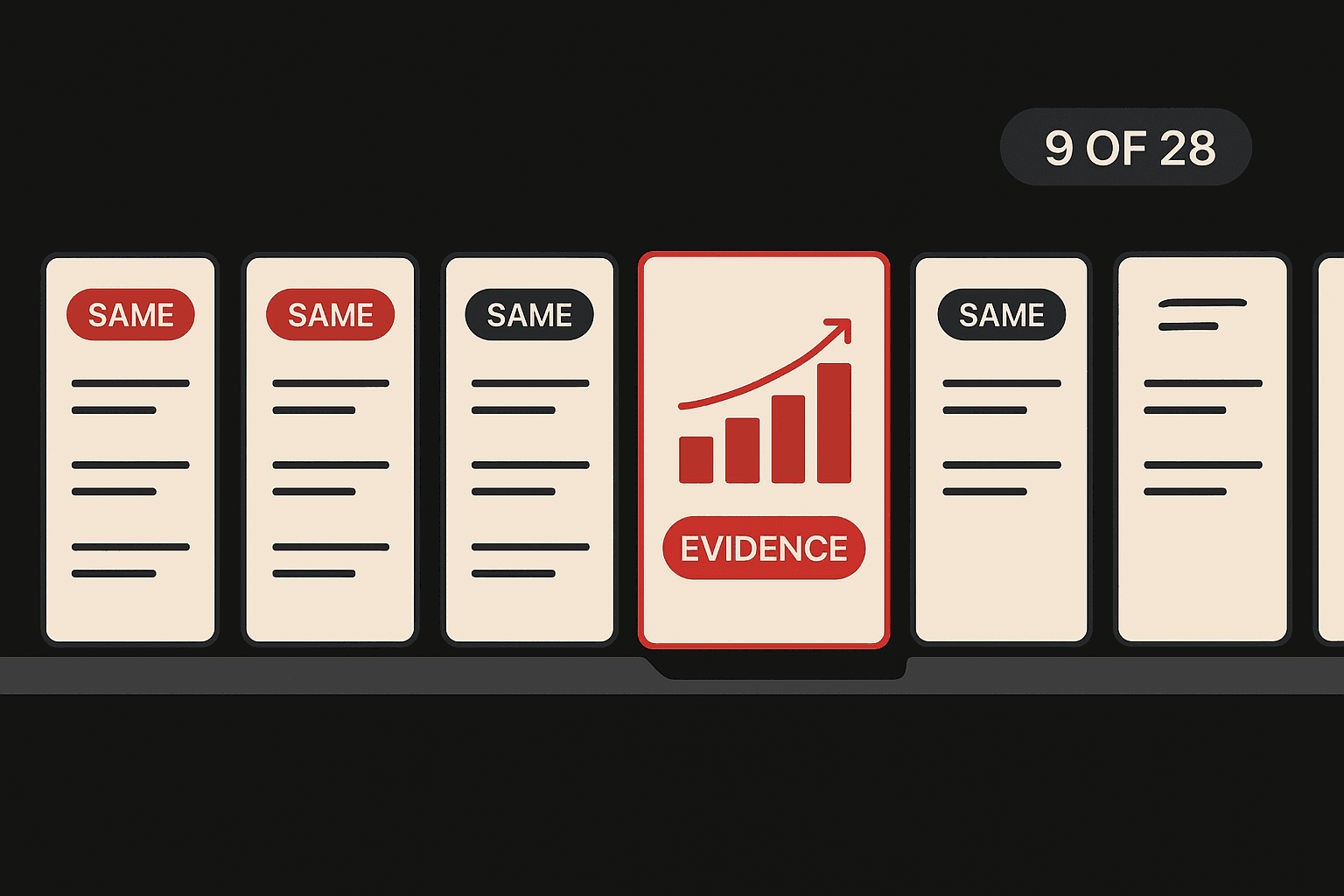
Search "b2b saas seo strategy" and Google returns eight organic results, an AI Overview assembled from them, and a video carousel. The titles are: best practices, the advanced guide, the pipeline-tied playbook, a complete strategy guide, a simple but complete guide, your guide to strategy and growth, and a complete organic growth guide.
You do not need a study to feel that something is wrong with that page. The interesting question is what exactly is wrong with it, because the answer determines what you should do about it - and the obvious answer turns out to be incorrect.
Everyone assumes the pages are the same. So the standard advice for competing on a saturated query is to find a different angle: reorder the sections, pick a narrower audience, invent a framework with a name. That advice assumes the sameness lives in the structure.
We measured it. It does not.
This post is the measurement: six seed queries, 34 unique ranking URLs, 28 pages fetched and parsed, every heading extracted and scored. It changed how we brief content for saturated topics, and the reason is a single number in the last section of the study rather than any of the ones we expected to matter.
The Short Answer
The pages ranking for B2B SaaS SEO queries are not structurally identical. Mean pairwise overlap of section topics across 28 pages was 0.306 on a 0-to-1 scale, and out of several hundred extracted headings only three phrases recurred on three or more pages. Measured as outlines, this SERP is more varied than its reputation.
The convergence is one layer down, in the recommendations. Each page selects a median of six tactics from a shared deck of sixteen, and the selections cluster hard: 21 of 28 pages frame the KPI as trial signups or MRR, 19 discuss keyword difficulty or volume, 18 cover internal linking, 17 argue for bottom-of-funnel first.
And underneath that sits the number that actually matters. Nine of 28 pages carried any first-party evidence - a test the authors ran, their own dataset, a stated methodology. Sixty-eight percent of page one for this topic is confident advice from someone who never published what happened when they followed it.
So the differentiation lever is not a better outline, because outlines are already varied and nobody is winning with them. It is evidence. On this SERP, being one of the nine is a structural advantage that cannot be copied without doing the work, and it is available to any team with a live site and an analytics property.
If you take one operating rule from this: on a saturated query, stop competing on how you organise the consensus and start competing on whether you have tested it.
How We Measured It
Six seed queries, chosen because they are close enough in meaning that a buyer would use them interchangeably: b2b saas seo, b2b saas seo strategy, saas seo strategy, saas seo guide, saas content marketing strategy, and b2b saas content strategy.
For each we pulled the top 10 organic results from the DataForSEO SERP API (United States, desktop, English) on 31 August 2026. That returned 34 unique URLs. We excluded five YouTube, Reddit and LinkedIn results because heading extraction is meaningless on them, attempted the remaining 29, and lost one to bot protection - seoptimer.com returned a 403. That leaves 28 analysed pages across 24 distinct domains.
For each page we fetched the raw HTML, extracted every H2 and H3, and scored it three ways:
Topic buckets. Sixteen regex-matched section types covering the load-bearing parts of a SaaS SEO guide - keyword research, technical SEO, link building, measurement, comparison pages, AI search, and so on. Similarity between any two pages is the Jaccard overlap of their topic sets.
Tactic markers. Sixteen specific recommendations matched against full body text rather than headings, because a page can push bottom-of-funnel prioritisation hard without ever putting "BOFU" in a heading. This is the layer where advice lives.
Evidence signals. Six first-person research patterns - "we tested", "we measured", "our data", "our clients", "methodology", "case study". A page counted as evidence-carrying at two or more distinct signals.
Four limitations you should hold against everything below.
First, regex is a proxy for meaning, not meaning itself. A page containing the words "case study" in a navigation menu scores a signal it has not earned. This inflates the evidence count, which makes the 32% finding a generous ceiling rather than a strict measurement. The true figure is lower.
Second, heading extraction misses JavaScript-rendered content. Pages that build their body client-side under-report. We did not use a headless browser.
Third, the topic buckets are our choice, and Jaccard similarity is sensitive to that choice. Sixteen buckets is a judgement call; more buckets would push similarity down and fewer would push it up. The comparison between pages is sound because every page is scored identically. The absolute value of 0.306 is not a universal constant.
Fourth, this is one snapshot of one SERP in one market. US desktop, one day. We are not claiming it generalises to every category, and we would expect a less mature category to look different.
The script that produced all of this is scripts/saas-serp-sameness-study.mjs, and it runs against any query list. The full output - per-page headings, tactic and evidence scores, and the raw SERP results for all six queries - is a single JSON file we are happy to send to anyone who wants to check our arithmetic or rerun it against their own category. Ask us for it.
Finding 1: Google Recycles 41% of the Result Set
Across six distinct queries we expected 60 result slots to yield somewhere near 60 different pages. We got 34 unique URLs, and 14 of them ranked for more than one query.
That is a 41% recycling rate across queries a keyword tool would happily present as six separate opportunities with six separate volumes.
The practical consequence is a planning error we see constantly. A team pulls a keyword list, sees saas seo strategy at 210 searches a month and b2b saas seo at 140 and b2b saas seo strategy at 20, and scopes three pages. Google has already decided those queries share an intent. Three pages produce internal competition, split link equity, and a set of near-duplicates that a keyword cannibalization audit will have to merge back together in eighteen months.
Three domains in our set appeared more than once: growandconvert.com three times, directiveconsulting.com twice, marketermilk.com twice. Those are sites that consolidated rather than fragmented, and they occupy multiple slots on the same page as a result.
Finding 2: The Outlines Are Not the Same
Here is where the premise broke.
Mean pairwise topic similarity across all 28 pages was 0.306. Two randomly selected ranking pages share about a third of their section topics. The most similar pair in the set reached 0.857, and a long tail sat well below the mean.
Exact heading repetition was rarer still. Out of several hundred extracted headings, only three phrases appeared on three or more distinct pages: "what is saas content marketing" on four, "what is saas seo" on three, and "faq" on three. That is it.
Median topic coverage was 6 of 16 buckets. The spread on length was enormous - median 7,277 words, ranging from 2,120 to 21,762. (That figure counts raw extracted body text including navigation and footer chrome, so read it comparatively rather than as a target.)
Length is clearly not the differentiator either. The longest page in the set, at 21,762 words, carried just two of our 16 tactic markers. A 3,231-word page carried nine and was one of the strongest on evidence.
So the widely repeated advice for saturated SERPs - find a fresh angle, restructure, go deeper - is advice to compete on a dimension where there is already variance and no correlation with winning. Everyone is already doing it. It is not working as a differentiator because it is not scarce.
Finding 3: The Advice Converges Even Where the Structure Doesn't
Drop from headings to recommendations and the picture changes shape.
Mean pairwise tactic similarity was 0.294, statistically similar to the structural figure. But the aggregate distribution is what matters, because it shows the same small set of ideas surfacing across pages that look nothing alike:
| Tactic | Pages (of 28) | Share |
|---|---|---|
| Trial signups / MRR / pipeline as the KPI | 21 | 75% |
| Keyword difficulty and search volume | 19 | 68% |
| Internal linking | 18 | 64% |
| Bottom-of-funnel prioritisation | 17 | 61% |
| Domain authority / domain rating | 14 | 50% |
| Guest posting and digital PR links | 13 | 46% |
| Topic clusters and pillar pages | 11 | 39% |
| Core Web Vitals and page speed | 11 | 39% |
| Comparison and alternative pages | 10 | 36% |
| Long-tail keywords | 10 | 36% |
| Schema and structured data | 10 | 36% |
| Free tools as linkable assets | 9 | 32% |
| Use-case and integration pages | 7 | 25% |
| Product-led content | 6 | 21% |
| Content refresh / historical optimisation | 5 | 18% |
| Programmatic SEO | 2 | 7% |
Median tactics per page: six. Each page draws roughly six cards from this sixteen-card deck, arranges them under headings of its own invention, and ships.
None of this advice is wrong. Bottom-of-funnel prioritisation is correct. Framing the KPI as pipeline rather than sessions is correct - we argue the same thing in our own SaaS SEO guide. The problem is not accuracy. The problem is that correct, widely-held advice has no marginal value on a page where twenty other results already contain it.
This is what Google's information gain patent describes: scoring a document partly on what it contributes beyond the documents already ranked. Restating the consensus fluently has a ceiling, and on this SERP most pages have hit it.
Finding 4: Two-Thirds of Page One Has No Evidence Behind It
This is the finding that changed our briefing process.
Nine of 28 pages carried two or more first-party evidence signals. Nineteen did not.
Remember that our detection is generous. Matching "case study" anywhere in the body text counts, including in a navigation menu or a footer link block. So 32% is an upper bound on the share of page one that shows its work, and the honest figure is lower.
Consider what that means in practice. Twenty-one pages tell you to measure trial signups instead of sessions. Nineteen of the twenty-eight pages on that SERP never published a trial signup number of their own. Seventeen pages tell you to prioritise bottom-of-funnel content. Most of them cannot show you what happened to their pipeline when they did.
The pages that did carry evidence are not the longest, and they are not the ones with the most tactics. technotize.io scored three evidence signals at 3,231 words with nine tactics. growandconvert.com and directiveconsulting.com carried evidence and were also the domains that appeared multiple times across our six queries. position.digital scored three.
That correlation is suggestive, not causal - our sample is 28 pages and we did not control for domain authority, backlink profile or age, all of which plausibly explain multi-query presence better than evidence does. We are not claiming original data caused those rankings. We are claiming that the scarcest input on this SERP is also present in the pages performing best, and that this is worth a test on your own property.
What This Changes About How You Brief Content
The brief for a saturated topic usually opens with competitor outlines and a word count target. Both of those, on this evidence, are close to worthless. Here is what we replaced them with.
Lead the brief with the evidence question, not the outline. Before anyone writes a heading, the brief has to answer: what do we know that the twenty-eight pages already ranking do not? If the honest answer is nothing, the piece does not get commissioned yet. It goes back for a data-gathering step, or it gets merged into an existing page.
Budget the measurement, not just the writing. Our own posts on what AI search optimisation did to our traffic and what schema markup actually moved each cost more in instrumentation and analysis than in drafting. That ratio is the point. The writing is the cheap part and it is the part competitors can match.
Publish the negative results. The schema post above reports a 6.4% decline on our cleanest cohort. It is one of our most-cited pages precisely because a null result is information no vendor blog will give you. Nineteen of twenty-eight ranking pages have nothing to lose by being wrong, which is exactly why they are interchangeable.
Consolidate before you create. Given 41% query recycling, the default assumption for a near-synonym should be that it belongs on an existing page. Our content decay and refresh process catches these, but catching them at brief time is cheaper.
Treat the consensus as a checklist, not a differentiator. Cover the six-of-sixteen the SERP expects, because omitting them reads as a gap. Then spend the remaining effort on the layer nobody else is funding. Our topical authority framework covers how the consensus layer should be organised across a cluster.
This also holds for AI search specifically. Language models are trained on the corpus that produced the consensus, so they can reproduce Layer 2 perfectly and at zero marginal cost. What they cannot generate is a number from your analytics property. That asymmetry is why the formats LLMs cite skew heavily toward original data, and it is the mechanism behind most of what we do in answer engine optimisation.
The Mistakes This Data Exposes
Auditing competitors by outline. Every content tool will export competitor headings and suggest the union of them. Our data says that union is a map of a dimension with no signal in it. You will produce a page that covers everything and contributes nothing.
Using word count as a proxy for depth. The 21,762-word page in our set carried two tactic markers. A 3,231-word page carried nine plus original data. Length correlates with effort, not with value.
Treating "add a unique angle" as sufficient. Angles are already varied at 0.31 mean similarity. A new angle on the same borrowed evidence is a new arrangement of the same nothing.
Scoping one page per keyword variant. 41% recycling means you are frequently building internal competitors and calling it coverage.
Confusing citations with evidence. Linking to someone else's study is not first-party data. It transfers authority to them. Nineteen pages in our set cite external statistics fluently and still land in the evidence-free group.
How to Run This on Your Own Category
The whole study is reproducible and the script is in our repo. Point it at your queries.
- Pick 5 to 8 seed queries a buyer would use interchangeably. Near-synonyms are the point.
- Pull the top 10 for each and count unique URLs. Your recycling rate is the first diagnostic - anything above 30% means your keyword plan probably over-scopes pages.
- Fetch every ranking URL and extract H2s and H3s. Expect to lose a few to bot protection.
- Define 12 to 20 tactic markers for your category and match them against body text, not headings.
- Score evidence signals. Count "we tested", "our data", "methodology", and equivalents. Be generous, then remember the number is a ceiling.
- Read the evidence share first. It tells you what it costs to be genuinely differentiated on that SERP.
The KPIs to watch afterwards are not rankings in week one. Track the share of your published pages that contain a first-party number, citations and mentions in AI answers for your target queries, and referring domains earned per published asset - original data earns links that restated advice does not, which is why this connects directly to link building and digital PR rather than sitting in a content silo.
Want to know where your category's evidence gap sits? We run this analysis as part of an SEO audit - your SERP, your competitors, and a ranked list of the content assets worth building because nobody in your market has published the data yet.
The Bottom Line
We set out to prove that every B2B SaaS SEO guide is the same and found that, structurally, they are not. Mean overlap of 0.306 and three repeated headings across 28 pages is a more varied SERP than anyone gives it credit for.
The sameness is real, but it lives underneath the structure. Twenty-eight pages drawing six cards each from a sixteen-card deck of correct, uncontroversial advice, and nineteen of them offering no evidence they have ever run it.
That is the gap. It is not a content gap in the sense the tools mean - there is no missing subtopic to cover. It is an evidence gap, and it is expensive to close, which is exactly why it stays open.
If you are competing for a saturated commercial term in B2B or SaaS, the highest-return thing you can do this quarter is not another guide. It is to run one of the tactics on the shared deck, measure it honestly on your own property, and publish what happened - including the part where it did not work.
That is a page nobody can copy. On this SERP, roughly two-thirds of your competition has never tried.
Building a content programme that competes on evidence rather than volume? That is the core of how we run content marketing and SEO for B2B and SaaS clients.

Aditya Kathotia
Founder & CEO
CEO of Nico Digital and founder of Digital Polo, Aditya Kathotia is a trailblazer in digital marketing. He's powered 500+ brands through transformative strategies, enabling clients worldwide to grow revenue exponentially. Aditya's work has been featured on Entrepreneur, Economic Times, Hubspot, Business.com, Clutch, and more.