

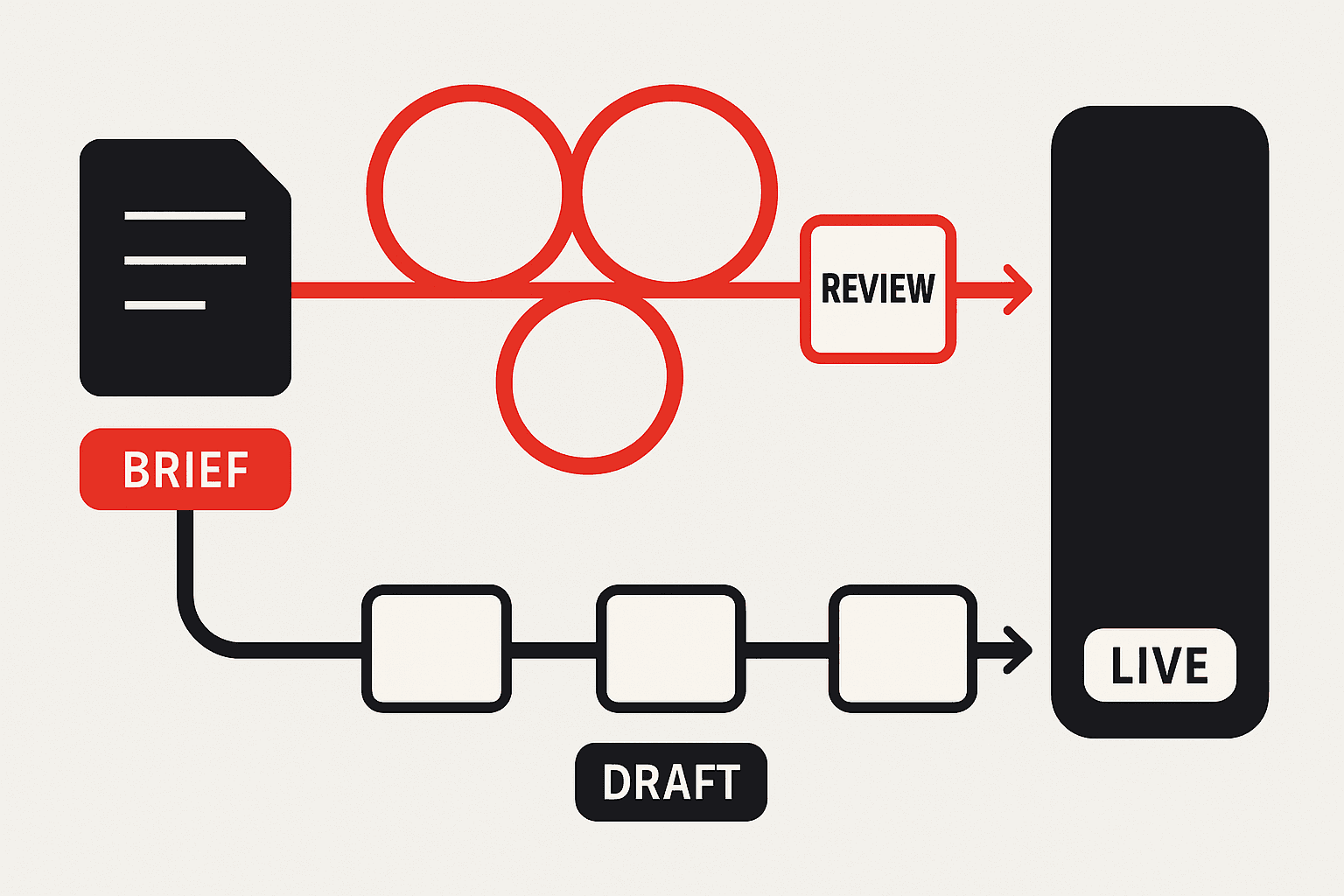
We were shipping content on time and it was taking twice as long as it should have.
Those two facts sound contradictory until you look at where the hours went. Deadlines were being met, so nothing looked broken from the outside. Inside the production line, a standard article was consuming somewhere between eleven and fourteen hours of combined strategist, writer and editor time, and roughly four of those hours were being spent on the third, fourth and occasionally fifth pass through review. Nobody was slow. Everybody was circling.
When we finally instrumented it properly, the finding was uncomfortable and completely unambiguous. The revision rounds were not caused by weak writing. They were caused by decisions that had never been made, arriving at the writer's desk disguised as instructions. Every "consider covering" and "you might want to include" in our briefs was an unmade decision, and unmade decisions do not disappear. They get made later, by the wrong person, at the most expensive point in the process, and then argued about.
This post is the briefing process we built in response, the eleven-block brief that came out of it, and the measured result. It is deliberately not another template listicle. There are already a dozen good ones, and if all you need is a list of fields, Search Engine Land's guide covers that ground perfectly well. What none of them explain is the part that actually determines whether briefing works: who does each stage, in what order, how long each stage gets, and what you are allowed to leave undecided.
The Short Answer
A content brief is not an instruction sheet for a writer. It is the document that transfers completed decisions from the person who researched a topic to the person who writes it, and every decision it leaves open becomes a revision round later. That reframing is the whole change, and it is why process matters more than template.
Our briefing process runs six stages with named owners and a time budget of forty-five to ninety minutes per brief: demand evidence, competitive teardown, the argument, structure, extractability, and the definition of done. The brief that comes out has eleven blocks. We removed four fields that most templates include, including keyword density targets and full H3-level outlines, because measurement showed they made output worse rather than better.
Across a rolling ninety-day comparison on our own production line, median revision rounds fell from 3.4 to 1.6 and median brief-to-publish cycle time fell from 9 working days to 4. Total production hours per piece dropped by slightly more than half. The briefing stage itself got roughly three times longer. That trade is the entire point. If you want the economics of this at scale rather than the mechanics, the real cost of producing AEO content at scale is the companion piece.
Where The Time Actually Went
Before changing anything, we logged eight weeks of production across a mixed set of client and internal pieces. Not estimates. Actual logged hours, tagged by stage. The distribution was the argument for everything that followed.
| Stage | Median hours, before | Share of total |
|---|---|---|
| Briefing | 0.4 | 3% |
| Research and drafting | 5.1 | 40% |
| Review round 1 | 1.3 | 10% |
| Review rounds 2 to 5 | 4.2 | 33% |
| Final edit, formatting, publish | 1.8 | 14% |
Two things jump out of that table.
The first is that the stage which determines the quality of everything downstream was receiving three percent of the effort. Twenty-four minutes. A form fill.
The second is subtler and more important. Review round one is a normal, healthy cost. Rounds two through five are not review at all. They are the deferred cost of decisions that should have been made before anyone started writing, and they were consuming more time than the entire drafting stage. We were paying a senior editor's hourly rate to make choices that a strategist could have made in fifteen minutes, three weeks earlier, with better information.
That is the pattern. Briefing time and revision time are not independent variables that both need reducing. They trade against each other at a punishing exchange rate. In our data, roughly one minute at brief stage was buying back somewhere between four and seven minutes later.
The Reframe: A Brief Is A Decision Transfer, Not An Instruction Sheet
Almost every template you can find online is built on an unstated assumption: that the writer is the person who needs information. Fill in the fields, hand it over, and the writer now knows what to do.
That assumption is wrong in a specific and costly way. The writer usually has plenty of information. What the writer lacks is authority over the decisions the piece depends on, and no amount of additional information substitutes for a decision that has not been made.
Consider the difference between these two lines appearing in a brief:
Consider addressing whether this applies to smaller businesses.
This piece is written for teams publishing four or more pieces a month. Below that volume the process is overhead, and we say so explicitly in the introduction rather than hedging.
The first is information-shaped but decision-free. A writer receiving it has three options, all bad: guess and risk a rewrite, ask and lose two days to a Slack thread, or hedge and produce a paragraph that commits to nothing. In practice most writers hedge, which is why so much published content reads as though it is trying not to be wrong rather than trying to be useful.
The second line closes the decision. The writer can now write with confidence, and the editor reviewing it is checking execution against an agreed position rather than relitigating the position itself.
Once we started reading our old briefs looking specifically for open decisions, we found an average of nine per brief. Nine unresolved questions, each of which had to be resolved by somebody eventually. That is what the review rounds were.
The Six-Stage Briefing Process
Here is the process itself. The stage names matter less than three things: the order, the named owner, and the fact that each stage has a time budget which is enforced.
Stage 1 - Demand evidence (Strategist, 15 minutes)
Establish that the topic has real demand and that we are not already serving it. Three outputs: the primary query and its realistic volume band, the cluster of secondary queries, and an explicit check against our own existing library for overlap.
That last one is not optional and it is the most commonly skipped step in the industry. Publishing a second page against a topic you already cover splits your own signals and, in our experience, is a more common cause of flat organic performance than any external competitive factor. The mechanics of diagnosing it are in our guide to keyword cannibalization audits. At brief stage the rule is simpler: if an existing page covers the intent, the correct output of this stage is a refresh brief, not a new brief. We kill roughly one topic in six here, and killing a topic at stage one costs fifteen minutes instead of twelve hours.
Stage 2 - Competitive teardown (Strategist, 20 minutes)
Read the pages currently ranking. Actually read them, not a tool's summary of them. For each, record two lines: what it does well, and what it fails to do.
The failure column is the one that matters, because it is the raw material for the argument in stage three. If you cannot articulate what the ranking pages fail to do, you have not found a gap and you should not commission the piece. We run a structured version of this, and the full method is written up in our SERP competitor teardown workflow.
For this very article, the teardown output was one line: every page ranking for content brief queries describes the fields of a brief, and none describes the process that produces one, the owners, or the time budget. That single sentence determined everything you are reading.
Stage 3 - The argument (Editor, 15 minutes)
Write one sentence that the piece will spend its length defending, and that a reasonable person could disagree with.
This is the stage most teams do not have at all, and it is the stage that separates content that gets cited from content that gets skimmed. If the sentence cannot be disagreed with, it is a description rather than an argument, and descriptions are exactly what large language models produce in unlimited quantity at zero cost. The scarce thing is a defensible position.
The test we use: could a competent competitor publish the opposite sentence and defend it? If not, the argument is a platitude. "Content briefs improve consistency" fails the test. "Briefing should take ninety minutes, not ten, and the time comes back at a four-to-one rate" passes it, because plenty of experienced operators would argue the opposite.
Stage 4 - Structure and evidence (Strategist and Editor, 20 minutes)
Now, and only now, the outline. H2 level only, six to twelve of them, each one a claim rather than a topic label. Alongside it, the evidence base: which internal data, client examples, named sources and screenshots the writer is permitted to draw on.
Naming the evidence in advance is what prevents the most damaging failure in AI-assisted production, which is fluent unsupported assertion. A writer with a named evidence base writes from it. A writer without one fills the gap with plausible-sounding generalities, and those are extremely difficult to catch in review because they read perfectly well.
Stage 5 - Extractability and linking (Strategist, 15 minutes)
Specify what a machine will lift from this page, and where the page sits in the site's structure.
The extractability block names the specific artifacts: the definition sentence that answers the primary question in under sixty words, the comparison table, the ordered list, the numbered process. These are not stylistic preferences. A page can rank respectably and be entirely absent from AI answers because nothing on it is cleanly quotable, and we have watched that happen to pages we were pleased with. The mechanics of why sit in how to rank on ChatGPT and how to rank on Perplexity, and the broader framework in SEO vs AEO vs GEO.
The linking block names each internal link, its anchor, and its reason. Not a suggestion to "link internally where relevant", which produces either nothing or a decorative cluster of links in the final paragraph. Named links with named anchors, decided by the person who understands the site architecture rather than the person who is mid-sentence.
Stage 6 - Definition of done (Editor, 10 minutes)
The checklist the piece will be reviewed against, written before the piece exists.
This is short, usually five to eight items, and its function is to convert review from a conversation about taste into a check against agreed criteria. If an item is not on this list, it cannot be grounds for a revision round. That rule is uncomfortable for the first month and then becomes the most valued part of the process by both writers and editors, because it ends the experience of receiving contradictory feedback from two reviewers who never agreed with each other in the first place.
The Eleven-Block Brief
The document that comes out of those six stages. Each block exists because its absence caused a specific, repeated failure.
| # | Block | What it prevents |
|---|---|---|
| 1 | The one question | A page that covers a topic instead of answering something |
| 2 | Reader and moment | Copy pitched at a generic audience that persuades nobody |
| 3 | The argument | Fluent, well-structured content with no position |
| 4 | Evidence base | Plausible unsupported assertion, the hardest error to catch in review |
| 5 | Competing pages and their gaps | Rewriting what already ranks, in slightly different words |
| 6 | H2 skeleton | Structural drift and the everything-section |
| 7 | Extractable elements | Ranking without ever being quoted in an AI answer |
| 8 | Internal links with anchors and reasons | Decorative linking, or none |
| 9 | Conversion path | Traffic that arrives and leaves with no next step |
| 10 | Constraints | Legal, factual and tonal problems discovered at final review |
| 11 | Definition of done | Review becoming a negotiation about taste |
Block three is the one to add first if you are only going to add one. Block eleven is the one that will make you most popular with your writers.
A note on block nine. The conversion path is a single named destination and the logic of why a reader of this specific piece would want it, not a generic call to action bolted on at the end. For an operational piece like this one, the honest path is our content marketing services for teams who would rather have the process run for them than build it, and nothing at all for teams who just wanted the template. Writing "nothing at all" into a brief as a legitimate option is unusual and worth doing, because forcing a conversion onto a piece that has not earned one is visible to readers and does more damage than the missed click is worth.
The Four Fields We Removed
Every template accretes. Ours had grown to nineteen fields before we measured which ones were doing work. Four came out, and output improved in each case.
Exact word count. Replaced with a band, and the band is advisory. A specific number produces padding when the argument runs short and truncation when it runs long, and both are worse than a piece of the length the argument actually needs. We now write "roughly 2,000 to 2,800, driven by the argument" and mean it.
Keyword density and placement targets. These encouraged writers to satisfy a counter rather than a reader, and they have not corresponded to ranking outcomes in any test we have run for several years. The primary query and its cluster are still in the brief. Instructions about how many times to use them are not.
The full H3-level outline. This was the hardest to give up because it feels like thoroughness. What it actually does is remove the writer's ability to find the natural shape of the argument while writing, which is where a good deal of the value of hiring a thinking writer lives. H2 level gives structure. H3 level gives dictation, and dictated pieces read like it.
A "tone of voice" paragraph. Every brief carried the same three adjectives, which meant it carried no information. Tone now lives in the style guide and in two linked examples of pieces that got it right, which transfers far more than an adjective ever did.
The general principle: a field earns its place by preventing a failure you have actually observed, not by being the kind of thing briefs usually contain. Audit your own template against that rule and most of you will remove three or four fields this week.
What Changed For AI Search
Three blocks in the eleven are newer than the rest, added since answer engines became a meaningful share of how our clients get found. It is worth being precise about this, because a lot of current advice implies your entire content operation needs rebuilding, and that is not what we found.
Block seven, extractable elements, is the significant one. An engine assembling an answer needs something it can lift without rewriting, and pages built as continuous flowing prose frequently offer nothing that qualifies. So the brief now names the artifacts explicitly: the definition sentence, the comparison table, the ordered process list, the direct answer paragraph placed near the top. We wrote up the full rebuild of a blog around this principle in how we rebuilt a blog to answer questions LLMs actually ask.
Within block four, the evidence base now carries a corroboration note flagging which claims need a citable external source. Assertions and corroborated statements are not treated equivalently by systems assembling answers, and the cheapest moment to decide which claims need support is before anyone writes them, not during a fact-check three days before publication.
Within block one, the question set is now drawn partly from the questions people actually put to assistants, which are longer, more conditional and more situational than keyword tools surface. "Content brief template" is a keyword. "Should the SEO or the editor write the brief in a three-person team" is a question, and the second one is where the citation opportunity sits.
That is the entire AEO adaptation. Three additions to an eleven-block document. If someone is selling you a wholesale content operations rebuild on the strength of AI search, the glossary is cheaper, and our answer engine optimization page sets out what genuinely changes.
Briefing When The Writer Is Partly A Machine
Most content teams now draft with model assistance in some form, and briefs written for a purely human production line do not hold up under that shift. Two adjustments.
The first is that the evidence base moves from useful to load-bearing. A human writer without evidence tends to write vaguely, which is visible. A model without evidence writes confidently, which is not. The brief has to name what may be drawn on, and the definition of done has to include a check that every non-obvious claim traces to something in that list.
The second is that the argument block becomes the only genuinely defensible part of the process. Everything else in a brief, the SERP pull, the competitor summary, the heading skeleton, the question extraction, is collection work that a model does adequately in a fraction of the time, and we use models for exactly that. What a model cannot do is decide that every page ranking for a query has made the same omission and that this omission is the reason to publish. That judgement requires having read the pages with a point of view.
Which produces an uncomfortable but clarifying conclusion for anyone running a content team right now: the parts of briefing that felt like the work are now cheap, and the part that felt like a formality is the entire remaining moat. We looked at what happens when everyone in a category applies the same tools to the same research in the SaaS SEO content sameness study, and the outcome is not subtle.
The Measured Result
Ninety days before, ninety days after, same team, comparable mix of work.
| Metric | Before | After | Change |
|---|---|---|---|
| Median revision rounds to approval | 3.4 | 1.6 | -53% |
| Median brief-to-publish, working days | 9 | 4 | -56% |
| Median total production hours per piece | 12.8 | 6.1 | -52% |
| Median briefing time per piece | 24 min | 71 min | +196% |
| Clarifying questions per piece from writers | 6.2 | 1.4 | -77% |
| Topics killed before drafting | 4% | 17% | +325% |
Two honest caveats, because a table like this invites more confidence than it deserves.
This is one team's production data over two quarters, not a controlled study. Some of the improvement is the ordinary effect of a team getting better at a process it is paying attention to, and we cannot cleanly separate that from the process design itself. Anyone reproducing this should expect direction to hold and magnitude to vary.
The second caveat is more interesting. The last row is arguably the most valuable line in the table and it looks like a failure metric. We now kill roughly one in six topics before anyone drafts, mostly at stage one for overlapping an existing page, and occasionally at stage three for having no defensible argument. Those pieces do not appear in any of the other rows, because they were never produced. The real efficiency gain is larger than the hours table shows, and it comes substantially from not writing things.
Six Ways This Process Fails
We have implemented versions of this with client teams enough times to know the failure modes.
The time budget is treated as aspirational. If briefing can expand to fill an afternoon, it will, and the process collapses under its own weight within a month. The budgets are constraints, not estimates. A brief that needs three hours is a signal that the topic is not ready or not understood, and the correct response is to send it back rather than to keep going.
One person owns every stage. Workable in a small team but only if the passes stay separate. When the same person does demand evidence and argument in a single sitting, the argument reliably degrades into a summary of what the tools returned. Do them on different days if you must, but do not blend them.
The definition of done is written after the draft arrives. At which point it is not a definition of done, it is a rationalisation of the feedback someone already wanted to give. Written before, it is a contract. Written after, it is worse than nothing because it carries false authority.
The argument block is filled with a description. The most common single failure. "This piece explains how content briefs work" is not an argument. If nobody could disagree with the sentence, the piece will not be worth reading and no amount of research will save it.
Briefs are written for content nobody has committed to publishing. Briefing at three times the depth for a pipeline that publishes half of what it briefs is an expensive way to generate documents. Fix the commitment problem first.
Nobody measures anything. Without revision rounds and cycle time tracked per piece, the process reverts within a quarter, because the cost of the change is immediate and visible while the benefit is delayed and diffuse. Track four numbers from the first week. The approach we use for content measurement more broadly is in measuring content ROI without rankings.
How To Roll This Out In 30 Days
Days 1 to 7. Measure the current state. Do not change anything yet. Log revision rounds, brief-to-publish days, and clarifying questions for every piece in flight. You need the baseline, and you will need it again in ninety days when someone asks whether this was worth doing.
Days 8 to 14. Add three blocks only. The argument, the evidence base, and the definition of done. Do not rebuild the template. Three blocks on top of what you already use, on every brief, without exception. Most of the measured gain comes from these three.
Days 15 to 21. Impose the time budget and the owners. Now split the stages, assign each one, and enforce the ninety-five minutes. This is the week people push back, because it is the week briefing feels slower and nothing downstream has visibly improved yet. Hold the line for one full cycle.
Days 22 to 30. Add the kill gates and remove dead fields. Introduce the stage-one overlap check and the stage-three argument test as actual gates that stop work. Then audit your template and delete every field that has not prevented an observed failure. Expect to remove three or four.
Then run it for a quarter before you judge it. The revision-round metric moves first, usually within three weeks. Cycle time follows. The topics-killed number is the one that will feel wrong and be right.
Where This Sits In A Wider Programme
Briefing is a production-line fix, and a production line only matters if it is pointed somewhere sensible. A perfect brief for a topic that does not deserve a page is a well-run waste of ninety-five minutes, which is why stage one exists and why the kill gate is at the front.
If the topic selection upstream of your briefs is the weaker link, that is an SEO audit and topical authority problem rather than a briefing problem, and no template will fix it. If the constraint is capacity rather than process, the honest comparison between building the function and buying it is in in-house SEO versus agency. And if you would rather have this process run for you than build it, that is what our content marketing services and SEO services exist to do.
The template is not the asset. Nine teams out of ten already have a perfectly good template sitting in a shared drive, and their content is still slow and generic. The asset is a process with owners, budgets, kill gates and a stage where somebody is required to say something a competitor could argue with.
Copy the eleven blocks if they are useful. The stage that will actually change your output is the fifteen minutes where somebody writes one disagreeable sentence.

Aditya Kathotia
Founder & CEO
CEO of Nico Digital and founder of Digital Polo, Aditya Kathotia is a trailblazer in digital marketing. He's powered 500+ brands through transformative strategies, enabling clients worldwide to grow revenue exponentially. Aditya's work has been featured on Entrepreneur, Economic Times, Hubspot, Business.com, Clutch, and more.