

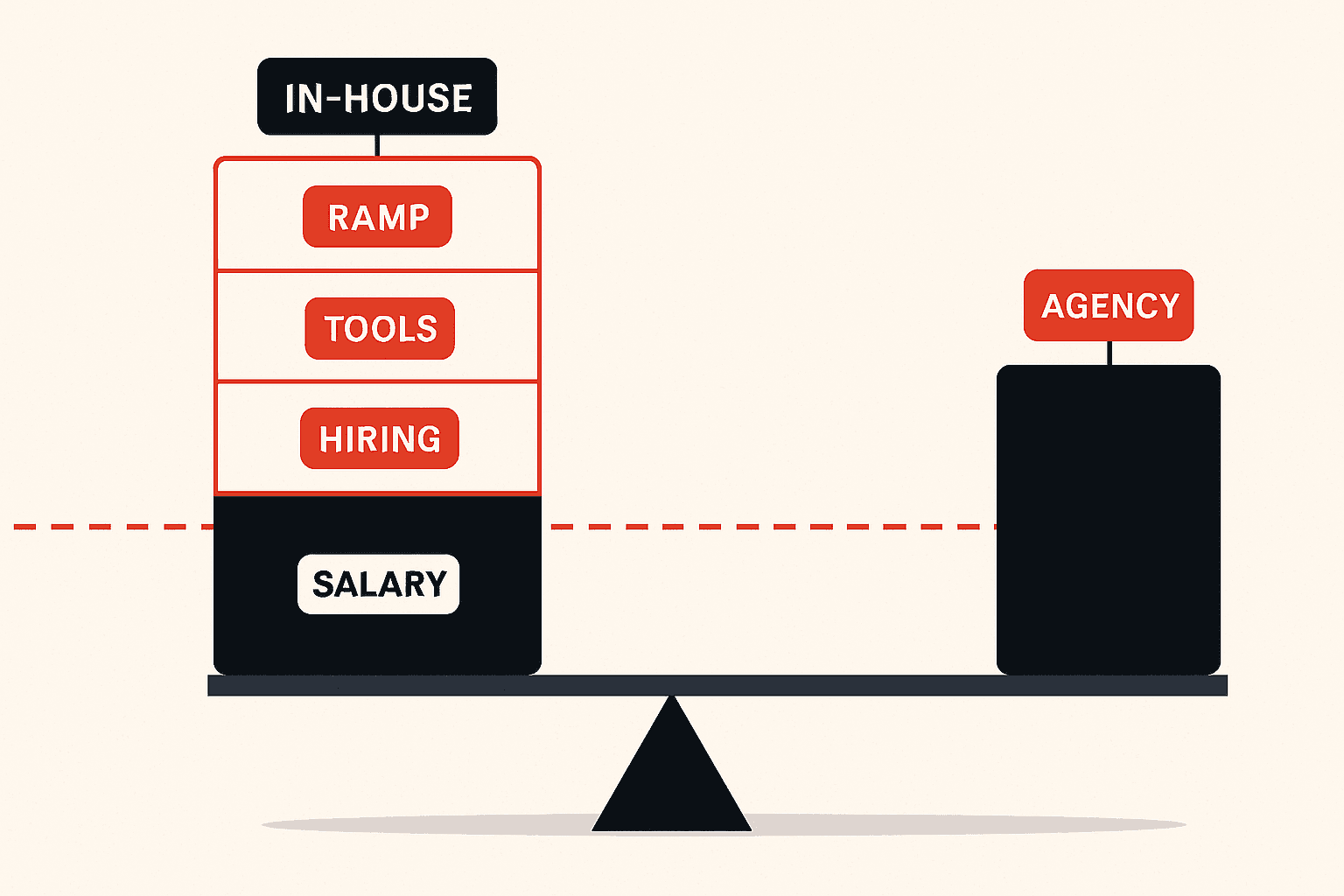
A founder sent us a one-line message last year: "Your retainer is more than an SEO manager's salary, so we're building the team instead."
He was right about the arithmetic he had done and wrong about the arithmetic that mattered. Fourteen months later the same company was back, having spent a little over thirty-one lakh, lost their hire at month eleven to a company that paid four lakh more, and shipped roughly five months of actual SEO work. Nothing about that outcome was unusual. It is what happens when a two-number comparison gets used for a seven-number decision.
That two-number comparison is on the first page of Google for this exact question, repeatedly. One salary against one retainer. It is the single most common budgeting error we see in Indian marketing teams, and it is also common enough in the US and UK that the pages ranking there make the same mistake with different currency symbols.
This post is the model we actually use when a client asks us, honestly, whether they should be paying us at all. It has seven cost lines instead of two, three team-size scenarios with full working, the same model in dollars for readers outside India, and the break-even threshold where building a team genuinely becomes the cheaper option. It also has an honest section on where an agency is the wrong answer, because we would rather lose a badly fitted engagement early than defend one for a year.
The Short Answer
In-house SEO is not cheaper than an agency until you are spending roughly ₹3.5-4 lakh a month on agency fees, sustained for at least eighteen to twenty-four months, and you have enough continuous specialist work to keep specialists busy. Below that, an agency delivers more capability per rupee, because salary is only about half the real cost of an in-house function once you count employer costs outside CTC, recruitment, the tool stack, the four-to-six-month ramp before a new hire produces anything, and the senior management time the function consumes.
A single mid-level in-house SEO in India costs around ₹21 lakh in year one and ₹18 lakh a year in steady state, not the ₹9 lakh salary the comparison usually uses. A three-person pod is around ₹55 lakh in year one. A six-person function is around ₹1.13 crore. For most brands the correct answer is neither pure option but a hybrid: one senior in-house owner for strategy and internal influence, external capacity for execution depth. If you want the market rates on the agency side of that equation, what SEO services actually cost in India sets out the bands, and our SEO pricing guide explains what changes them.
Why the Usual Comparison Is Wrong Before It Starts
The comparison that circulates goes like this. An SEO manager costs ₹15 lakh a year, which is ₹1.25 lakh a month. An agency retainer is ₹1.5 lakh a month. Therefore the agency is more expensive, and you also get a dedicated person instead of a shared one.
Every number in that paragraph is real. The conclusion is still wrong, for a reason that has nothing to do with SEO and everything to do with how organisations account for employees.
A salary is a line item. A function is a cost centre. When you hire, you do not acquire one salary; you acquire a salary plus everything that has to exist around a salary for it to produce output. Finance teams know this well for manufacturing and forget it entirely for marketing. The standard framing quietly assumes that recruitment is free, that tools are already paid for, that a new hire is fully productive on day one, that nobody senior spends time managing them, and that they will still be there in three years.
None of those hold. Here is the same decision with the assumptions made visible.
| What the usual comparison counts | What it silently assumes is free |
|---|---|
| Annual salary or CTC | Employer costs sitting outside CTC |
| Nothing | Recruitment fees and internal hiring time |
| Nothing | The SEO tool stack |
| Nothing | The four to six months before the hire is productive |
| Nothing | Senior management time spent directing the function |
| Nothing | Re-hiring when the person leaves |
| Agency retainer | Nothing - the retainer is the full cost |
Notice the asymmetry. The agency line is complete, because a retainer genuinely is the whole cost. The in-house line is missing five of its seven components. You are comparing a full price against a deposit.
The Seven Cost Lines of an In-House SEO Function
These are the lines we model. All Indian figures are metro market bands for 2026 and should be checked against a live salary source before you commit a budget to them; treat them as the shape of the model rather than as quotes.
1. Salary or CTC. The visible number. Indian metro bands run roughly ₹3.5-5.5 lakh for an SEO executive with under two years, ₹6-9 lakh for a specialist at two to four years, ₹12-18 lakh for a manager at five to eight, and ₹20-35 lakh for a head of SEO. Technical SEO with genuine development fluency commands a premium and is the hardest of these roles to fill.
2. Employer costs outside CTC. Hardware, workstation or desk allocation, insurance top-ups beyond statutory cover, learning and conference budget, and the per-head administrative load carried by HR and finance. Budget ₹1-1.5 lakh per head annually. Modest, but it is not zero, and it recurs.
3. Recruitment. A consultancy placement in Indian digital marketing typically costs between one and two months of the hire's salary, which is roughly 8-17% of first-year CTC. Doing it in-house is cheaper in cash and expensive in senior time. Amortise it across expected tenure rather than charging it all to year one, because you will pay it again.
4. The tool stack. This is the line most in-house business cases underestimate by the widest margin. An all-in-one platform at a usable tier is ₹2-4 lakh a year on its own. Add a crawler, rank tracking, content optimisation tooling, technical or log analysis, and reporting connectors and a lean serious stack is near ₹6 lakh. AI-visibility tracking, which barely existed as a category three years ago, adds ₹1.5-4 lakh more. A larger team lands between ₹8 and ₹12 lakh.
This is where agency economics are structurally different rather than merely cheaper. An agency buys that stack once and runs it across every client. An in-house team buys the same stack to point it at one domain. Nothing about diligence or negotiation closes that gap; it is arithmetic.
5. Ramp. A senior SEO hire is not productive for four to six months. Month one is access, tooling and orientation. Months two and three are learning the product, the site's architecture, the history of decisions already made, and how work actually gets shipped inside your company. Independent output usually begins somewhere in month four. That is paid time producing little, and it belongs in the model. Charging roughly 35% of first-year salary as ramp cost is conservative.
6. Management overhead. Someone senior sets direction, unblocks, reviews and defends the function's budget. For a solo hire that is often 10% of a marketing lead's week; for a pod, closer to 15%. Priced against a ₹30-35 lakh marketing head, that is ₹3-5 lakh a year of real cost that never appears in the SEO budget line.
7. Attrition. Digital marketing carries high churn in India, and SEO specifically churns hard because the skills are portable and the market for them is liquid. Every departure re-triggers recruitment and ramp, and takes institutional knowledge with it. Model an expected tenure of around two years and amortise lines three and five accordingly.
Three Scenarios, Fully Costed
Capability, not headcount, is what you are actually buying. Each scenario below states what it does not cover, because that omission is usually where the business case quietly fails.
Scenario A: One in-house generalist
A mid-level SEO specialist, three to five years in, owning the whole function.
| Cost line | Year 1 | Steady state |
|---|---|---|
| Salary (CTC) | ₹9,00,000 | ₹9,00,000 |
| Employer costs outside CTC | ₹1,20,000 | ₹1,20,000 |
| Recruitment (amortised, 2-yr tenure) | ₹45,000 | ₹45,000 |
| Tool stack (lean) | ₹4,50,000 | ₹4,50,000 |
| Management overhead (10% of a ₹30L lead) | ₹3,00,000 | ₹3,00,000 |
| Ramp (4 months at reduced output) | ₹3,15,000 | ₹0 |
| Total | ₹21,30,000 | ₹18,15,000 |
| Per month | ₹1.78L | ₹1.51L |
What this does not cover: technical SEO beyond basic auditing, content production at any volume, link acquisition or digital PR, design, and AI-search work. One generalist can diagnose all of it and execute a fraction of it. The most common failure here is a capable person spending their year writing tickets nobody prioritises.
Scenario B: A three-person pod
An SEO manager, an executive, and a dedicated SEO content writer.
| Cost line | Year 1 | Steady state |
|---|---|---|
| Salaries (₹15L + ₹6L + ₹6.5L) | ₹27,50,000 | ₹27,50,000 |
| Employer costs outside CTC | ₹3,60,000 | ₹3,60,000 |
| Recruitment (amortised) | ₹1,40,000 | ₹1,40,000 |
| Tool stack | ₹8,00,000 | ₹8,00,000 |
| Management overhead (15% of a ₹35L lead) | ₹5,25,000 | ₹5,25,000 |
| Ramp (3 hires) | ₹9,60,000 | ₹0 |
| Total | ₹55,35,000 | ₹45,75,000 |
| Per month | ₹4.61L | ₹3.81L |
What this does not cover: dedicated technical SEO, link acquisition, and engineering time. This pod produces content well and negotiates for development resource badly, which is the constraint that ends up governing its results.
Scenario C: A full in-house function
Head of SEO, technical SEO, two content specialists, an outreach lead, and an analyst.
| Cost line | Year 1 | Steady state |
|---|---|---|
| Salaries (6 roles) | ₹65,00,000 | ₹65,00,000 |
| Employer costs outside CTC | ₹7,20,000 | ₹7,20,000 |
| Recruitment (amortised) | ₹3,25,000 | ₹3,25,000 |
| Tool stack (full) | ₹12,00,000 | ₹12,00,000 |
| Management overhead (Head of SEO absorbs most) | ₹3,00,000 | ₹3,00,000 |
| Ramp (6 hires) | ₹22,75,000 | ₹0 |
| Total | ₹1,13,20,000 | ₹90,45,000 |
| Per month | ₹9.43L | ₹7.54L |
What this does not cover: very little, and that is the point. This is a real function. It is also a ₹90 lakh annual commitment that only makes sense when organic search is a primary revenue channel rather than one of several.
The Same Model in Dollars
For US and UK readers, the shape of the model holds and the multipliers change. American bands run roughly $60-80K for an SEO specialist, $85-120K for a manager, and $130-180K for a director. Employer burden is heavier: 25-35% over base once benefits, payroll taxes and insurance are counted, against the far lighter loading typical in Indian CTC structures. Recruitment through an agency is 15-25% of first-year base. The tool stack is close to a constant in dollar terms at $12-25K a year, which means it is a much heavier proportional burden on an Indian budget than an American one.
Here is Scenario A rebuilt on US assumptions, itemised the same way so the two are directly comparable.
| Cost line | Year 1 | Steady state |
|---|---|---|
| Base salary (mid specialist) | $70,000 | $70,000 |
| Employer burden at 30% | $21,000 | $21,000 |
| Recruitment (20% of base, amortised over 2 yrs) | $7,000 | $7,000 |
| Tool stack | $15,000 | $15,000 |
| Management overhead (10% of a $140K lead) | $14,000 | $14,000 |
| Ramp (35% of base, 4-6 months) | $24,500 | $0 |
| Total | $151,500 | $127,000 |
| Per month | $12,625 | $10,583 |
Against a typical US agency retainer band of $3,000-$8,000 a month, the same conclusion falls out: one in-house generalist at a fully loaded $10,583 a month is more expensive than a mid-tier agency engagement, and buys narrower coverage. The steady-state figure also lands close to the $100,000-$150,000 range the better US comparisons publish, which is a useful check on the method. The difference is what sits underneath it. Our number is built from six declared lines you can substitute your own assumptions into, rather than a range someone quoted.
The proportional comparison is the interesting part:
| Line | India (mid specialist) | US (mid specialist) |
|---|---|---|
| Employer burden over base | ~13% | ~30% |
| Recruitment | 8-17% of CTC | 15-25% of base |
| Tool stack as a share of salary | ~50% | ~21% |
| Ramp period | 4-6 months | 4-6 months |
| Salary as a share of fully loaded year 1 | 42% | 46% |
The tool stack row is the one worth sitting with. In India it is half a salary; in the US it is a fifth of one. That single line is why the agency amortisation advantage is structurally larger in the Indian market than in the American one, and why an Indian in-house business case that omits tooling is not merely optimistic but wrong by a wide margin.
The Break-Even: When In-House Actually Wins
Two thresholds have to clear simultaneously. Almost every company that regrets this decision checked one and assumed the other.
Threshold one, cost. In-house begins to win on cost per unit of delivered capability above roughly ₹3.5-4 lakh a month of sustained agency spend, held for at least eighteen to twenty-four months. The duration matters as much as the amount. Recruitment and ramp are front-loaded and do not recur annually, so a team assessed on a twelve-month horizon looks far worse than the same team assessed over three years. Conversely, a team built against a one-year budget will be dismantled before it ever earns back its setup cost.
Threshold two, capability utilisation. You need enough continuous specialist work to keep specialists busy. In practice that means at least one of: a site large enough that technical work is never finished, several markets or languages under international SEO, a weekly or faster release cadence that constantly creates new risk, or a business where organic search is the acquisition channel rather than one of five.
Only one of those four quadrants makes a full in-house function the right answer. That ratio matches what we see in practice, and it is why most of the companies who ask us this question end up somewhere other than where they expected.
Not sure which quadrant you are actually in? We will model your fully loaded in-house cost against your current or proposed agency spend and tell you plainly which one wins - including when the answer is that you do not need us. Request a build-vs-buy cost review →
What Each Model Is Genuinely Better At
Cost is one axis. It is not the only one, and for some companies it is not the deciding one.
| Dimension | In-house team | Agency or consultant |
|---|---|---|
| Cost per unit of capability, under ₹3.5L/mo | Worse | Better |
| Cost per unit of capability, above ₹4L/mo sustained | Better | Worse |
| Time to first meaningful output | 4-6 months | 2-4 weeks |
| Internal influence over roadmap and releases | Much stronger | Structurally weak |
| Breadth of specialisms covered | Narrow unless funded fully | Broad by default |
| Pattern library across many sites | None | Substantial |
| Tool stack access | Paid in full for one site | Amortised across clients |
| Product and commercial context | Compounds over time | Has to be transferred |
| Knowledge retention when people leave | Partial | You keep only what is documented |
| Ability to scale up or down in a quarter | Slow and painful | Contractual |
| Accountability for outcomes | Diffuse, absorbed into salary | Concrete and reviewable |
Two rows deserve emphasis because they decide more of these engagements than cost does.
Internal influence is the strongest genuine argument for hiring. An employee sits in sprint planning and can stop a replatform that would have cost a quarter of your organic traffic. We have written a recommendation like that, sent it, had it acknowledged, and watched it not get prioritised, because an agency cannot outrank a product manager's roadmap. If your biggest organic risk is engineering-driven, hire, even if the spreadsheet disagrees.
Pattern library is the strongest genuine argument for external help. A team working on one site sees one site's evidence. A team working across dozens sees which interventions repeat and which were coincidence. That difference is why an independent SEO audit from outside usually finds things a competent internal team missed - not because the internal team is weaker, but because they have one sample.
The Third Option Most People Skip
For a large share of mid-market brands, the correct answer is neither column.
The hybrid model: one senior in-house owner, plus external capacity for depth.
The in-house person holds strategy, prioritisation and internal influence. They sit in planning meetings, own the relationship with engineering, and decide what matters. That is the part no external party can do well, and it is the part that most often determines whether anything ships.
The external side supplies what a single hire cannot: technical SEO depth, content production at volume, link acquisition, and AI-search work. None of these justify a full-time salary at mid-market scale, and all of them are needed intermittently.
Costed at Indian rates, a hybrid typically runs a ₹15-20 lakh senior hire plus a ₹1.5-2.5 lakh monthly external engagement - roughly ₹40-50 lakh a year fully loaded. That is below Scenario C's ₹90 lakh and above Scenario A's ₹18 lakh, and it usually delivers more than either, because it puts the money against the two things that are actually scarce: internal authority and specialist depth. If the shape of the senior role is what you are unsure about, our SEO consultant page sets out the engagement models we see working, and agency versus freelancer covers the same decision one step lower down the budget.
The 2026 Wrinkle Nobody Is Pricing
Every cost model above would have been broadly valid in 2022. One thing has changed since, and it moves the decision.
The skills that matter now include work that barely existed when most of today's senior SEOs trained: entity and citation strategy, structured data built for machine extraction rather than rich snippets, and measurement of visibility inside AI-generated answers rather than only in ranking positions. We have written about what actually moves the needle there in how to rank on ChatGPT and how to rank on Perplexity, and SEO vs AEO vs GEO sets out how the three layers relate.
The hiring consequence is straightforward and uncomfortable. You can hire a strong classical SEO in India today without much difficulty. Hiring someone with real operating experience running an AI-visibility programme - not opinions about it, experience of it - is materially harder, because the discipline is a few years old and the people who have done it at scale are mostly still employed doing it.
This means an in-house hire made in 2026 is more likely than an in-house hire made in 2021 to arrive with a genuine capability gap in exactly the area moving fastest. It also means the gap is expensive to close internally: one person, on one site, learning a discipline where the feedback loop is slow and noisy. Teams running the work across many properties accumulate that pattern library considerably faster. Our own numbers on how quickly this surface is shifting are collected in AI search statistics and, for the Indian market specifically, in SEO statistics for India.
This is not an argument that you cannot build AI-search capability in-house. It is an argument that you should price the learning curve rather than assume it away, and that a hybrid arrangement is a reasonable way to buy the pattern library while your own person develops it.
The Failure Modes of Each
Both options fail in predictable ways. Knowing the failure mode is more useful than knowing the average outcome.
In-house fails like this. You hire one generalist to cover six disciplines. They spend four months ramping, then produce a credible technical audit that requires forty hours of engineering time nobody will allocate. By month nine they are writing blog posts, because that is the only work they can complete without asking permission. By month fourteen they leave for a company where the work is more interesting, and you restart the clock having learned very little. The tell is a hire made against a budget rather than against a workload.
Agency fails like this. You buy a retainer against a deliverables list rather than an outcome. The senior people who ran the pitch are not the people on the account. Reporting measures activity because activity is easy to count. Recommendations pile up in a shared drive because they need your developers and nobody owns getting them prioritised. Eighteen months later you have a large archive and a flat traffic line. The tell is an engagement where nobody internally is accountable for implementing what the agency finds.
Both failure modes share one root cause: nobody owned the decision about what would actually get shipped. That problem is organisational, and neither hiring nor outsourcing solves it on its own.
Where We Fit, and Where We Do Not
We are an agency, so read this section with appropriate scepticism and then check it against the model above.
Where we are the right answer. You are spending under ₹3.5-4 lakh a month, you need breadth across technical, content, links and AI search, you need output inside a quarter rather than after a ramp, or you want a pattern library your single-site team cannot build. That covers a large share of Indian growth-stage brands and most of what our SEO services engagements look like.
Where we are the wrong answer. Your primary organic risk is engineering-driven and you need someone in sprint planning with real authority. You have sustained spend above ₹4 lakh a month, deep continuous work, and a multi-year commitment. Or search is genuinely the channel for your business rather than one of several - in which case build the function, and use external help only for the specialisms you cannot keep busy.
Where the honest answer is hybrid. Most of the rest. If you are in that group, the useful thing we can do is help you scope the internal role properly and cover the gaps around it, which is a smaller engagement than you probably expected to buy.
We say this plainly because the alternative is defending a badly fitted engagement for a year, which is worse for everyone including us. If you are evaluating options more broadly, how to choose an SEO agency in India sets out the criteria we would use if we were on your side of the table.
Nine Questions Before You Decide
Answer these honestly before committing a budget either way.
- What is our sustained monthly SEO spend going to be for the next twenty-four months? Not this quarter's. If you cannot answer for twenty-four months, do not hire.
- Have we costed all seven lines, or just salary? If the business case has one number in it, it is not a business case.
- What happens in months one to four while the hire ramps? Who does the work, and what does the delay cost in pipeline?
- Is our biggest organic constraint diagnosis or implementation? If it is implementation, an external audit will not fix it and an internal owner might.
- Can we keep a specialist busy year-round? Be specific about the workload, not the ambition.
- Who will manage this person, and how many hours a week? Name them. That time is a real cost and it comes out of something else.
- What is our realistic expected tenure, and what happens at exit? Model two years, not five.
- Do we have the tool budget on top of the salary budget, approved? ₹4.5-12 lakh a year, and it is not optional.
- Who owns AI-search capability, and how are they going to build it? If the answer is "the new hire will figure it out," price the learning curve.
If more than three of those have vague answers, the decision is not ready to be made and a shorter external engagement will buy you the clarity more cheaply than a hire will.
What to Do Next
Run the model on your own numbers before you run anyone's recommendation. Take the seven lines from this post, substitute your salary bands, your recruitment reality and your tool requirements, and produce a fully loaded annual figure. Then compare that against a real agency quote for equivalent scope rather than against a remembered one.
If the in-house figure is lower and both thresholds clear, hire, and budget for twenty-four months rather than twelve. If it is higher, or only one threshold clears, the hybrid is almost certainly your answer, and the sequencing matters: hire the senior owner first, then buy depth around them. Doing it in the other order produces an agency relationship nobody internally is accountable for, which is the second failure mode above.
And whichever way it goes, write down the assumptions. A model with visible parameters can be argued with and corrected next year. A number someone remembers from a vendor conversation cannot, and that is how a company ends up thirty-one lakh into a decision it never actually made.
Want the model run against your real numbers? We will build the fully loaded in-house comparison for your scope and headcount, put it against a like-for-like agency figure, and give you the recommendation the numbers support - including when that recommendation is to hire rather than engage us. Book a build-vs-buy review →

Aditya Kathotia
Founder & CEO
CEO of Nico Digital and founder of Digital Polo, Aditya Kathotia is a trailblazer in digital marketing. He's powered 500+ brands through transformative strategies, enabling clients worldwide to grow revenue exponentially. Aditya's work has been featured on Entrepreneur, Economic Times, Hubspot, Business.com, Clutch, and more.