

Most sites publish good content and then leave it stranded. No links pointing in, no clear path from the homepage, no signal to Google about what the page is for. Internal linking is the cheapest, most controllable ranking lever you own, and almost nobody runs it as a system. This is the playbook we use: what internal links actually do, how to audit the four failure modes, the hub-and-spoke model, anchor text rules, link placement by value, and the per-page workflow that keeps the structure healthy.
A founder publishes a thorough, genuinely useful guide. It is better than most of what ranks for the target term. Three months later it is on page four, picking up a handful of visits a week, and nobody can explain why.
The content is not the problem. The problem is that the page is an island. Nothing on the site points to it with any intent. There is no path to it from the homepage in fewer than five clicks. Google found it once, indexed it, decided it was a minor page because the site itself treats it like a minor page, and moved on.
This happens constantly, and it happens because internal linking is treated as an afterthought instead of a system. Teams obsess over backlinks, which they barely control, and ignore internal links, which they control completely. Every internal link on your site is your decision. You choose which pages connect, which pages receive the most signals, and how clearly your structure tells search engines what you are an authority on. That is enormous leverage, sitting unused on most sites. This post is the system we run to use it.
What Internal Linking Actually Does
An internal link is any link from one page on your site to another page on the same site. Navigation menus, footers, sidebars, and links inside the body of a page are all internal links. They do four distinct jobs, and understanding the four separately is what turns internal linking from a vague best practice into a deliberate strategy.
Job one: discovery and crawling. Search engines find pages by following links. A crawler lands on a page, extracts every link, and queues those URLs to crawl next. A page with internal links pointing to it gets discovered and recrawled reliably. A page with no internal links pointing to it, an orphan, is hard to find and may sit uncrawled for a long time. Internal links are the roads a crawler drives on.
Job two: distributing ranking signals. Links pass authority, often described as link equity or PageRank. A page accumulates authority from the backlinks pointing at it and from the internal links pointing at it, and it passes a share of that authority along to every page it links to. This means internal linking is how you route the authority your site has earned. Link heavily to a page from strong pages, and you tell search engines that page matters. Leave a page with two weak internal links, and you tell them it does not.
Job three: communicating relevance and context. The anchor text of a link, and the words surrounding it, describe the destination page. When ten pages about technical SEO all link to one page using anchor text about site audits, search engines build a strong association between that page and the concept of an SEO audit. Internal links are how you tell search engines what each page is about, in your own words, repeatedly.
Job four: guiding users. Internal links move readers from one relevant page to the next. They reduce bounce, increase session depth, and steer visitors from informational content toward the pages that convert. A reader who lands on a how-to guide and follows a well-placed link to a service page is internal linking doing revenue work.
Most sites get a passable version of job four from their navigation and call it done. The other three jobs, the ones that move rankings, require deliberate contextual links inside content, and that is where the opportunity sits.
How Link Equity and Crawl Depth Work
Two concepts decide whether your internal linking helps or hurts: how equity flows, and how deep your pages sit.
Picture authority as water. Your homepage and your most-linked pages are the reservoirs, full because they collect the most internal and external links. Every internal link is a pipe. Water flows from full pages through those pipes to the pages they link to. A page with many pipes coming in fills up. A page with one thin pipe stays nearly empty. A page with no pipes, an orphan, never fills at all.
Crawl depth, also called click depth, is the second concept. It is the number of clicks from the homepage to a given page. A page linked from the homepage has a depth of one. A page you reach only after four clicks has a depth of four. Crawl depth correlates with how important search engines judge a page to be, and how often they crawl it. Shallow pages are crawled often, indexed fast, and treated as priorities. Deep pages are crawled rarely and treated as minor.
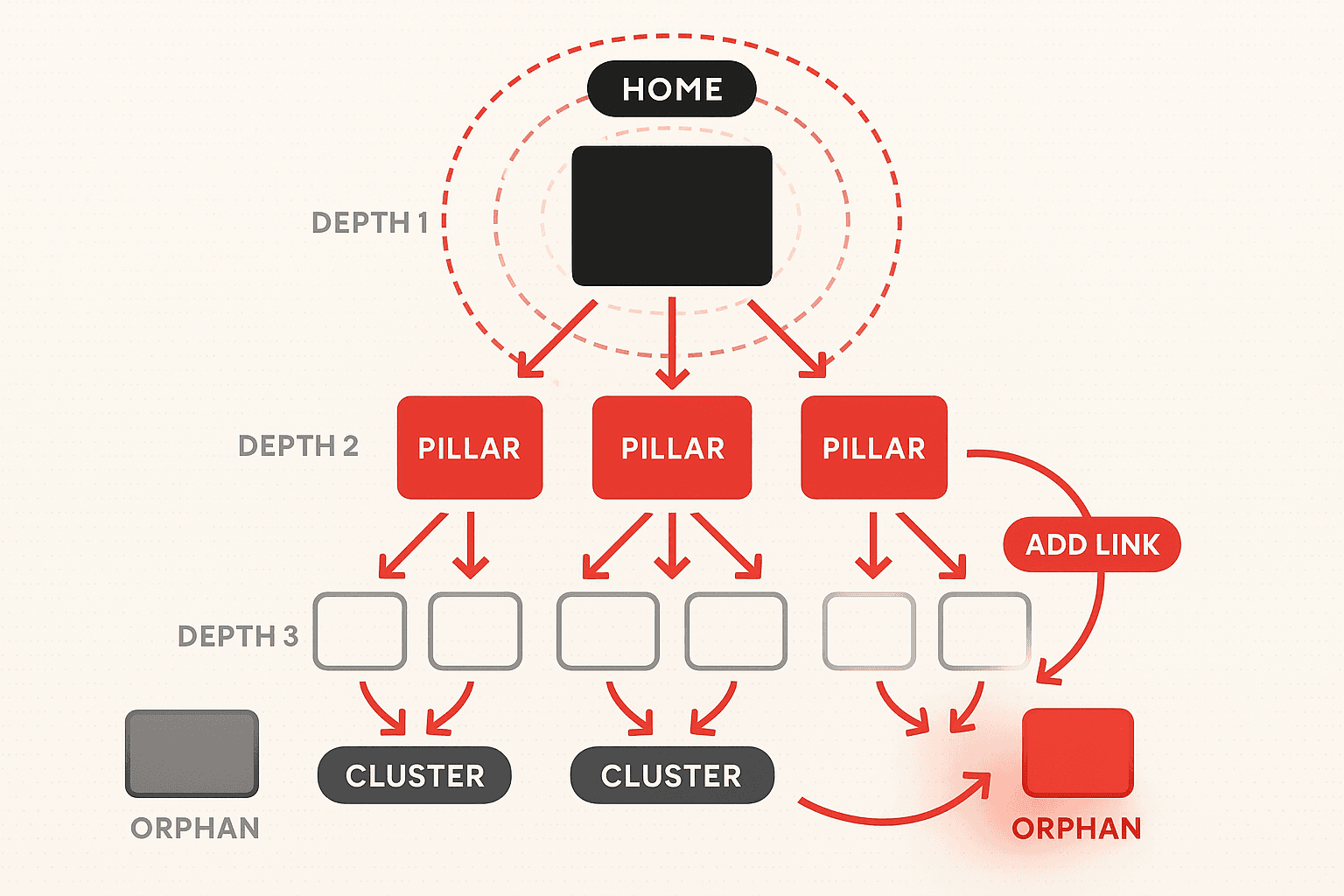
The damaging pattern is a commercially important page sitting at depth five. It earns money when it ranks, but the site structure tells Google it is a backwater. The diagram below shows how equity flows through a healthy structure, and what happens to the pages that fall outside it.
The healthy structure is the top three tiers: a homepage that links to pillar pages, pillars that link down to their cluster pages and sideways to related clusters, and equity flowing cleanly down and across. The orphan pages at the bottom sit outside all of it. They could be your best content, and structurally the site is telling Google they do not matter.
The Four Failure Modes
Almost every broken internal linking structure is some combination of four failure modes. Naming them is the first step to auditing them.
Failure one: orphan pages. Pages with no internal links pointing in at all. They are created constantly and without anyone noticing, a post published without anyone remembering to link to it, a landing page built for a campaign outside the normal structure, old links dropped in a redesign. They are crawled rarely, ranked poorly, and invisible to anyone browsing the site. This is the same problem we cover in depth in the orphan page audit, and it is the single most common internal linking failure.
Failure two: pages buried too deep. Pages that exist in the structure but sit at crawl depth five or six. They are not orphans, but they are so far from the homepage that search engines treat them as minor. When the buried page is a commercial page, this failure mode is directly costing revenue.
Failure three: equity trapped on the wrong pages. Some sites pour internal links into pages that do not need them, a privacy policy in the footer linked from every page, a thin tag archive linked from a sidebar, while the pages that should rank get a couple of weak links. The structure is busy, but the equity is pooling in the wrong reservoirs.
Failure four: weak or missing topical clustering. Related pages that should be tightly interlinked into a cluster instead sit as scattered, disconnected pages. Each one is on its own. Search engines see ten separate thin signals instead of one strong, bounded cluster, and the site never builds the topical authority it could.
A site can have all four at once, and many do. The audit that follows finds each of them.
The Internal Linking Audit
You cannot fix what you have not measured. A proper internal linking audit produces four things.
A crawl of the whole site. Run a crawler such as Screaming Frog. It will produce, for every URL, the number of internal links pointing in (inlinks), the number pointing out, the anchor text used, and the crawl depth. This single dataset answers most of the questions below.
An orphan list. Compare every URL in your CMS, sitemap, or analytics against the list of URLs the crawler reached by following links. Any URL that exists but the crawler never reached through a link is an orphan. Most crawlers will produce this list directly when you feed them the sitemap alongside the crawl.
A crawl-depth report. Sort every important page by crawl depth. Flag any commercial or pillar page sitting deeper than three clicks. These are your buried pages.
An inlink distribution. Sort all pages by number of internal inlinks. You are looking for two problems: important pages with very few inlinks, and unimportant pages hoarding inlinks. Google Search Console has a built-in version of this under Links, then Internal links, which ranks your pages by how many internal links Google itself has counted. It is a fast first read, and if your most important commercial page is not near the top of that list, your internal linking is misallocated.
Cross-reference this with a Search Console traffic-drop diagnosis if pages have lost rankings, because internal linking changes from a redesign are a frequent and overlooked cause. The output of the audit is a prioritised list: which pages need links added, which need links rerouted, and which clusters need building. The matrix below is how we prioritise that list.
The bottom-right quadrant is where the fastest wins are. A high-value page starved of internal links is a page that is already good enough to rank, held back only by the structure around it. Fix that, and you are not creating new content, you are unlocking content you already have.
The Hub-and-Spoke Model
Once the audit is done, the structure you are building toward is the hub-and-spoke model, also called the topic cluster model. It is the single most effective internal linking pattern, and it is simple.
A hub, or pillar page, is a broad, comprehensive page on a major topic. The spokes are narrower pages that each go deep on one subtopic. The linking rule is precise:
- Every spoke links up to the hub.
- The hub links down to every spoke.
- Spokes link sideways to other closely related spokes.
That is the whole model. What it produces is a tightly bounded cluster of pages, all about one subject, all interlinked. Search engines read that density of relevant interlinking as a strong signal that the site has genuine depth on the topic, which lifts the whole cluster. And because every spoke links up to the hub, the hub accumulates the most internal equity, which is exactly what you want, because the hub usually targets the most competitive, highest-value term.
For a marketing agency, a cluster might look like a technical SEO services hub, with spokes on crawl budget, orphan pages, site speed, structured data, and faceted navigation, each spoke linking up to the hub and across to its closest siblings. The faceted navigation guide and the keyword cannibalisation audit are spokes in exactly that kind of cluster.
Build clusters deliberately. When you plan content, plan it as clusters, not as standalone posts. When you publish a new spoke, the in-linking work is already defined: link up to the hub, link to two or three sibling spokes, and add a link to the new spoke from the hub. The cluster grows as a structured thing, not a pile.
Anchor Text: Descriptive, Natural, Varied
The clickable text of an internal link is a ranking signal. It tells search engines what the destination page is about. Three rules govern it.
Descriptive. The anchor text should describe the destination. "Click here" and "read more" describe nothing. "Our process for a technical SEO audit" tells the reader and the search engine exactly what they will get. Every internal anchor should pass the test: would this make sense to someone who could only see the link and nothing else?
Natural. The link should sit inside a sentence that reads normally. A keyword phrase awkwardly bolted into a sentence purely to hold a link is obvious to readers and to search engines. Write the sentence first, then link the words that genuinely describe the destination.
Varied. Do not link to the same page with the identical exact-match keyword anchor every single time. Some variation is natural and expected. If every internal link to your services page uses the exact phrase "best SEO agency", that pattern looks engineered. Mix the phrasing while keeping it descriptive. Real writing varies; engineered linking does not.
One more rule: link the most relevant words, not the most words. A precise three-word anchor on the phrase that actually describes the destination beats a whole sentence turned into a link.
Where to Place Internal Links
Not all link positions are equal. The same link carries different weight depending on where it sits.
In-content links are the most valuable. A link inside the body text of a page, surrounded by relevant copy, is the strongest internal link you can place. It is contextual, it is clearly editorial, and the surrounding text reinforces its relevance. This is where your strategic linking work belongs. The five to fifteen contextual links in a well-linked article are doing the real work.
Navigation links are structural, not strategic. Main navigation links are valuable because they appear site-wide and define your top-level structure, but they are fixed and limited. Use them for your most important pages and do not expect them to do nuanced topical work.
Sidebar and related-content links are moderate. A "related posts" block or a contextual sidebar helps, especially for users, but it carries less weight than an in-content link because it is templated rather than editorial. Useful, not central.
Footer links are the weakest. A link that appears in the footer of every page is barely a recommendation. Footers are fine for utility pages, but do not expect a footer link to rank a page. If a page only has footer links pointing to it, treat it as close to an orphan.
The practical takeaway: when a page in the "add links now" quadrant needs help, add in-content links from relevant pages. Do not just drop it into the footer and call it linked.
The Per-Page Linking Workflow
Internal linking fails on most sites not because people do not know it matters, but because there is no process. The fix is to make linking part of publishing. Every time a page goes live, two things must happen.
Link out. Before publishing, add five to fifteen contextual internal links from the new page to relevant existing pages: the hub it belongs under, two or three sibling pages, and any relevant service or commercial pages. This is usually remembered, because it happens while writing.
Link in. This is the step that gets skipped. After publishing, find three to five existing pages that are genuinely relevant to the new page, and add a contextual link from each of them to the new page. A new page with no inlinks is born an orphan. The link-in step is what prevents that, and it is the single most valuable habit in internal linking.
For a site already in trouble, this is also a remediation workflow. Run the audit, take the orphan list and the buried-page list, and for each page on it, do the link-in step: find relevant existing pages and add contextual links. This is the same recovery logic behind a content decay audit, where adding fresh internal links to a fading page is one of the highest-leverage refresh moves available.
Make link-in a non-negotiable publishing checklist item, and the orphan problem stops recurring. Skip it, and you will be re-running the audit forever.
Internal Linking and AI Search
AI search engines and the crawlers behind large language models read internal links to understand a site, and arguably they depend on structure even more than traditional search does. Internal links tell an AI system which pages are related, which page is the authoritative hub on a topic, and how a brand organises its expertise.
A site with clean hub-and-spoke clusters hands AI systems an explicit, machine-readable map of what the brand knows and how deeply. That makes the site easier to model, attribute, and cite in an AI answer. A site where good content sits in disconnected islands gives AI systems nothing to work with, and its genuine expertise goes underrepresented. The same discipline that improves Google rankings, clear clusters, no orphans, descriptive anchors, shallow depth, is what makes a site legible to AI search and intent-driven systems. You are not doing two jobs. The internal linking work pays off on both surfaces at once.
The Mistakes We See Most Often
The errors that turn up again and again on internal linking audits:
- No link-in step. New pages published with outbound links but no inbound links, born as orphans, every time.
- "Click here" anchors. Throwing away the relevance signal that descriptive anchor text would have carried.
- Identical exact-match anchors everywhere. The opposite error, every link to a page using the same engineered keyword phrase.
- Money pages buried deep. Commercial pages sitting at depth five while a blog archive sits at depth one.
- Footer-only linking. Treating a sitewide footer link as if it were a real recommendation for a page.
- Linking for the sake of it. Padding articles with irrelevant internal links to hit a number. Relevance always beats volume.
- No clusters. Publishing related content as standalone posts that never get interlinked into a hub-and-spoke structure.
- Set and forget. Auditing once, fixing the orphans, and never building the per-page workflow that stops new orphans appearing.
The Bottom Line
Internal linking is the most controllable ranking lever you have, and on most sites it is the most neglected. Every link is your decision. You choose which pages connect, which pages collect the most signals, how deep each page sits, and how clearly your structure tells search engines, and AI systems, what you are an authority on.
The work is not complicated. Audit the site to find the four failure modes: orphans, buried pages, trapped equity, and missing clusters. Use the priority matrix to find the high-value pages starved of links, because those are pages that are already good enough to rank and held back only by structure. Build content as hub-and-spoke clusters, not as standalone posts. Write descriptive, natural, varied anchor text. Place your strategic links in body content, not in footers. And above all, make the link-in step a non-negotiable part of publishing, so every new page is born connected.
Do that, and the good content you already own stops being a set of islands and becomes a structured, mutually reinforcing system, where authority flows to the pages that earn revenue and every page worth ranking has a clear path from the homepage. It is the cheapest compounding asset in SEO, and it is sitting unused on most sites right now.
Not sure how much traffic your structure is leaking? We run an internal linking audit that maps every orphan page, flags every buried money page, shows where your link equity is trapped, and returns a prioritised plan for which pages need links added and which clusters need building. Request an internal linking audit
Cross-Linked Resources for Site Architecture and SEO
Internal linking sits inside a wider technical and content SEO programme. The pieces below cover the surrounding work:
- Technical SEO Services for crawl, index, and architecture work across the whole site
- SEO Audit Services for the full crawl and inlink-distribution diagnosis that starts this fix
- SEO Services for the broader organic strategy this structure supports
- Content Marketing Services for planning and producing content as hub-and-spoke clusters
- SEO Consultant India for senior advisory on site architecture and linking priorities
- Orphan Page Audit for finding and recovering the pages with no links pointing in
- Keyword Cannibalisation Audit for the duplicate-targeting problem internal linking decisions can cause or fix
- Faceted Navigation SEO for controlling the crawlable internal links a filter system generates
- Search Console Traffic-Drop Decision Tree for diagnosing ranking drops caused by structural changes
- Content Decay Audit for refreshing fading pages, where adding internal links is a core move
- Topical Authority and Content Silos for the cluster strategy hub-and-spoke linking reinforces
- Programmatic SEO Playbook for linking large sets of generated pages into a coherent structure
- Schema Markup Secrets for the structured data that complements a clean internal link structure

Aditya Kathotia
Founder & CEO
CEO of Nico Digital and founder of Digital Polo, Aditya Kathotia is a trailblazer in digital marketing. He's powered 500+ brands through transformative strategies, enabling clients worldwide to grow revenue exponentially. Aditya's work has been featured on Entrepreneur, Economic Times, Hubspot, Business.com, Clutch, and more. Join Aditya Kathotia's orbit on LinkedIn to gain exclusive access to his treasure trove of niche-specific marketing secrets and insights.