

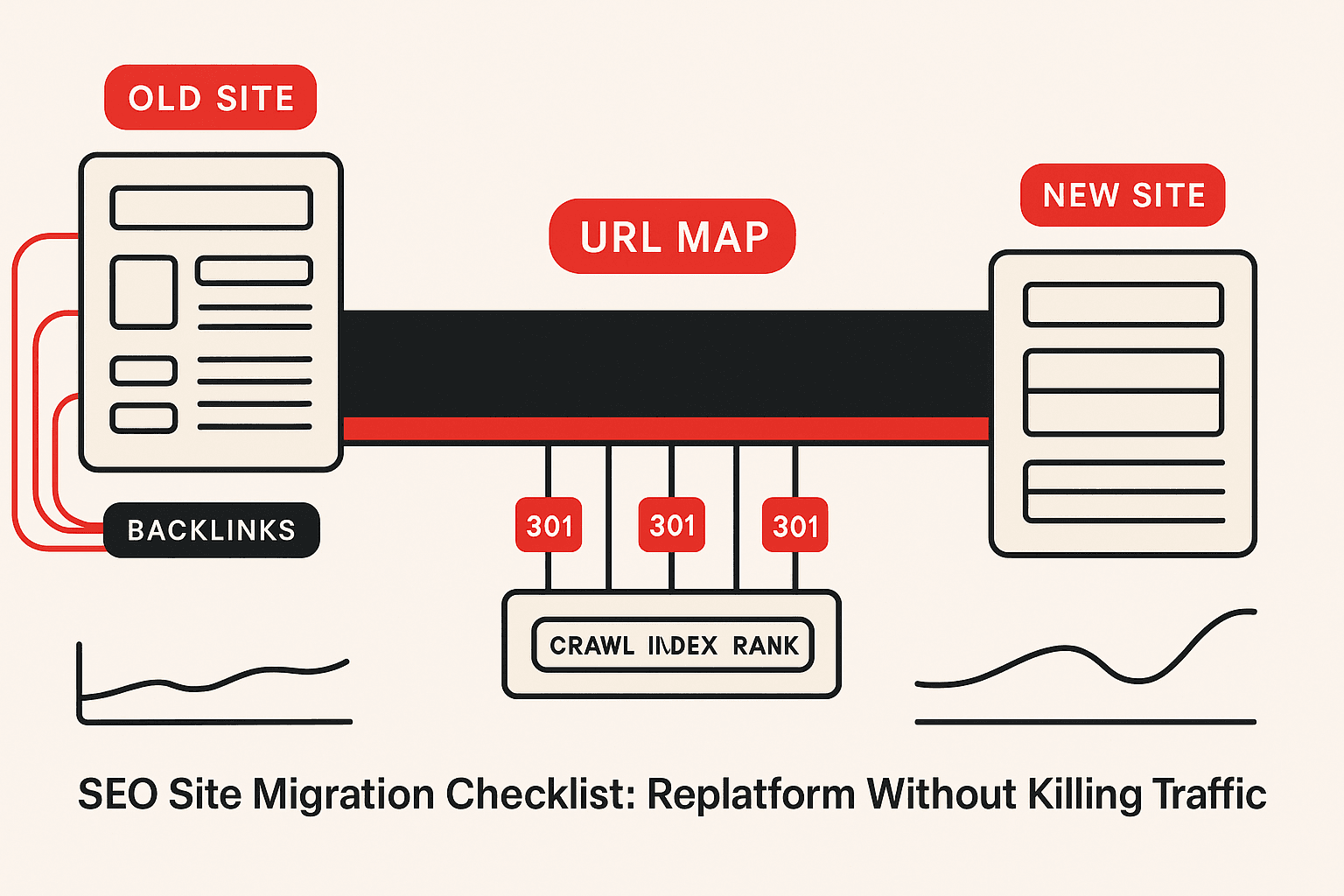
Most of the traffic loss that follows a redesign, replatform, or domain change is not caused by Google. It is caused by the migration plan. URL maps that miss the long tail. Redirect chains that collapse equity. Schema that gets stripped in the new template. Sitemaps that point at the staging domain after launch. This is the migration checklist we run before, during, and after launch, the eleven failure modes that account for most of the damage, and the 30-day monitoring protocol that catches problems while they are still reversible.
Most founders who lose half their organic traffic during a site migration blame Google. They watch the rankings dissolve in Search Console, file a recovery ticket with their development agency, and spend the next nine months trying to claw back what they had on launch day minus one.
The data is clear that Google is rarely the problem. A site migration that loses 40 percent of its traffic is almost always carrying one of eleven specific defects in the migration plan. Each defect is preventable. Each one is detectable in the staging window before launch. None of them require deep technical SEO genius. They require a checklist that the development team and the SEO team both work against, and a launch protocol that treats the first 72 hours as the highest-risk window of the entire project.
This post is the checklist we have been refining across 40 migrations between 2023 and early 2026. It covers the six migration categories with different risk profiles, the eleven failure modes that account for most of the damage, the pre-launch QA gates, the launch day sequence, and the 30-day post-launch monitoring protocol. Every section maps to a decision that someone on the migration team has to own.
The Six Migration Categories and Why the Plan Has to Match
The first mistake teams make is treating every migration as the same project. A redesign on the same URLs and same CMS does not need the same checklist as a domain change combined with a CMS replatform combined with a URL restructure. Using the heavy checklist on a light migration wastes time. Using the light checklist on a heavy migration loses traffic.
There are six migration categories. Each one has a different risk profile and a different set of mandatory steps.
The categories at the bottom of the chart are the ones that get botched most often, not because they are harder technically, but because teams underestimate how much planning effort they require. A full overhaul is a four-dimensional migration. Trying to compress it into the same six-week timeline as a redesign is the most common reason a brand loses half its organic traffic on launch day.
The Pre-Migration Audit: What to Inventory Before Touching the New Site
Migrations fail in the planning phase, not in the execution phase. The single most useful pre-migration deliverable is a master inventory document that captures the current state of the site across seven layers. Without that inventory, the URL map cannot be built completely, the redirect rules cannot be written confidently, and the post-launch monitoring cannot detect what changed.
The inventory has to capture, at minimum:
The URL inventory. Every URL that currently resolves on the site, deduplicated across XML sitemap, Search Console, server logs (last 90 days), Screaming Frog crawl, Ahrefs URL list, and Semrush URL list. This is the source of truth for the URL map. Most teams pull only the XML sitemap and miss roughly 20 to 30 percent of the historical URL base.
The ranking inventory. Every keyword that the site currently ranks for in the top 100 positions, with the landing page that ranks for it. This is the test set for post-launch recovery monitoring. Pull from Google Search Console (last 16 months), supplement with Ahrefs Organic Keywords export and Semrush Organic Research export.
The backlink inventory. Every inbound external backlink with at least one referring domain, with the destination URL it points at. Sorted by referring domain authority and topical relevance. This is the list of high-value pages that absolutely must survive the migration with their equity intact, and the list of pages where an outreach pass might be worth running if the destination URL is being retired.
The schema and metadata inventory. Every schema type currently rendered on the site (Article, Product, Organization, Service, FAQPage, BreadcrumbList, Person, others), every meta title and description pattern, every canonical rule, every robots directive, every hreflang implementation. The new site has to recreate or improve every one of these. If a page currently renders FAQPage schema and the new template does not, that page will lose its rich-result eligibility on launch day.
The internal link graph. The current inbound internal link count for every URL, the anchor text distribution, and the topical clusters those links form. This is the input to rebuilding the internal link strategy on the new site, and it surfaces the orphan pages that should be retired or re-linked during the migration. We covered the orphan pattern in Orphan Page Audit.
The crawl and indexation inventory. Current crawl frequency by URL cluster, current indexation rate, current canonical conflicts, and any crawl errors flagged in Search Console. The new site needs to start at parity with these signals or improve them, not degrade them.
The performance inventory. Current Core Web Vitals, current page weight, current Time to First Byte, current cache hit rate. The new site has to match or beat these. A new template that looks better but loads slower will lose rankings in the first 30 days as Google reprocesses the page-experience signals.
Once these seven inventories are captured, the URL map can be built against a complete picture rather than an estimate.
URL Mapping: The Most Important Spreadsheet of the Migration
If only one deliverable in the entire migration is going to be done well, this is the one. The URL map is the master document that says, for every URL on the current site, what happens to it on the new site.
Build it as a spreadsheet with these columns: source URL, current organic clicks (last 90 days), current inbound backlinks, current rank position for primary keyword, target URL on new site, redirect rule, consolidation note, and QA status.
Three principles guide the mapping decisions.
One-to-one redirects whenever possible. Every current URL that has any organic value (clicks in the last 90 days, inbound backlinks, top 100 ranking position) should map to a single destination URL on the new site that covers the same intent. If the new site has a page that serves the same query, that is the destination. If the new site does not have a page that serves the same query, build the page or accept the loss. Avoid redirecting a hundred specific pages to the homepage. Google treats redirects to the homepage as effectively soft 404s and will deindex the source URL within weeks, taking the equity with it.
Consolidation where intent overlaps. When the current site has three thin pages that should have been one strong page, the migration is the opportunity to fix it. All three source URLs redirect to one consolidated target URL. The consolidated page has to actually cover the combined intent (length, depth, internal links) or the consolidation does more harm than good. We covered the related cannibalization pattern in Keyword Cannibalization Audit.
410 for intentional retirement. Some pages should not migrate. Out-of-stock products with no replacement. Discontinued services. Old promotional landing pages. Author archives for authors who no longer write. Tag pages with one post. These should return a 410 status code, which tells Google explicitly to deindex. A 410 is faster and cleaner than letting the URL 404 by default, and it prevents the URL from sitting in Search Console as a soft 404 for months.
The URL map is the single document that the dev team writes redirect rules against, the QA team tests against, and the post-launch monitoring measures against. Treat it as the contract for the migration.
The 11 Failure Modes That Cause Most Migration Traffic Loss

Across 40 migration audits, the same eleven defects appear over and over. They account for roughly 90 percent of the traffic loss we see in post-mortems. Each one is preventable on the pre-launch checklist.
1. Incomplete URL map. The map covers the top 200 to 500 URLs but misses the long tail. Long-tail URLs return 404 on launch day and stop ranking immediately. Fix: pull URLs from all six sources (sitemap, GSC, server logs, Screaming Frog, Ahrefs, Semrush) and deduplicate before building the map.
2. Redirect chains. Redirects accumulate to three or four hops because legacy redirects from previous migrations were not flattened. Equity transmission degrades on every hop. Fix: flatten all legacy redirects to single-hop before launch, then write new redirects against canonical destinations.
3. Staging site indexed. The staging environment was not noindexed during the build window. Google indexes the staging URLs before launch, causing duplicate content issues on launch day. Fix: every staging environment gets robots.txt Disallow and meta robots noindex on every page, plus HTTP Basic Auth as a belt-and-braces measure.
4. Robots.txt blocking crawl. The new robots.txt accidentally carries over a staging Disallow rule or lists a directory that needs to be indexed. Fix: pre-launch validation of robots.txt against a manual checklist of the directories that must be crawlable.
5. Schema stripped. The new template does not render schema that the old template did. Pages lose rich result eligibility. Fix: schema inventory and parity check in the staging QA window, validated with Google Rich Results Test against a sample of every page type.
6. Canonicals point at staging. Canonical tags hardcoded to absolute URLs were left pointing at the staging domain after launch. Google treats every page as canonical to staging, drops them from the index. Fix: canonical rule has to be relative or has to dynamically pull the current domain, never hardcoded.
7. Hreflang malformed. Multilingual sites end up with broken or missing hreflang tags after the migration. International rankings drop in the affected locales. Fix: hreflang inventory and validation in staging, plus post-launch hreflang verification against the test set.
8. Internal link graph degraded. The new site has fewer internal links pointing at key money pages than the old site. Topical authority weakens, rankings drop. Fix: internal link audit before launch, with explicit minimum inbound internal link count for every key URL on the new site.
9. XML sitemap stale. The new sitemap still references retired URLs or omits new ones. Crawl efficiency drops. Fix: sitemap generation runs automatically against the new URL inventory, validated in the launch sequence.
10. Image URLs change. Image filenames change in the new CMS. Inbound backlinks pointing at images break. Fix: image inventory with redirect rules where high-value backlinks exist on image URLs, or preserve the original image filenames in the new CMS.
11. Server response time degrades. The new infrastructure was sized for launch traffic, not for steady-state crawl load. TTFB jumps, Core Web Vitals drop. Fix: load testing in staging at projected crawl rates, not just at projected user traffic rates.
Print this list. Tape it to the wall of the migration team's room. Walk it every two weeks during the build window. Walk it again the day before launch. Walk it again on launch day plus three.
Launch Day Sequence
Launch day is the single highest-risk window of the entire migration. It needs a fixed sequence that runs the same way every time, regardless of which team is on call.
T minus 24 hours. Final QA pass on staging: redirects, schema, canonicals, robots.txt, hreflang, sitemap. Final URL map verification. Final crawl of staging to confirm parity with target inventory. Stakeholder confirmation that the launch is going.
T minus 4 hours. Take baseline snapshots: fresh Screaming Frog crawl of the live old site, Search Console export of the last 16 months of query and page data, Ahrefs and Semrush ranking snapshot, Google Analytics 4 traffic snapshot for the last 30 days. These are the recovery measurement baselines.
T zero (cutover). Deploy the new site. Verify the homepage loads. Verify the new robots.txt is correct. Verify the new sitemap is reachable at the canonical URL. Run curl against a sample of 50 redirect rules to verify they resolve correctly on the production environment.
T plus 1 hour. Submit the new sitemap in Google Search Console. Submit in Bing Webmaster Tools. Run an IndexNow ping for the top 200 changed URLs. Fetch and inspect a sample of priority pages via the Search Console URL Inspection tool to confirm the new render is what you expect.
T plus 4 hours. Monitor Search Console Coverage report. Monitor server logs for 404 and 5xx spikes. Monitor GA4 real-time traffic for unexpected patterns. Flag any anomalies for the on-call team.
T plus 12 hours. Pull server log analysis for the first 12 hours of traffic. Identify any URL clusters with disproportionate 404 rates. Map back to the URL map to identify what was missed.
T plus 24 hours. Run a fresh Screaming Frog crawl of the new site at full depth. Compare the URL inventory against the migration URL map. Flag any URLs in the map that do not resolve on the new site, and any URLs on the new site that are not in the map.
T plus 72 hours. Pull the first GSC Coverage report update. Compare indexation rates against the pre-launch baseline. Identify any indexation gaps and triage. By this point, most of the early-signal recovery patterns are visible.
Post-Launch Monitoring: The First 30 Days
The first 30 days of monitoring catch problems while they are still cheap to fix. After 30 days, lost rankings start to redistribute to competitors and the cost of recovery rises sharply.
Week 1: daily review of GSC Coverage, GSC Performance, server logs, GA4 real-time, and a fixed set of priority keyword ranking positions. Any anomaly gets triaged the same day.
Week 2 to 4: twice-weekly review of the same dashboards, with the addition of crawl stats (is Googlebot crawling the new site at expected rates), ranking position monitoring on a wider keyword set, and inbound link tracking (are the high-value backlinks still pointing at URLs that resolve). We covered the diagnostic decision tree for the early signals in Diagnose a Google Search Console Traffic Drop.
Week 5 to 8: weekly review with focus on the slower-moving signals: AI search citation rate (are AI engines now citing the new URLs), Knowledge Panel and entity data refresh, and any competitive ranking displacement during the recovery window.
Week 9 to 12: bi-weekly review with focus on content cluster performance and any specific recovery actions for under-performing URL groups. By this point the migration is either complete or the team has a clear list of remediation items.
What to Do When the Migration Has Already Bled Traffic
If the post is reaching you 30 days after a botched migration, the work is recovery rather than prevention.
Pull the same seven inventories described in the pre-migration audit section, but run them against both the old and new sites in parallel. The diff between the two is the recovery scope.
Triage in priority order: URL mapping defects first (404s on URLs that should resolve), then redirect chain defects, then schema and canonical defects, then internal link graph defects, then performance degradation. Most of the recovery work is fixing the same eleven failure modes after the fact rather than discovering new ones.
The recovery window depends on the depth of the defects. A migration with two or three defects (incomplete URL map plus a few redirect chains) usually recovers within 8 to 12 weeks once the defects are fixed. A migration with five or more defects often does not fully recover and the rankings have to be rebuilt from a lower baseline. The lower baseline becomes the new normal.
This is also the right moment to revisit the broader technical foundation. A migration that exposed defects often reveals that the pre-migration site was already carrying technical debt that was simply masked by the legacy ranking inertia. The Technical SEO Services approach is the systematic way to surface and fix that debt before the next migration arrives.
Cross-Linked Resources for the Migration Team
Site migrations cut across most of the technical and content SEO disciplines. The pieces below cover the surrounding work that the migration plan depends on:
- Technical SEO Services for the broader technical foundation
- SEO Audit Services for the pre-migration baseline audit
- Keyword Cannibalization Audit for the consolidation logic in the URL map
- Orphan Page Audit for the inbound internal link rebuild
- Diagnose a Google Search Console Traffic Drop for the post-launch triage decision tree
- Schema Markup Secrets for the schema parity check
- Programmatic SEO 2026 Playbook when the migration involves rebuilding programmatic page templates
- Ecommerce SEO Checklist 2026 for ecommerce-specific migration steps
- Content Decay Audit for the content refresh decisions inside the URL map
- Entity SEO and Knowledge Graph for the entity reinforcement that protects AI citation rate during the move
- SEO Consultant India when the migration needs an external SEO lead separate from the development team
The Bottom Line
A site migration is the single highest-risk SEO event most brands ever execute. The risk is not Google. The risk is the migration plan.
A complete URL map, redirects that resolve in a single hop, schema parity in the staging window, a clean robots.txt, a sitemap that reflects the new URL structure, and a 30-day monitoring protocol that triages early signals catch roughly 90 percent of what goes wrong. None of this requires deep technical genius. It requires a checklist, a launch day sequence, and a discipline that treats the migration as a planned program rather than a development project that someone bolts an SEO review onto in week six.
The teams that do this well move their organic traffic forward through a migration. The teams that do not lose nine months of rankings to a project that was supposed to take eight weeks.

Aditya Kathotia
Founder & CEO
CEO of Nico Digital and founder of Digital Polo, Aditya Kathotia is a trailblazer in digital marketing. He's powered 500+ brands through transformative strategies, enabling clients worldwide to grow revenue exponentially. Aditya's work has been featured on Entrepreneur, Economic Times, Hubspot, Business.com, Clutch, and more. Join Aditya Kathotia's orbit on LinkedIn to gain exclusive access to his treasure trove of niche-specific marketing secrets and insights.