

Search "seo for car dealerships" and read what comes back. An AI Overview telling you to implement automotive schema markup so search engines understand your inventory. Below it, a dealership website platform. Below that, a Reddit thread. Then another dealership website platform. Then a marketplace. Then a CRM vendor.
Almost every source on the page sells software to dealerships. That is not a conspiracy - it is what happens when a category's marketing advice is written entirely by its suppliers. But it produces a specific, expensive blind spot, and one line in that AI Overview makes it visible immediately: the schema markup it recommends was deleted from Google's own documentation twelve months ago.
The short version
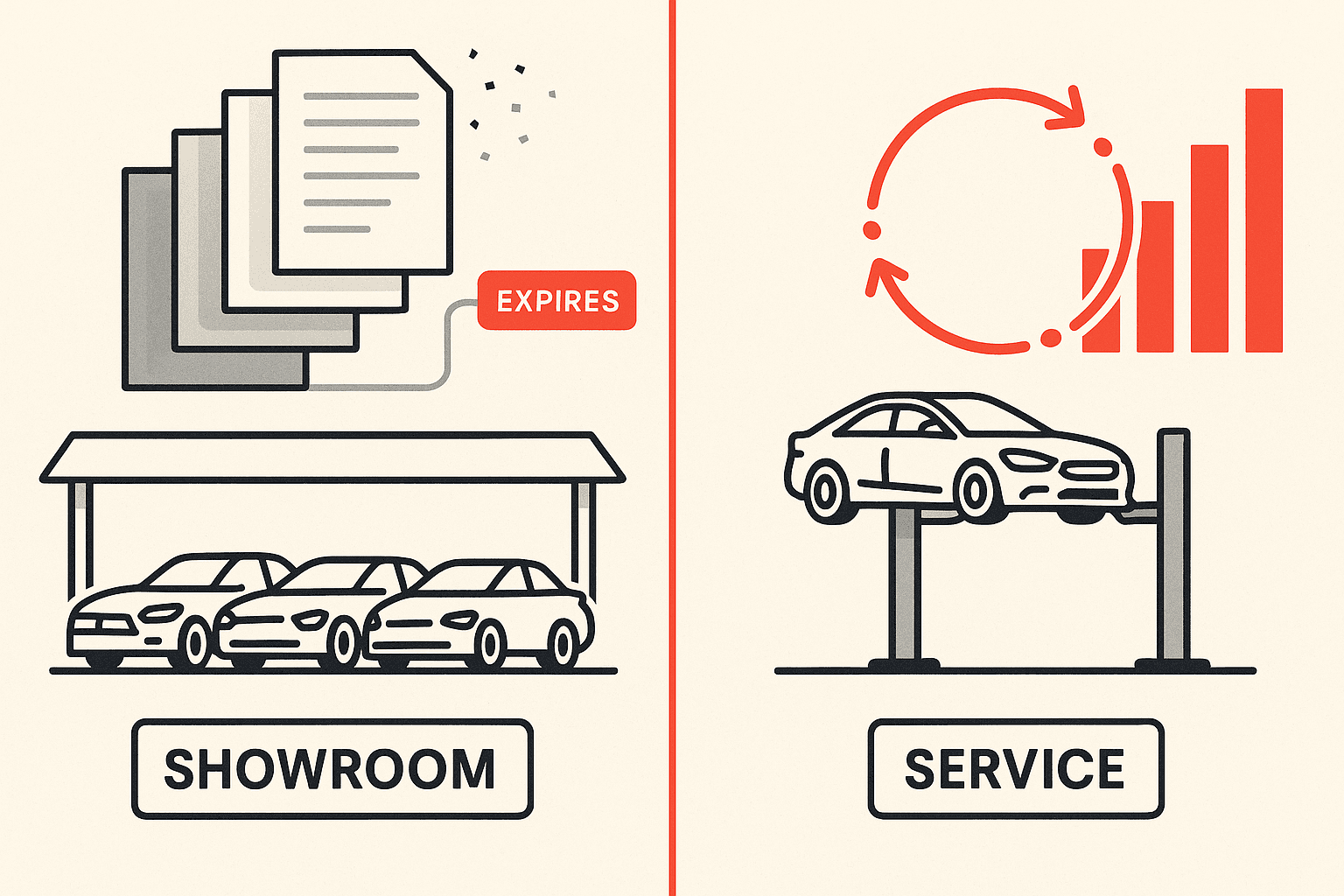
Dealership search is three query layers, and the money is concentrated in the weakest one.
The inventory layer - vehicle detail pages - is built on URLs that expire in 45 to 90 days, competing against Cars.com, CarGurus and Autotrader on stock you are paying those same marketplaces to list. The fixed operations layer - service, parts, tyres, recalls, warranty - carries roughly ten times the search volume of vehicle queries, recurs for a decade per customer, and is almost universally under-optimised. The research and finance layer - trade-in values, financing, ownership costs, model comparisons - is where a single rooftop can actually build topical authority.
Two facts frame everything below. The average franchised dealership spends $117,249 a year on third-party listing sites and $114,318 on its own SEO, per NADA Data 2025 - it pays more to rent visibility from the marketplaces that outrank it than to own visibility itself. And "oil change near me" draws about 1,500,000 US searches a month against 201,000 for "car dealership near me".
The budget is in the wrong place. Here is where it should go.
Where dealership money actually goes
NADA publishes the numbers every year and almost nobody in the SEO industry reads them. The 2025 full-year data covers 16,990 franchised light-vehicle dealers who sold 16.2 million light-duty vehicles and spent $9.96 billion on advertising - $739 per new unit sold.
The media split is the interesting part.
Read the top three lines again. Search engine marketing, third-party listing sites, and SEO together take 60.6 percent of a dealership's advertising. Search is not a channel in car retail. It is the business.
And the second line is the one that should make a dealer principal uncomfortable. $117,249 a year goes to Cars.com, CarGurus, Autotrader and Carfax - platforms that then outrank the dealership for its own inventory, capture the lead, and sell it back. That is a defensible spend when the alternative is invisibility. It stops being defensible when the store has never seriously attempted to build the organic assets that would reduce its dependence on them.
There is one more number worth noting, from the other side of the transaction. The keyword "car dealership seo" carries a cost per click of roughly $80 in the United States. The keyword "car dealership near me" - an actual in-market buyer - costs about $3.15. Agencies pay twenty-five times more to reach dealers than dealers pay to reach buyers. That tells you which side of this market is competitive.
The schema advice that Google deleted
On 9 September 2025, Google removed the vehicle listing structured data documentation from Search Central. The stated reason, in Google's own documentation update log, was that the type is no longer shown in Google Search results. Search Console rich result reporting, the Rich Results Test and the Search appearance filters all dropped it the same day. The Search Console API continued to accept it only through December 2025.
That feature had shipped in October 2023 with genuine promise: dealerships could mark up used-vehicle listings and become eligible for a dedicated vehicle listing experience. Two years later it was gone, folded into Google's broader simplification of rich result types that were not seeing meaningful use.
Yet it is still, in September 2026, the single most repeated recommendation in dealership SEO content - repeated confidently enough that Google's own AI Overview for "seo for car dealerships" surfaces it, sourced from vendor pages selling exactly that service.
To be precise about what remains true, because the correction is not "skip structured data":
| What dealership SEO content still says | What is actually true |
|---|---|
| Vehicle listing schema gets your inventory into Google rich results | The type was removed from Google's documentation on 9 September 2025 and is no longer shown in Search |
| Automotive schema is how AI engines understand your inventory | AI engines read your rendered page; they are not gated on a deprecated Search feature |
| Structured data is therefore pointless for dealerships | False. Organization, LocalBusiness/AutoDealer, BreadcrumbList and FAQPage are all supported and worth shipping |
| Schema is a ranking factor for dealership pages | It is an eligibility and clarity mechanism, not a ranking input |
Ship structured data for entity clarity, breadcrumb display and FAQ eligibility. Ship it because it helps machines resolve which legal entity, which rooftop and which department a page belongs to - which matters more than ever now that entity signals feed the knowledge graph and AI citations. Just stop paying for it as a route to a Search feature that has been switched off for a year. If you are not certain what is currently deployed across your rooftops, that is exactly the kind of thing a technical SEO audit exists to establish, and we cover the broader shift in what actually moved on schema for AI search.
Inventory pages are a rented foundation
The instinct is understandable. You have 300 cars on the lot, each with a page, each page a chance to rank. Build enough of them and surely something sticks.
Here is why it does not.
A vehicle detail page is a URL bound to a single VIN. It is created when the unit arrives, crawled and indexed on Google's schedule rather than yours, and then removed when the car sells - typically inside 45 to 90 days. In most cases the page is deleted or redirected before it has accumulated a single external link or enough engagement history to compete for anything but its own stock number. You are running a treadmill where the belt resets faster than you can walk.
Now add the competition. That same 2021 Honda CR-V is syndicated to Cars.com, CarGurus, Autotrader and Carfax - all of which carry domain authority no individual rooftop can approach, all of which have been accumulating links since before your website vendor existed, and all of which you are paying to be on. When a shopper searches the exact year, make, model and trim, you are competing against four copies of your own listing hosted on stronger domains.
This is not an argument for neglecting vehicle pages. It is an argument against building the strategy on them. Vehicle pages need to be technically sound - fast, crawlable, correctly canonicalised, with sold units handled through a deliberate end-of-life policy rather than left to 404 in bulk - and then left to do the modest job they can do. Large-inventory sites are genuinely a programmatic SEO problem, but the template quality bar is high and the payoff sits in the category and body-style tier above individual VINs, not in the VINs themselves.
The durable assets sit one level up.
The biggest query in car retail is an oil change
This is the finding that reorganises the whole budget.
"Oil change near me" is roughly 1,500,000 US searches a month. That is seven and a half times "car dealership near me" and eleven times "used cars for sale near me". Add brake repair, car service, tyre rotation, transmission, battery, recall and brand-specific service centre queries and the fixed operations demand pool is in a different league entirely.
The business case matches the search case. NADA reports 276,128,228 repair orders written across franchised dealerships in 2025, with service and parts sales of $164.6 billion. The average store wrote 16,252 repair orders and booked $9.69 million in service and parts revenue, at $494 per customer repair order and a mean customer mechanical labour rate of $186 an hour. Service and parts is 13.3 percent of dealership sales dollars - and the department that keeps a customer in the building between purchases.
A vehicle buyer transacts with you once every six or seven years. A service customer transacts three to six times a year for a decade, and is materially more likely to buy their next car where they already service the current one.
Almost nobody optimises for this. Walk through most dealership websites and the service section is a single page with an appointment iframe, a phone number and a paragraph of copy the platform vendor wrote in 2019. Meanwhile the site has 300 vehicle pages that will not exist in three months.
The durable layer: pages that outlive your inventory
Here is the page architecture that actually holds rankings, ordered by how much of it most dealerships are missing.
| Page type | Why it holds | Typical state at a dealership |
|---|---|---|
| Individual service pages (oil change, brakes, tyres, transmission, battery, AC, alignment) | Highest volume, recurring, low competitive intensity relative to volume | One combined service page, if any |
| Brand service pages ("Honda service in [city]") | Captures the franchise-plus-service intersection where you have a genuine advantage | Missing |
| Recall and warranty pages by model | Urgent intent, high trust value, extremely thin competition | Missing |
| Service pricing and menu pages | Wins the comparison query; most competitors hide pricing | Hidden behind a form |
| Trade-in and valuation pages | High commercial intent, feeds used inventory acquisition | One generic form page |
| Financing and credit pages, including subprime | Long-consideration, high-value, question-heavy | Boilerplate the vendor supplied |
| Body-style and category pages (SUVs, trucks, EVs under a budget) | Survives inventory turnover; the right level for programmatic templates | Filtered inventory URLs with thin or duplicated copy |
| Model research and comparison pages | Upper-funnel authority, strong AI citation candidates | Missing, or syndicated OEM copy |
| Location pages for surrounding towns | Captures proximity intent beyond your immediate city | One thin page per town, or none |
| Ownership cost and maintenance schedule content | Genuine expertise, links naturally, feeds the service funnel | Missing |
Two things about this table matter more than the individual rows.
First, every one of these page types survives an inventory turnover. That is the whole point. You are building assets that compound rather than assets that expire.
Second, the ones marked "missing" are missing at almost every dealership, which means the competitive bar is low. This is unusual in 2026. Most local verticals have been picked over. Dealership fixed operations content has not, because the entire industry's marketing attention - and $117,249 a year per store - points at the inventory layer instead. A structured content marketing programme aimed at this layer is one of the few remaining local SEO opportunities where volume and competition are genuinely mismatched.
Beware of one trap: filtered inventory URLs are not category pages. A URL like /used-inventory/?bodystyle=suv&price=25000 is a facet, usually parameterised, frequently duplicated across dozens of filter combinations, and rarely worth indexing. A real body-style page has its own URL, its own copy about what those vehicles suit locally, its own internal links, and a dynamic inventory module underneath rather than instead of the content.
You probably do not own your website
This is the constraint that separates dealership SEO from every other local vertical, and no guide written by a website vendor is going to raise it.
Most franchise dealers run on a website platform chosen from a manufacturer's certified-vendor programme. The OEM approves a shortlist. Co-op advertising dollars often part-fund the subscription, which makes staying inside the programme economically rational even when the platform is technically mediocre. The dealer signs, and inherits a site built to serve every rooftop on that vendor identically.
Which means the dealer frequently cannot change:
- Template markup and heading structure, because it is shared across the vendor's entire client base
- URL patterns for inventory, category and location pages
- Canonical and pagination logic on inventory listings
- Internal linking architecture between service, inventory and content sections
- Page speed budgets, since third-party chat, trade-in, finance and inventory scripts are bundled at platform level
- Which pages exist at all, if the CMS only supports the page types the vendor has built
An SEO plan that assumes root-level control of the site will fail on contact with this. What works instead is treating dealership SEO as two workstreams that run in parallel.
The first is vendor management. Audit the platform against a documented technical baseline and write down precisely what it does and does not permit. Take the fixable items to your vendor's product team in writing, with the business case attached, and put them on a roadmap with dates. Vendors do ship these changes - they ship them for the dealers who ask specifically and repeatedly, and for nobody else. If you have never sent your website provider a written technical requirements document, that is the highest-leverage hour available to you this quarter, and a technical SEO baseline is what it should be built from.
The second is the layer you fully control: content within whatever page types the CMS allows, Google Business Profile, reviews, local citations, third-party mentions, and off-site presence. This is where most dealerships have made no serious attempt at all, which is convenient, because it is also the part nobody can veto.
Local SEO for a dealership is a multi-entity problem
A dentist has one profile. A dealership usually has at least two, and treating it as one is the most common local mistake in the category.
Google permits distinct Business Profiles for departments that operate as separately staffed, publicly accessible units with their own hours and their own entrance. A dealership service drive almost always meets that description. So does the parts counter at larger stores, and the body shop where one exists.
The consequence is direct. A single profile with the primary category set to your franchise brand is forced to compete for both "Honda dealer near me" and "Honda service near me" using one category signal, one review pool and one set of photos. Split them and each profile gets a primary category that matches its actual query set - the franchise or "Used Car Dealer" for sales, "Auto Repair Shop" or equivalent for service - and each accumulates reviews from the customers who used that department.
Beyond the split, the fundamentals that move local pack position are unglamorous and mostly unattended at dealerships:
- NAP consistency across both profiles and every citation, including the automotive-specific directories that syndicate from your DMS
- Review velocity on the service profile, which is easier to build than sales reviews because the transaction frequency is higher and the emotional stakes lower
- Genuine on-lot photography rather than manufacturer stock, uploaded regularly, because engagement with photos is a documented profile signal
- Service-level Q&A answered by the dealership rather than left to customers
- Hours accuracy including holidays, since a wrong-hours listing generates one-star reviews that have nothing to do with your service quality
We have written the mechanics of this out at length in how the local pack actually ranks, and the same proximity, prominence and relevance framework we use across local SEO engagements applies here with one adjustment: you are optimising two entities that share an address and compete for different queries.
The AI answer layer
Run a category prompt through ChatGPT, Perplexity or Google's AI Overviews - "best used car dealership in [city]", "where should I get my Honda serviced in [city]" - and look at what gets cited.
It is Google Business Profile reviews. It is Reddit threads in city and enthusiast subreddits. It is local news. It is the marketplaces. It is, very occasionally, a dealership's own site.
That pattern is consistent with what we found when we tested AI engines on local business searches: engines assemble local answers from third-party corroboration far more readily than from a business describing itself. A dealership website saying it offers exceptional service and unbeatable prices provides a language model with nothing quotable, because every competing dealership site says the same sentence.
Three things change your odds.
Third-party presence. Consistent, genuine participation in the places engines actually read - local press, community forums, model-specific subreddits, review platforms. Not spam. Our own six months of Reddit work for AI citations documented how slowly and how specifically this compounds, and the same logic drives our Reddit SEO engagements.
Extractable structure on your own pages. Short definitional answers near the top of a page. Real service pricing where you can publish it. Named neighbourhoods and highways rather than "the greater metro area". Specific maintenance intervals for specific models. Comparison tables. The techniques we set out in how to rank in AI Overviews and across our answer engine optimisation work translate directly.
Entity clarity. Make it unambiguous which legal entity, which rooftop and which department each page belongs to, and keep that consistent across your site, both Business Profiles, your citations and your OEM locator listing. This is the job structured data still does well, now that it is no longer pretending to do the other one.
What to measure instead of vehicle page sessions
VDP sessions is the metric almost every dealership reports and it is close to meaningless, because it tracks inventory volume. Take delivery of 80 extra units and VDP sessions rise. Sell down and they fall. Neither movement tells you anything about search performance.
Report these instead:
- Service appointment requests and inbound service calls from organic, split by service type where your booking tool allows it. This is the recurring revenue line and it is directly attributable.
- Trade-in and valuation form starts, not just completions. A started valuation is an in-market seller who is usually also an in-market buyer.
- Non-brand organic share - people who found you without searching your dealership name. If 85 percent of your organic traffic is brand, your SEO is functioning as a switchboard, not as demand generation.
- Google Business Profile actions split by profile - calls, direction requests, website clicks, separated between sales and service.
- AI citation presence for your category prompts, tracked as a rate over repeated checks rather than a single spot check, for the reasons we set out in 90 days of citation tracking.
Two of these are increasingly invisible in conventional reporting because the answer is delivered before the click. If a shopper reads your service hours and rating in an AI Overview and then drives over, no session was recorded. Our approach to measuring zero-click search and to content ROI when rankings are not the outcome both apply here, and dealerships are among the businesses most exposed to the gap.
One underused source sits inside your own site: internal search queries. Every "does it have adaptive cruise", "brake pad replacement cost", "do you take trade-ins from out of state" typed into your site search is a content brief written by a customer. We have covered mining internal site search in GA4 as a standalone method, and dealership sites produce unusually rich data because visitors arrive with very specific questions.
Common mistakes
- Building the strategy on vehicle detail pages. They expire faster than they rank, and four better-resourced marketplaces carry the same listing.
- Paying for vehicle listing schema. Removed from Google's documentation on 9 September 2025. Ship supported types instead.
- Running one Business Profile for sales and service. One category signal cannot serve two query sets, and the service set is the larger one.
- Treating filtered inventory URLs as category pages. A parameterised facet is not a landing page.
- Accepting the platform as immovable. Vendors ship changes for dealers who submit written, specific, repeated requirements. Most never ask.
- Publishing OEM-syndicated model copy verbatim. Identical text across hundreds of rooftops earns nothing and cannot be cited by an AI engine that has seen it four hundred times.
- Letting sold units 404 in bulk. Decide the end-of-life policy - redirect to the model or body-style page, or return a proper status with a useful alternative - and apply it consistently.
- Reporting VDP sessions as the headline. It measures your lot, not your search performance.
- Ignoring the service review pool. It is the easiest review velocity in local business and most dealerships never ask for it.
- Assuming paid search covers the gap. At $739 of advertising per new unit sold, paid is already carrying more than its share. Paid and organic should be scoped against each other, not stacked blindly.
Your first 90 days
Weeks 1 to 3 - establish the constraint. Audit the site against a technical baseline and separate findings into what you can change and what your platform vendor controls. Write the vendor list up formally and send it. Simultaneously, split or claim the service Business Profile, fix categories on both, and correct NAP inconsistencies across your citation set.
Weeks 4 to 8 - build the fixed operations layer. Ship individual service pages for your highest-volume jobs, brand service pages for your franchise, a published service menu with real prices, and recall pages for the models you sell. This is the fastest-converting content a dealership can publish because the intent is immediate and the competition has not shown up.
Weeks 6 to 12 - build the durable purchase layer. Body-style and category pages with genuine local copy, a trade-in page that answers the actual questions rather than only capturing a lead, financing content including the subprime questions nobody wants to write about, and location pages for the towns you realistically draw from.
Throughout - work the off-site layer. Service review velocity as a weekly habit. Local press and community presence. Real photography uploaded to both profiles. Third-party mentions where AI engines actually look.
Week 12 - re-baseline. Non-brand organic share, service enquiries from organic, both profiles' actions, and AI citation rate for your category prompts. Compare against week one. Not VDP sessions.
Running a dealership group and not sure how much of this your website platform is blocking? We audit the site, the profiles and the AI answer layer together, then hand you two lists: what your team can fix this quarter, and what to put in writing to your vendor.
Request a dealership search auditWhere this goes next
The structural picture in car retail is that dealerships have been sold a version of SEO that mirrors their inventory business - transactional, unit-based, and expiring. The version that compounds looks like a service business: recurring local demand, published expertise, real reviews, and a presence in the places customers and machines both check before they trust you.
The economics already point that way. Fixed operations generated 276 million repair orders and $164.6 billion in 2025 while receiving a rounding error of the search attention. The demand exists, the competition has not arrived, and the advantage goes to whoever builds the pages first.
That is a rare position in local search in 2026, and it will not stay open indefinitely. If you want an outside read on where your rooftops actually stand, our SEO services and AI SEO teams work this exact intersection - technical constraint, local entity structure, and the answer layer sitting above both.

Aditya Kathotia
Founder & CEO
CEO of Nico Digital and founder of Digital Polo, Aditya Kathotia is a trailblazer in digital marketing. He's powered 500+ brands through transformative strategies, enabling clients worldwide to grow revenue exponentially. Aditya's work has been featured on Entrepreneur, Economic Times, Hubspot, Business.com, Clutch, and more.