
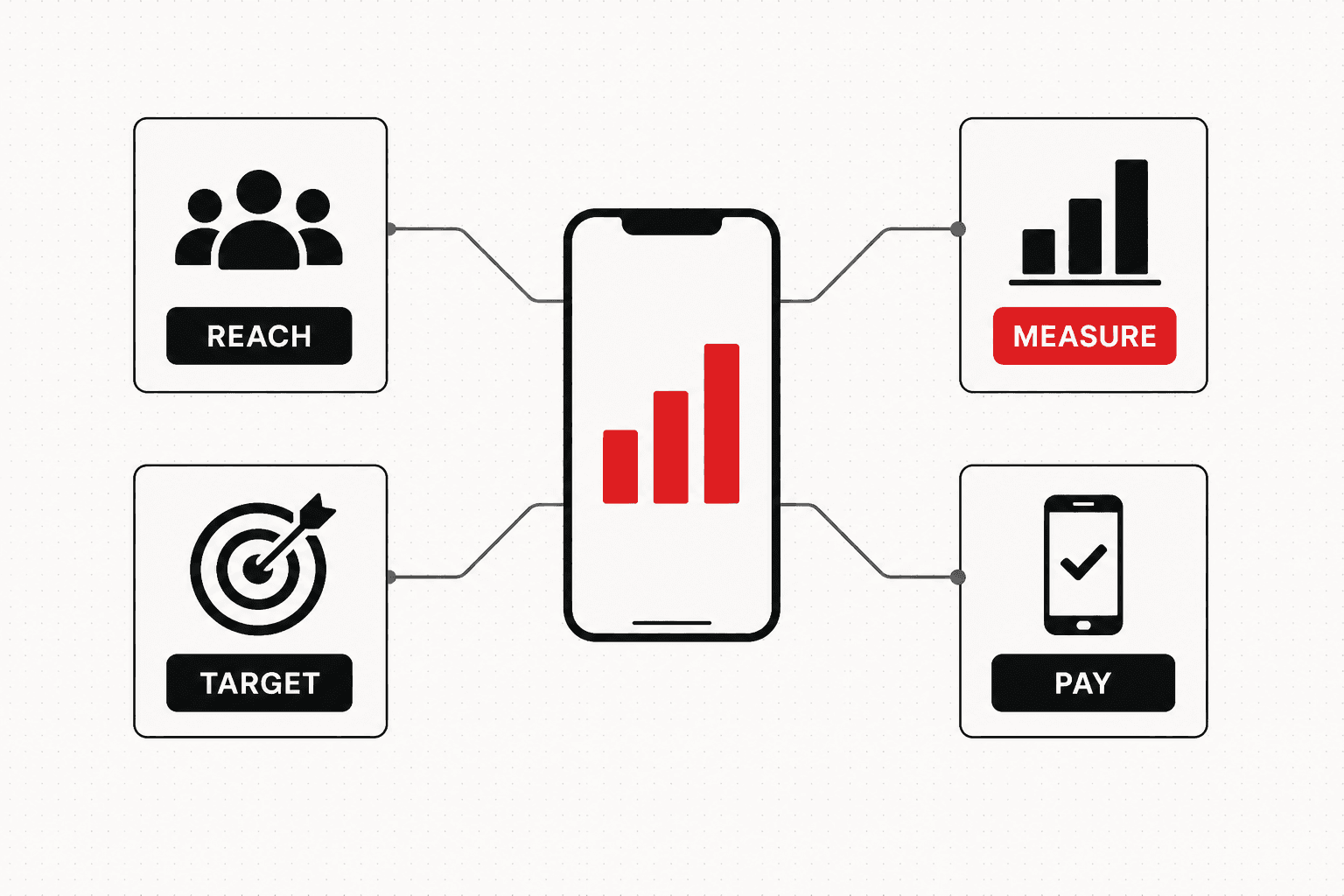
India had 958 million active internet users in 2025, and digital took 59 percent of the country's advertising spend. Those two numbers, from the IAMAI and Kantar Internet in India Report 2025 (Business Today, 29 January 2026) and the dentsu-e4m Digital Advertising Report 2026 (Bestmediainfo, 2 February 2026), are the short case for digital marketing. The audience is online, and so is most of the money competing for it.
Most lists of benefits stop at vague claims like "wider reach" and "better ROI". This one gives each benefit a sourced India figure, so you can judge it for your own business, and ends with the five limits that matter just as much.
The Benefits at a Glance
| Benefit | India figure | Source |
|---|---|---|
| 1. Reach | 958M active internet users, 2025 | IAMAI and Kantar, January 2026 |
| 2. Mobile-first access | 84.21% of web traffic on mobile, October 2026 | StatCounter GlobalStats |
| 3. Rural and regional markets | 548M rural internet users, growing about 4x faster than urban | IAMAI and Kantar, January 2026 |
| 4. Payment in the same session | 25.47 billion UPI transactions in October 2026 | NPCI, via Entrepreneur India, November 2026 |
| 5. Low entry cost | Meta CPM about ₹50 to ₹300 | Nico Digital Meta Ads benchmarks, 2026 |
| 6. Paying for intent | Google Ads CPC about ₹3 to ₹460 by industry | Google Keyword Planner averages, November 2026 |
| 7. Measurable cost per lead | 662 leads at ₹11.8 CPL on one published lending campaign | Nivi Loans case study, 2026 |
| 8. Where competitors already spend | Digital 59% of ad spend, ₹71,621 crore, 2025 | dentsu-e4m, February 2026 |
| 9. Reported sales gains for MSMEs | 41.4% of digitised MSMEs report 21 to 30% sales uplift | India SME Forum, December 2025 |
1. Reach: Most of Your Market Is Already Online
The IAMAI and Kantar ICUBE study counted 958 million active internet users in India in 2025, up about 8 percent year on year, from a survey of more than 87,000 consumers (Business Today, January 2026). TRAI's count of internet subscriptions, which counts connections rather than people, reached 1,114.17 million at the end of June 2026 (News On AIR, reporting TRAI data, 13 October 2026).
No other medium reaches that many Indians who can also respond, compare and buy in the same moment.
2. Mobile-First: You Reach Buyers on the Device They Use
In October 2026, 84.21 percent of web traffic in India came from mobile devices, against 15.17 percent from desktop (StatCounter GlobalStats, October 2026). The phone is where Indian buyers search, watch, message and pay, and every digital channel is built to reach them there. A brochure cannot follow someone from a Google search to their Instagram feed; a retargeting ad can.
3. Rural and Regional Markets Without a Distribution Network
Rural India accounted for about 548 million of the 958 million active users in 2025, more than half the base, and grew nearly four times faster than urban India (IAMAI and Kantar, via Business Today, January 2026). Short video reached 588 million users, 61 percent of the online population, with rural users slightly outnumbering urban ones.
For a business in Kolkata or Coimbatore, this is the benefit traditional marketing could not offer at small scale: targeting a district, a pin code or a language without opening a branch or buying regional airtime.
4. Payment Happens in the Same Session
Digital marketing in India benefits from something most countries do not have: a payment rail almost everyone already uses. UPI processed a record 25.47 billion transactions worth ₹31.53 lakh crore in October 2026, up 23 percent in volume on the year, with an average of 822 million transactions a day (NPCI data, via Entrepreneur India, 3 November 2026).
That shortens the path from ad to sale. A customer can see a reel, tap through, and pay in under a minute, which means campaigns can be judged on orders rather than on recall.
5. You Can Start Small and Stop the Same Day
There is no minimum print run or airtime package. Meta ads in India generally cost between ₹50 and ₹300 per thousand impressions, depending on audience, placement and season (Nico Digital Meta Ads benchmarks, 2026). A local business can test a campaign with a few thousand rupees, see results within days, and switch it off if it does not work. That flexibility is the single biggest difference from traditional media, where the money is committed before anyone sees the ad.
6. You Pay for Intent, Not Just Attention
Search advertising lets you pay only when someone who searched for what you sell clicks your ad. Average cost per click on Google Ads in India runs from about ₹3 in low-margin ecommerce to about ₹460 in insurance, with most service businesses between ₹25 and ₹250 (Google Keyword Planner averages, in our Google Ads cost benchmarks, November 2026). Google carried 98.06 percent of India's search engine referrals in October 2026 (StatCounter), so one platform covers almost the entire search market.
7. Every Rupee Can Be Measured Against a Lead
The real advantage over traditional media is not that digital is cheaper, it is that you can see what each rupee produced. The core formula is simple: cost per lead equals cost per click divided by the landing page conversion rate.
Measured results show how wide the outcomes are. A published Meta Ads campaign for a personal lending company produced 662 leads at an average ₹11.8 per lead (Nivi Loans case study, 2026). Third-party benchmarks for Meta lending campaigns range from ₹100 to ₹2,000 per lead (Scalify Labs, November 2026, and upGrowth, September 2026, compiled in the Meta Ads benchmarks above). A gap that size is only visible, and only fixable, because the channel reports it.
8. Your Competitors' Budgets Have Already Moved
Digital ad spend in India grew 19 percent to ₹71,621 crore in 2025, 59 percent of total advertising, up from 12 percent in 2016, and is projected to reach 70 percent by 2027 (dentsu-e4m Digital Advertising Report 2026, via Bestmediainfo, February 2026). WPP Media's forecast puts digital, including the digital arms of TV, print and outdoor, at 68.1 percent of India's 2026 ad revenue of ₹2,01,891 crore (WPP Media, This Year Next Year India, February 2026).
The benefit here is defensive. Your buyers see your competitors' ads, reviews and content online every day. Being absent is a choice they notice.
9. Small Businesses Report Real Sales Gains
The India SME Forum surveyed 7,835 MSMEs in 2024-25 for its December 2025 report on digitalisation (The State of Digitalisation in Indian MSMEs). Among firms that had adopted digital tools, 41.4 percent reported a 21 to 30 percent increase in sales they attributed to digital channels, and 69 percent reported at least 10 percent growth in their customer base. These are self-reported outcomes, not audited ones, but the direction is consistent across the sample.
The same report shows how much room is left. Only 53.8 percent of surveyed MSMEs had adopted at least one digital tool, and among the digitised firms, roughly half had their own business website. For the rest, the benefit is still available at the price of getting started.
There is a tenth benefit that does not fit neatly into one figure: digital assets compound. A page that ranks, an email list and a library of reviews keep producing leads long after the money that built them was spent. The types of digital marketing guide sets out which channels compound and which stop when spending stops.
The Disadvantages and Limits of Digital Marketing
An honest case includes what digital does not do well.
- Paid costs climb in competitive categories, and stop when you stop. Insurance clicks on Google Ads average ₹310 to ₹460 in India (Google Keyword Planner averages, November 2026). Pause the budget and the leads stop the same day.
- Not everyone is online. About 579 million Indians, 38 percent of the population, were not active internet users in 2025 (IAMAI and Kantar, January 2026). For some rural, older or B2B audiences, offline channels and relationships still carry the sale.
- Measurement is less exact than the dashboard. Cross-device journeys, privacy controls, offline closes and AI answers that never send a click all leave gaps in attribution. In the US, 58.5 percent of Google searches end without a click (SparkToro and Datos, 2024 Zero-Click Search Study), and no equivalent India figure is published.
- Organic results take time. SEO and content usually need three to nine months before they produce steady traffic, which is a long wait for a business that needs leads this quarter.
- Choosing the right tools is hard. In the India SME Forum survey, 52.6 percent of MSMEs found it somewhat or very difficult to find the right digital tools, the biggest ongoing challenge they reported (December 2025).
For more India figures across search, AI and the agency market, see our SEO statistics for India, updated quarterly.
Frequently Asked Questions
What are the main benefits of digital marketing?
For an Indian business the main benefits are reach (958 million active internet users in 2025 per IAMAI and Kantar), the ability to start with a small budget, paying for intent through search ads, precise targeting by city, language and interest, measurable cost per lead, payment in the same session through UPI, and owned assets such as a ranking website that keep working after spending stops. Small businesses that have gone digital also report sales gains in survey data.
Why is digital marketing important for Indian businesses in 2026?
Because the audience and the ad money have both moved. India had 1,114 million internet subscriptions at the end of June 2026 according to TRAI, and digital took 59 percent of India's advertising spend in 2025, about 71,621 crore rupees, per the dentsu-e4m Digital Advertising Report 2026. Buyers now search, compare and pay on their phones, so a business that is not visible there is missing from the step where decisions are made.
What are the advantages of digital marketing for small businesses?
Small businesses gain the most from low entry costs, local targeting and measurability. In a December 2025 survey of 7,835 Indian MSMEs by the India SME Forum, 41.4 percent of digitised firms reported a 21 to 30 percent sales increase they attributed to digital tools, and 69 percent reported at least 10 percent growth in their customer base. These are self-reported figures, but the direction is consistent.
What are the disadvantages of digital marketing?
Paid channels get expensive in competitive categories and stop the moment spending stops. Around 579 million Indians, 38 percent of the population, were still not active internet users in 2025 per IAMAI and Kantar. Attribution is less exact than dashboards suggest, organic results take months, and choosing the right tools is hard: 52.6 percent of MSMEs in the India SME Forum survey found it somewhat or very difficult.
Is digital marketing cheaper than traditional marketing?
It is cheaper to start and easier to scale up or down, because there is no minimum print run or airtime slot. Meta ads in India typically cost about 50 to 300 rupees per thousand impressions, and you can stop a campaign the same day. It is not automatically cheaper per customer: in categories such as insurance, a single Google Ads click can cost over 300 rupees. The advantage is that you can measure the cost per lead and cut what does not work.
Which type of digital marketing gives the best results?
It depends on how your buyers behave. If people already search for what you sell, search ads give the fastest leads and SEO gives the cheapest leads over time. If your product is visual or impulse-driven, paid social on Instagram and Facebook usually works better. Most Indian businesses get the best results from a combination: one paid channel for predictable demand and one owned channel, such as SEO or email, that compounds.
Benefits only show up in the numbers if the channels are run against leads. Our SEO services build the organic traffic that compounds, and our PPC services run Google and Meta campaigns judged on cost per lead and revenue, so you can see exactly which benefit each rupee is buying.

Aditya Kathotia
Founder & CEO
CEO of Nico Digital and founder of Digital Polo, Aditya Kathotia is a trailblazer in digital marketing. He's powered 500+ brands through transformative strategies, enabling clients worldwide to grow revenue exponentially. Aditya's work has been featured on Entrepreneur, Economic Times, Hubspot, Business.com, Clutch, and more. Join Aditya Kathotia's orbit on LinkedIn to gain exclusive access to his treasure trove of niche-specific marketing secrets and insights.
More in Digital Marketing
- Marketing Funnel: Stages, Metrics and Examples for Indian Brands
- Biggest Advertising Agencies in India: The Major Networks
- Best AI SEO Agencies in 2026: A Verified Global Shortlist
- Fintech Companies in India: 30 Notable Names by Segment
- 10 Types of Digital Marketing: India Costs and When Each Fits
- Why Not to Hire a Full-Service Marketing Agency