

The short answer
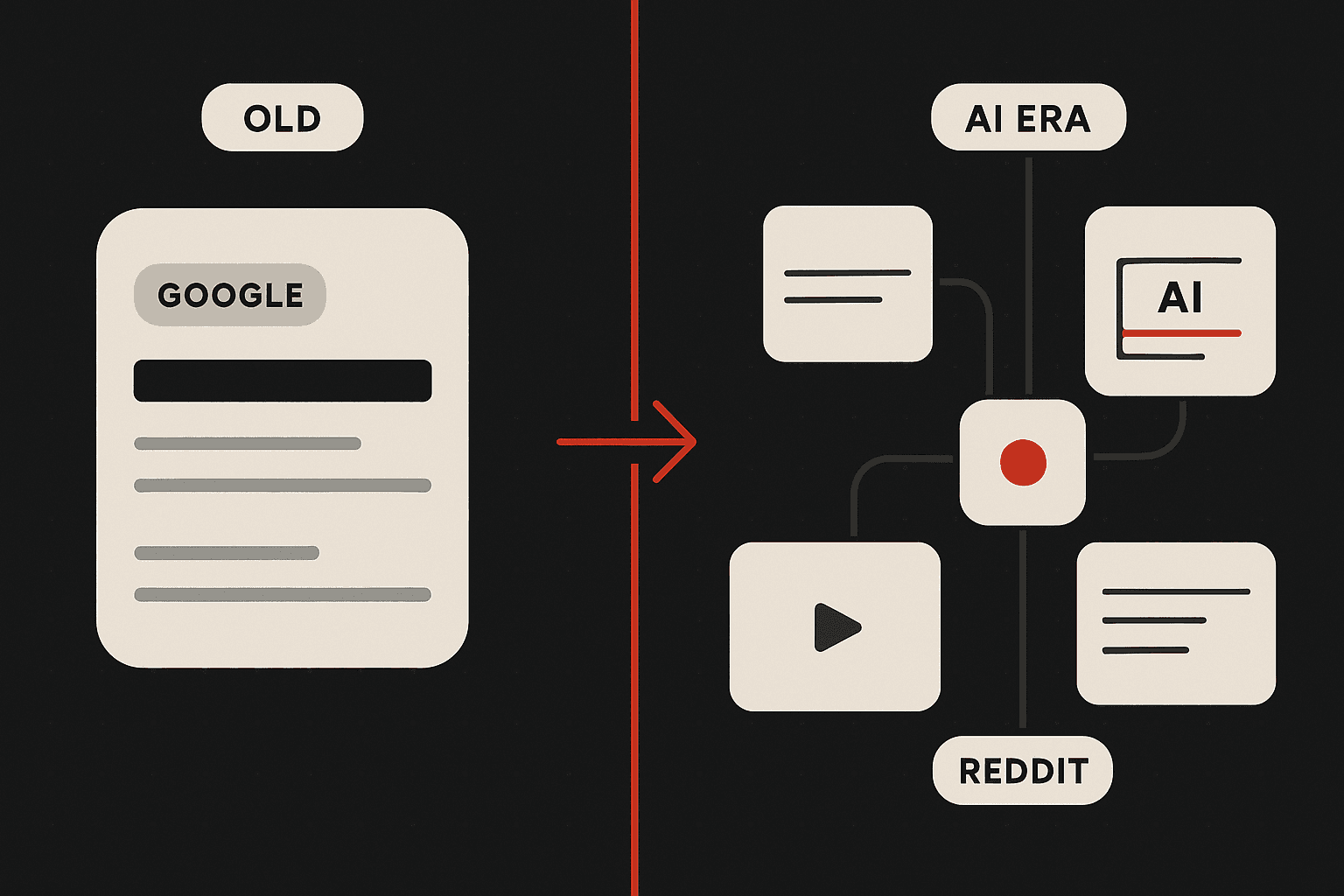
Most Indian D2C brands are running a 2019 SEO playbook against a 2026 buyer. The buyer has quietly split their research across Google, Google's AI Overviews, ChatGPT, Perplexity and third-party sources like Reddit and YouTube - and the brand is still briefing "ten blogs targeting a keyword" and optimising product pages. The six mistakes we see most often are: chasing keywords when AI runs on entities and questions; pouring SEO into product and category pages while ignoring the pre-purchase questions buyers now ask assistants; neglecting off-site presence on the third-party sources LLMs actually cite; watching rankings while AI citations go completely unmeasured; confusing a fast Shopify theme with real technical SEO; and assuming paid ads can substitute for organic and AI discovery. None of these require rebuilding everything. They require moving effort from where it no longer compounds to where it now does.
First, the thing that has not changed
Before the mistakes, one reassurance: the foundation has not moved. Genuinely useful content, researched properly, structured clearly, published by an identifiable expert, still wins - on Google, in answer boxes, and inside AI assistants. In our own nine-month run of SEO, AEO and GEO for one D2C client, the pages that ranked were, almost without exception, the same pages that got cited by ChatGPT and Perplexity. There is no separate "AI content" that works while your SEO content does not. There is good content, and good content now pays out across more surfaces than before.
So this is not an argument to throw away SEO. It is an argument that most D2C brands are spending their SEO effort in the wrong places for how buyers actually research now. Here is where.
Mistake 1: Chasing keywords when AI runs on entities and questions
The most common brief we still receive from D2C founders reads like it was written in 2019: "here are ten keywords, write ten blogs." That model assumes a searcher types a keyword, sees ten blue links, and clicks one. A growing share of your category's high-intent research no longer works that way. A buyer opens ChatGPT or Perplexity and asks a full question - "which protein powder is best for someone lactose intolerant" - and gets a synthesised answer that names a few brands and never shows a ranked list at all.
That answer is not assembled from keyword density. It is assembled from two things: the model's understanding of entities (is your brand a known, consistently described thing in this category?) and clean, liftable passages that directly answer the question. Keyword-first content optimises for neither. It produces pages that mention a phrase often but never state a crisp, quotable answer, and it does nothing to make your brand a recognisable entity.
The fix: brief around questions and entities, not keywords. Build a map of the actual questions your buyers ask an assistant before they know you exist, write content that answers each in a tight, extractable passage near the top of the page, and make sure your brand is described consistently everywhere it appears. This is the core of answer engine optimization, and it is the cheapest high-leverage shift most D2C brands can make.
Mistake 2: Over-investing in product pages, ignoring the questions buyers ask before they know you
D2C SEO budgets skew almost entirely to the bottom of the funnel: product detail pages, collection pages, and transactional keywords like "buy X online." That work matters for the buyer who already wants your product. But it is invisible to the buyer who has not chosen a category winner yet - and in the AI era, that buyer is forming their preference inside an assistant, using questions your product pages will never answer.
"Is a vitamin C serum worth it for oily skin?" "Cold-pressed vs regular juice - does it matter?" "What should I look for in a first air purifier?" These are the moments brand preference is actually decided now, and they happen before the buyer ever reaches a product page. If your brand is absent from those answers, you are competing only for buyers who already decided - a shrinking, expensive pool.
The fix: rebalance the content mix toward consideration-stage, question-led assets - comparisons, honest buying guides and category explainers - and make sure each one links down to the relevant product pages so the authority it earns flows to where you convert. If you sell direct-to-consumer, our D2C growth approach and ecommerce SEO work both start here, because this is the layer that has been most neglected and now compounds the fastest.
Mistake 3: Ignoring the off-site presence that LLMs actually cite
Here is the uncomfortable finding from watching where AI assistants pull answers: they lean disproportionately on third-party sources. Reddit threads, YouTube reviews, established publications, and "best X in India" comparison lists show up in citations far more than any single brand's own blog. A D2C brand can publish the most thorough guide on the internet and still lose the citation to a Reddit thread that mentions three competitors and not them.
Indian D2C brands systematically under-invest here because owned-blog content feels controllable and off-site presence feels like someone else's job. But if the model retrieves from Reddit and comparison lists and your brand is mentioned in neither, no amount of owned content closes the gap. This is exactly the mechanism behind brands that rank on Google but stay invisible in AI answers.
The fix: treat off-site presence as a core SEO deliverable, not a PR afterthought. Earn legitimate mentions on the sources models trust - genuine Reddit participation, review and comparison placements, and digital PR that lands you on third-party lists and in established publications. Combined with disciplined link building, this is what builds the entity signal an assistant needs before it will name you. If the budget for PR is not there yet, start with the owned-relationship links most D2C brands never claim.
Mistake 4: Watching the wrong scoreboard
Ask a D2C marketing lead how SEO is doing and you will get a ranking chart and a traffic number. Ask how often ChatGPT or Perplexity names their brand for the questions buyers ask, and you usually get silence. That silence is the mistake. Rankings and organic traffic live in Search Console; answer-box presence does not; and AI citations live nowhere unless you deliberately build the tracking.
This is why so many brands conclude "AI search isn't doing anything for us" - they are looking at a dashboard that structurally cannot show AI performance. You cannot manage what you never measured, and you cannot prove the value of AEO or GEO work without a baseline.
The fix: build the AI-surface scoreboard before you optimise. Pick a fixed set of category questions your buyers ask, run them across ChatGPT, Perplexity and Gemini on a regular cadence, and record whether and how your brand is named. Roll it up into a citation rate and share of voice you report alongside traffic and revenue. We wrote a full method for this in how to track AI brand mentions across ChatGPT and Perplexity - the point is simply to have the number.
Mistake 5: Confusing a fast Shopify theme with technical SEO
"We are on Shopify with a fast premium theme, so technical SEO is handled." We hear this constantly, and it is wrong. A fast theme solves page speed and Core Web Vitals, which is real and worth having. It does not touch the technical issues that quietly cap most D2C stores' organic ceiling.
The recurring culprits are almost always the same: faceted navigation and filter combinations generating thousands of near-duplicate crawlable URLs that dilute crawl budget; important content that only appears after JavaScript runs and is therefore invisible to some crawlers; missing or duplicated Product schema; thin variant pages competing with each other for the same term; and internal linking so weak that authority never flows from content down to product pages. A faster theme fixes none of these.
The fix: treat technical SEO as a discipline, not a theme choice. Get deliberate about crawl and index control, clean canonical logic, complete and valid structured data, and internal linking that passes equity to the pages that convert. This is standard scope in our technical SEO work, and for most D2C stores it unlocks more than any content project because it removes the ceiling everything else keeps hitting.
Mistake 6: Believing paid ads can replace organic and AI discovery
The default D2C growth engine is Meta and Google Ads, and for a while rising ad budgets hid the absence of organic strength. That trade is getting worse on both ends. Acquisition costs keep climbing, and AI answers increasingly intercept research before a buyer ever sees an ad - so the brand with no organic entity presence is invisible at the exact moment a buyer asks an assistant "which brand should I actually buy."
Paid buys attention only for as long as you keep paying. It contributes nothing to the AI-assembled answer that now shapes preference upstream of the ad. A brand that has outsourced all its demand to ad platforms has no moat: costs compound, and the assistant recommends a competitor who invested in being recommendable.
The fix: treat organic and AI visibility as a moat that lowers blended acquisition cost over time, with paid as an accelerant rather than the entire engine. The brands that compound are the ones that became the answer, so that when a buyer researches - on Google, in an Overview, or inside an assistant - the brand is simply present. That is the strategic case behind our AI SEO services and the wider SEO programmes we run for D2C clients.
What to do this quarter
You do not need to fix all six at once. In order of leverage for a typical Indian D2C brand:
- Build the AI-citation baseline. Pick 20 to 30 category questions, run them across ChatGPT, Perplexity and Gemini, and record your citation rate. You cannot improve what you never measured.
- Audit your content mix. If more than 80 percent of your SEO effort sits on product and collection pages, rebalance toward consideration-stage question content and at least one piece of original data only you own.
- Run a real technical audit. Check faceted navigation, JavaScript rendering, Product schema and internal linking - not just page speed.
- Map your off-site presence. Search your category questions and note where competitors are cited and you are not. Those third-party surfaces become your outreach targets.
- Fix your entity consistency. Make sure your brand name, description and category are described identically across your site, Google Business Profile, directories and any profiles you control.
- Reframe the paid conversation internally. Position organic and AI visibility as a moat that lowers blended CAC, so it gets budget on merit rather than as a leftover.
The brands winning in Indian D2C right now are not the ones with the biggest ad budgets or the most blog posts. They are the ones their buyers' assistants already recommend. If you want a clear-eyed read on where your brand actually stands across Google and AI search - and which of these six is costing you the most - our team runs exactly this diagnosis. Talk to us about an AI-era SEO audit.
The bottom line
Nothing about the AI era makes SEO less important for D2C - it makes the narrow, keyword-first version of SEO obsolete and the broad, entity-and-question version essential. Your buyers moved their research across Google, AI Overviews and assistants; most brands moved their effort nowhere. Chase questions instead of keywords, invest in the consideration content and off-site presence AI actually cites, measure the surface you have been ignoring, treat technical SEO as a discipline, and stop mistaking ad spend for a moat. Do that, and you stop competing for the buyers who already decided - and start being the brand the assistant decides for them.

Aditya Kathotia
Founder & CEO
CEO of Nico Digital and founder of Digital Polo, Aditya Kathotia is a trailblazer in digital marketing. He's powered 500+ brands through transformative strategies, enabling clients worldwide to grow revenue exponentially. Aditya's work has been featured on Entrepreneur, Economic Times, Hubspot, Business.com, Clutch, and more.