

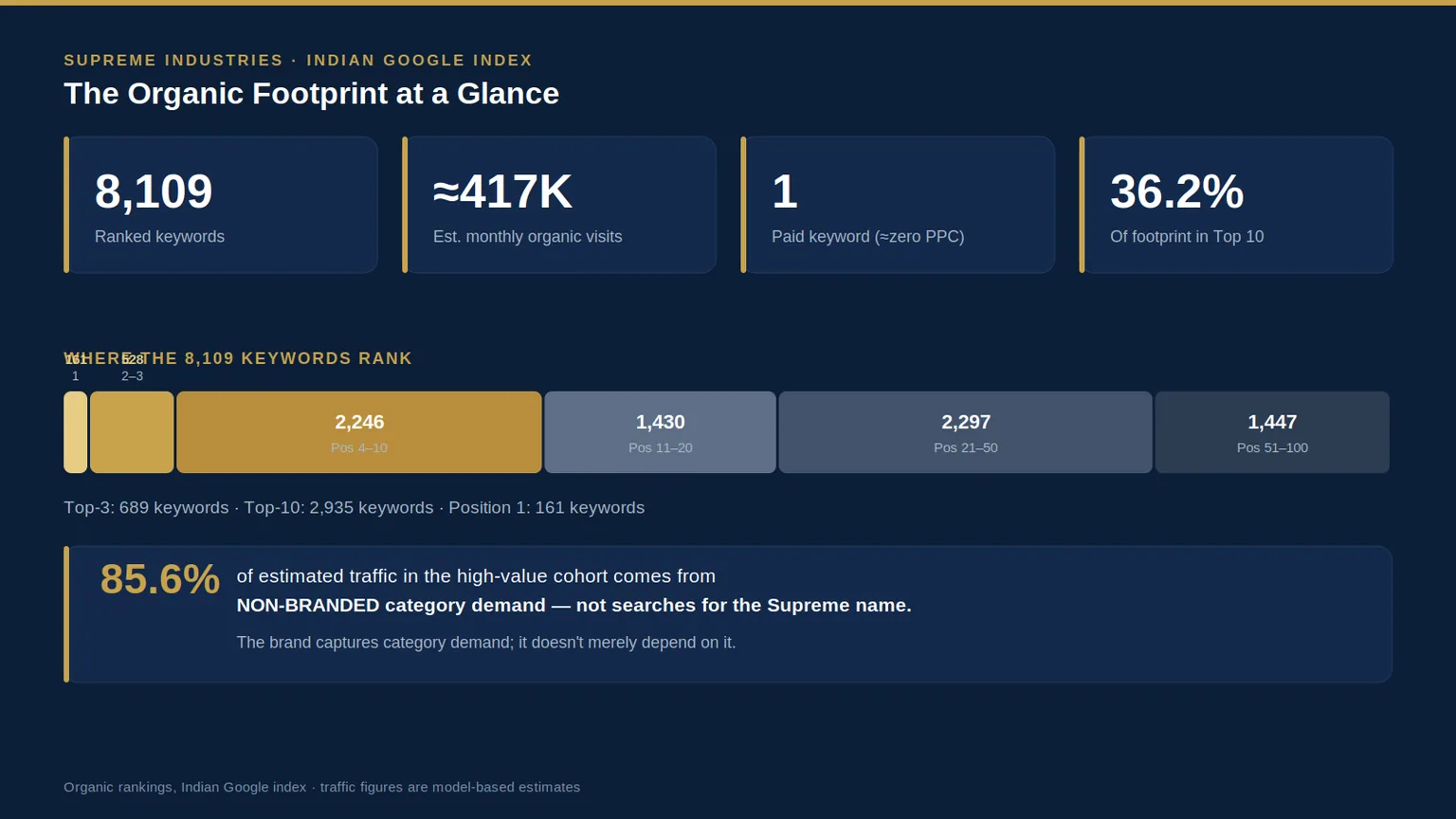
Supreme's organic footprint at a glance — a concentrated, non-branded, transactional keyword base.
Introduction
Most manufacturing companies treat their website as a brochure. A homepage, an "about us," a product catalogue that nobody can find, a contact form, and a sitemap that Google quietly ignores. Search visibility, for the average industrial brand in India, is an accident — a few branded queries, the company name, maybe a product term they happen to own because no one else bothered to compete for it.
Supreme Industries is the opposite of an accident.
A closer look at supreme.co.in reveals something that very few manufacturing brands anywhere in the world have managed to build: a search system. Not a collection of pages, but an architecture — eight product divisions wired together with a consistent URL logic, a category layer engineered to absorb head-term demand, a product layer deep enough to capture the long tail, a corporate trust layer that most e-commerce competitors can't replicate, and a dealer-discovery layer that quietly converts local intent into commercial leads. The result is a domain that ranks for roughly 8,100 keywords in India, pulls an estimated 417,000 organic visits a month, and does it while spending almost nothing on paid search.
That last detail is worth sitting with. Supreme runs effectively one paid keyword. The entire visibility engine is organic. In a category where competitors burn budget bidding on "pvc pipe" and "water tank," Supreme has built a position where Google sends it that traffic for free — and has been doing so durably enough that the rankings have survived a deliberate, large-scale pruning of the site's footprint without losing traffic.
This is a teardown of how that machine is built. Not a surface-level "they rank well because they're a big brand" observation — the data shows the brand is the output of the system, not the input. We'll map the architecture, isolate the eight ranking factors doing the heaviest lifting, model the flywheel that makes the whole thing compound, benchmark it against Finolex, Astral, Prince Pipes, Nilkamal, Sintex and Plasto, and extract the specific, replicable lessons that explain why Supreme is so difficult to outrank.
By the end, the question won't be why does Supreme rank — it'll be why doesn't everyone do this.
The Scale of Supreme's Organic Footprint
Start with the raw shape of the thing.
In the Indian Google index, supreme.co.in ranks for approximately 8,109 organic keywords. That number alone is unremarkable — plenty of e-commerce sites rank for far more. What matters is where those keywords sit and what they're worth.
The position distribution
| Position band | Keywords | Share of footprint |
|---|---|---|
| Position 1 | 161 | 2.0% |
| Positions 2–3 | 528 | 6.5% |
| Positions 4–10 | 2,246 | 27.7% |
| Top 10 (cumulative) | 2,935 | 36.2% |
| Positions 11–20 | 1,430 | 17.6% |
| Positions 21–50 | 2,297 | 28.3% |
| Positions 51–100 | 1,447 | 17.8% |
More than a third of Supreme's tracked keyword footprint sits inside the first page of Google. For a diversified manufacturer — not a pure-play retailer optimising for transactions all day — that top-10 concentration is exceptional. The footprint isn't padded with thousands of position-80 keywords that exist only on paper. It's front-loaded.
The estimated organic traffic value reinforces this. The model puts Supreme's monthly organic visits at roughly 417,000, with a paid-equivalent value (what that traffic would cost to buy through Google Ads) of around $46,000 per month. That's more than half a million dollars a year in acquisition cost that Supreme simply doesn't pay, because the architecture earns it.
Branded vs. non-branded — where the real signal lives
Here's the observation that separates Supreme from most "well-known brand ranks for its own name" stories. Inside the high-traffic cohort of its keyword portfolio, roughly 86% of the estimated traffic comes from non-branded queries. People aren't searching "Supreme water tank" — they're searching "water tank," "plastic chair," "cpvc pipe," "conduit pipe," and "crate," and landing on Supreme.
ESTIMATED TRAFFIC SOURCE (top-traffic cohort)
Non-branded category demand  ████████████████████████████  85.6%
Branded / navigational       ████                          14.4%
This is the difference between a brand that captures existing demand and a brand that depends on it. Supreme's name carries weight — "supreme industries," "supreme pipes," and "supreme chair" all rank at or near position 1 — but the brand terms are the cherry, not the cake. The cake is generic category demand, and Supreme is eating a disproportionate share of it.
Intent distribution
The footprint skews hard toward the bottom of the funnel. In the high-traffic cohort, intent breaks down roughly as:
| Intent | Share | What it means |
|---|---|---|
| Transactional | ~73% | Users ready to buy or specify a product |
| Informational | ~14% | "What is CPVC," "how to," research queries |
| Navigational | ~9% | Brand and store-finding queries |
| Commercial | ~4% | Comparison and evaluation queries |
A footprint this transactional is normally the signature of a retailer. Supreme is a manufacturer that doesn't even sell direct-to-consumer at scale — and yet it has positioned itself to absorb purchase-intent demand and route it toward its dealer network. That's not a content strategy. That's a demand-capture strategy.
The takeaway: Supreme's footprint is small in raw count, but it is concentrated, non-branded, and transactional — the three qualities that turn keyword rankings into a business asset rather than a vanity metric.
The Architecture Behind the Rankings
Everything Supreme does in search rests on one structural decision: the site is organised by business division, and every division follows the same URL grammar. This sounds trivial. It is the single most important reason the rankings are so resilient.
The division model
Supreme's eight product divisions each occupy a top-level directory:
supreme.co.in
├── /pipe         → Plastic Piping Systems  (the traffic engine)
├── /furniture    → Moulded Furniture       (the depth engine)
├── /mhd          → Material Handling        (crates, pallets, bins)
├── /ppd          → Protective Packaging     (foam, mats, EPE)
├── /xf           → Cross-Laminated Films     (tarpaulin, films)
├── /pfd          → Performance / Specialty Films
├── /ipd          → Industrial Products
└── /cylinder     → Composite LPG Cylinders
Below each division sits a consistent three-tier hierarchy:
DIVISION LANDING            /pipe
        │
        ▼
CATEGORY (faceted)          /pipe/products?pipe_categories=water-tanks
        │
        ▼
PRODUCT                     /pipe/products/weathershield-premium-overhead-tank
This is a textbook hub-and-spoke information architecture — but the execution detail is what creates the SEO leverage.
The faceted-URL gamble that paid off
Most SEO teams treat parameterised, faceted URLs (?pipe_categories=water-tanks) as a liability. They're usually blocked in robots.txt, canonicalised away, or noindex-ed, because faceted navigation is the classic source of crawl-budget waste and duplicate content.
Supreme did the opposite. A closer look at the top-performing pages reveals that its single highest-traffic URL is a faceted category page — /pipe/products?pipe_categories=water-tanks — pulling an estimated 52,000 visits a month across 315 keywords. The plumbing facet and the drainage facet rank too. Supreme decided that its category facets should be first-class, indexable, rankable destinations, and it built them to absorb the broadest head terms in each division.
This is a deliberate inversion of conventional wisdom, and Google is rewarding it because each facet maps cleanly to a real search demand cluster ("water tanks," "plumbing pipes," "drainage systems") with a stable URL, consistent internal links, and product inventory behind it.
The corporate trust layer
Wrapped around the commercial directories is a corporate layer that almost no e-commerce competitor maintains:
/overview  /milestones  /group-locations  /sustainability
/csr  /supreme-impact  /investor  /careers  /contact-us
And a commercial-discovery layer:
/stores            → dealer / store locator
/become-a-dealer   → distributor recruitment
/blog              → editorial / educational content
/brochures         → downloadable spec assets
The full URL universe declared in the sitemap is roughly 3,464 URLs, supported by separate video and image sitemaps — a detail that signals Supreme is actively competing for image and video SERP real estate, not just blue links.
Why the architecture creates leverage
The genius isn't any single page. It's that the same pattern repeats across eight divisions. Every division gets a landing hub, a set of indexable category facets, and a product layer. When Supreme learns what works in piping — say, that a faceted category page can outrank specialists — that learning is instantly transferable to furniture, to material handling, to cylinders. The architecture is a template, and a template scales.
This is also why the rankings are hard to attack. A competitor isn't fighting one page. They're fighting a system that has been replicated eight times, each instance reinforcing the others through shared navigation and a unified domain authority.
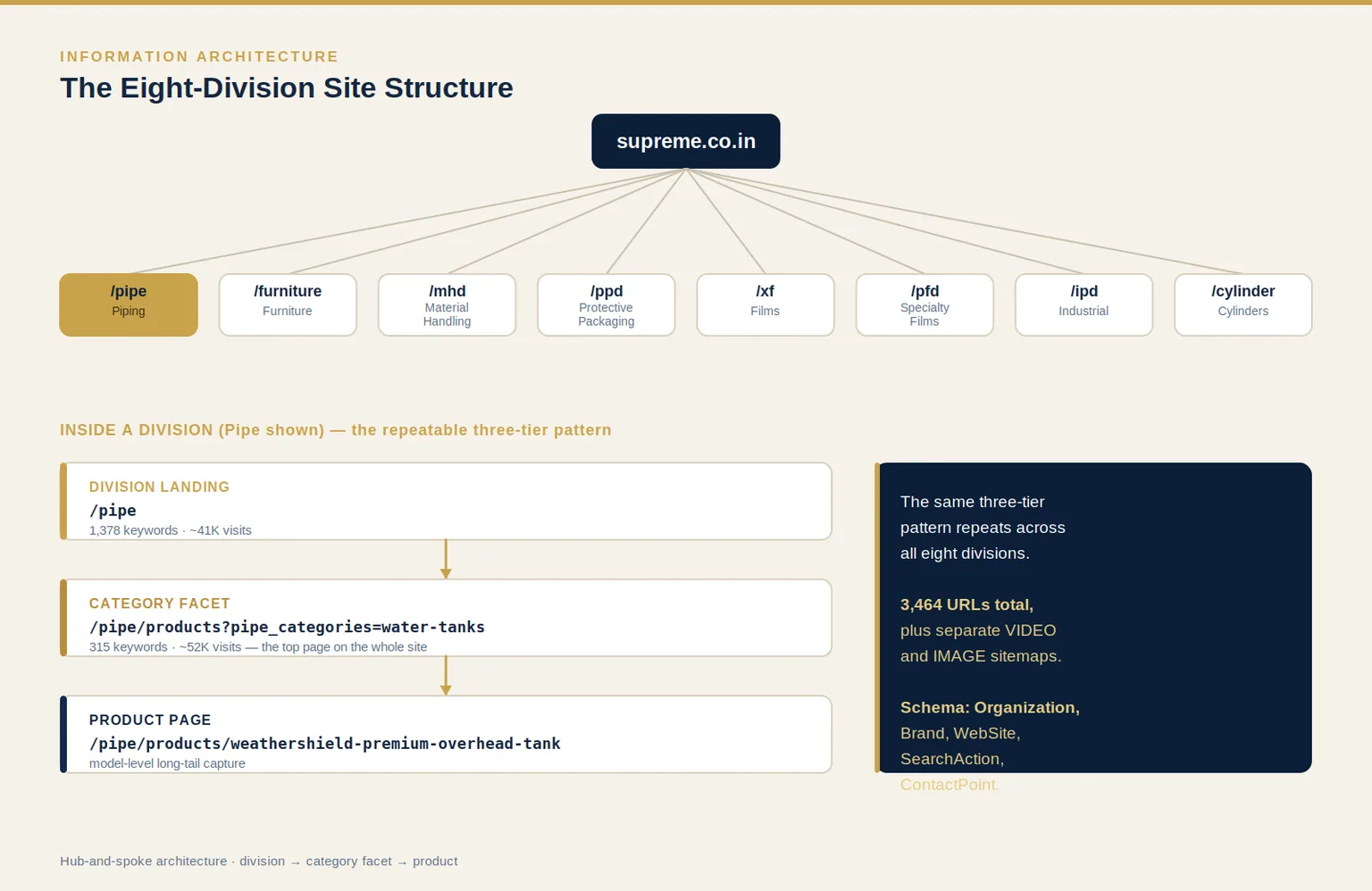
Supreme's eight-division hub-and-spoke architecture, showing the repeatable division → category-facet → product pattern.
Ranking Factor #1: Category-Level Domination
If you want to understand why Supreme ranks, start with its category pages — because they, not the homepage, are doing the heaviest commercial lifting.
The data tells a clean story. Supreme's top revenue-relevant pages are overwhelmingly category and faceted-category pages, not individual products:
| Page | Keywords | Est. monthly visits |
|---|---|---|
/pipe/products?pipe_categories=water-tanks | 315 | ~51,955 |
/furniture/products/seatings | 627 | ~45,483 |
/pipe (division hub) | 1,378 | ~40,904 |
/pipe/products?pipe_categories=plumbing | 72 | ~15,610 |
/pipe/products/electrical-conduits-and-fittings | 81 | ~13,591 |
/furniture/products/table | 131 | ~12,648 |
/furniture/products/storage | 277 | ~9,617 |
/mhd/category/crates | 47 | ~9,275 |
Look at the seatings page: 627 keywords on a single URL. That's not a product page. That's a demand magnet. It ranks for "plastic chair," "plastic chairs," "chairs," "office chair," and dozens of long-tail variants, all funneled into one authoritative category destination.
Why category pages become ranking assets
Three mechanics are at work.
First, intent breadth. A query like "plastic chair" (90,500 monthly searches) or "water tank" (135,000 searches) doesn't have a single right answer at the product level — the searcher hasn't decided which model they want yet. Google prefers to rank a category page that shows the range, because it satisfies the broadest interpretation of the query. Supreme's category pages are built precisely for this ambiguity.
Second, link concentration. Every product page in a division links up to its category page. Every navigation menu surfaces the category. The category page therefore accumulates internal link equity from dozens or hundreds of product URLs, making it the strongest node in the division's link graph after the hub itself.
Third, freshness and inventory signals. Category pages update as products are added or repositioned, giving Google a steady stream of "this page is maintained" signals — without the content decay that plagues static blog posts.
The faceted-category decision compounds all three. By making ?pipe_categories=water-tanks a real page, Supreme created a destination specific enough to match "overhead water storage tank" yet broad enough to match "water tank" — and it owns the internal links pointing at it.
The strategic implication
Supreme ranks for high-volume commercial head terms not because it has the most products, but because it has the most deliberately constructed category surfaces. Each one is engineered to be the single best answer to a category-level query. In manufacturing SEO, where head terms carry enormous volume and even more commercial intent, owning the category page is owning the category — the same principle we apply when we build SEO architectures for enterprise and industrial brands.
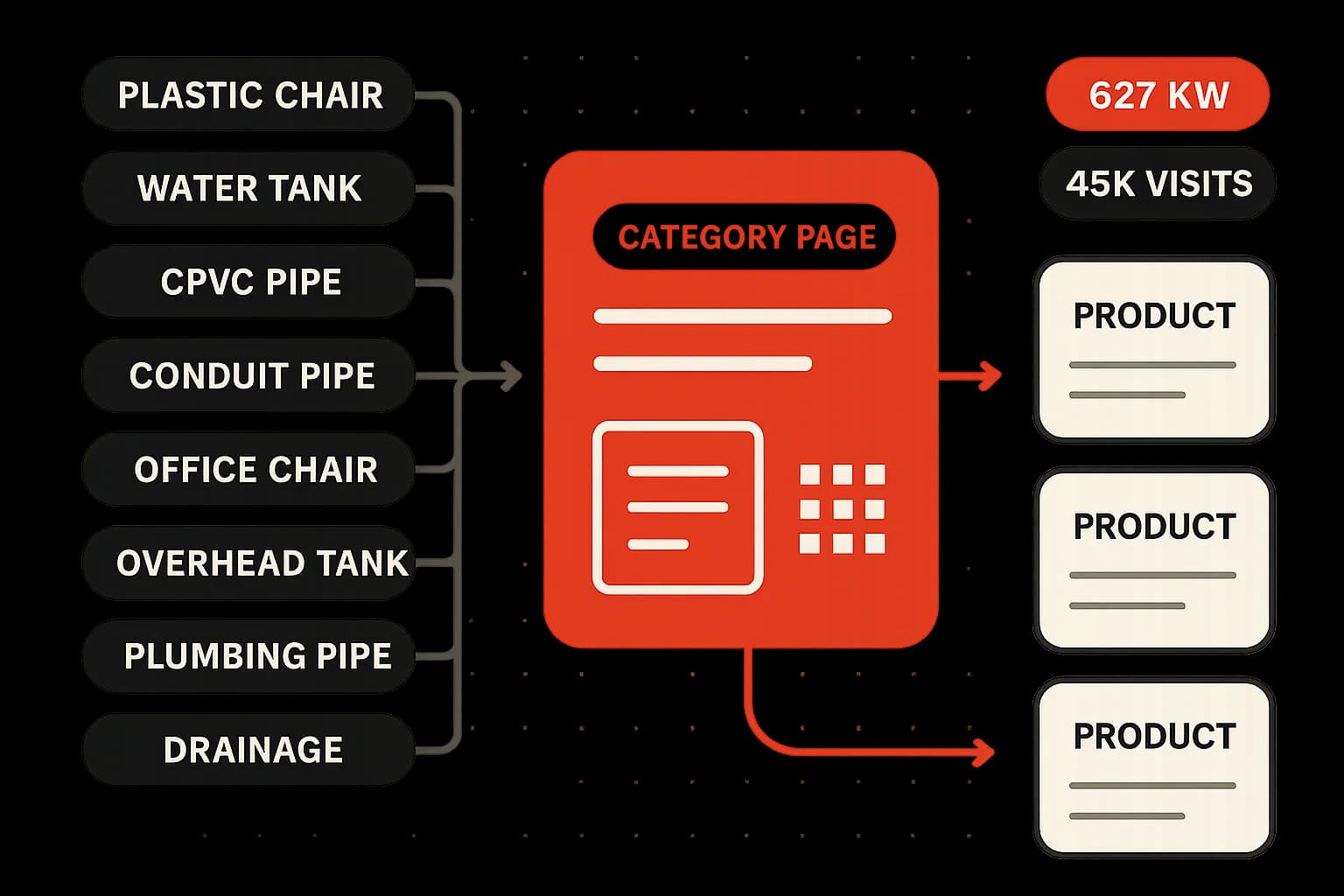
How a single category page absorbs many high-volume queries and ranks above individual products.
Ranking Factor #2: Product Depth at Scale
Category pages win the head terms. Product pages win everything underneath them — and this is where Supreme's furniture division reveals a completely different play from its piping division.
Two divisions, two strategies
Pull the sitemap apart by directory and a striking asymmetry appears:
| Division | Approx. URLs in sitemap | Primary ranking strategy |
|---|---|---|
| Furniture | ~1,627 | Depth — thousands of product/variant pages |
| Material Handling | ~354 | Moderate depth |
| Protective Packaging | ~127 | Selective |
| Pipe | ~80 | Leverage — few pages, category-led |
The piping division ranks #1 for traffic across the entire site with roughly 80 URLs. Furniture, by contrast, runs over 1,600 URLs. These are two fundamentally different SEO theories operating under one roof.
Piping demand is consolidated — a handful of category terms (water tank, plumbing pipe, cpvc, conduit) carry most of the volume, so Supreme concentrates authority into a few powerful category surfaces.
Furniture demand is fragmented — chairs, tables, stools, storage, multipurpose racks, premium sets, dining sets, each with dozens of models, colours, and use-cases. So Supreme goes wide, publishing a product page for every variant to capture the long tail of "[material] [furniture type] [attribute]" queries that collectively rival the head terms in volume.
Why depth matters where it matters
Depth isn't universally good. A thousand thin product pages in a consolidated-demand category would dilute authority and waste crawl budget — which is likely why piping stays lean. But in a fragmented-demand category, depth is the only way to be present for the full spread of queries. Each furniture product page is a small net; cast enough of them and you catch the entire long tail.
The supporting evidence is in the rankings: individual furniture product URLs (the "fusion" sets, specific table and stool models) appear independently in the traffic data, each pulling its own cluster of model-specific and attribute-specific searches. They don't cannibalise the seatings category page — they sit beneath it, catching what it's too broad to rank for.
The discipline behind it
What makes this advanced rather than reckless is the matching of structure to demand shape. Supreme appears to have asked, division by division, "is the demand here consolidated or fragmented?" — and built lean where demand is consolidated, deep where it's fragmented. Most brands pick one philosophy and apply it everywhere. Supreme runs both, simultaneously, and lets the demand curve of each category dictate the architecture. (This is exactly the call we make on every technical SEO audit — before a single page is written, the demand shape decides the build.)
Ranking Factor #3: Search Intent Coverage
A durable organic system doesn't just rank for the money keyword. It occupies every stage of the buyer's journey, so that wherever a prospect enters the funnel, Supreme is already there. Mapping the footprint against intent stages shows how complete that coverage is.
THE SUPREME INTENT FUNNEL
─────────────────────────────────────────────────────────
AWARENESS        "what are cpvc pipes"          → /blog
   │             "dry and wet waste segregation"
   ▼
RESEARCH         "types of water tanks"          → /blog, category
   │             "best plastic for chairs"
   ▼
CONSIDERATION    "overhead water storage tank"   → category facet
   │             "cpvc vs upvc"
   ▼
COMMERCIAL       "supreme industries"            → homepage, /overview
   │             "supreme pipes price"
   ▼
PURCHASE         "plastic chair", "water tank"   → category + product
   │             "conduit pipe", "crate"
   ▼
DEALER DISCOVERY "plastic store near me"         → /stores
                 "supreme dealer"                → /become-a-dealer
─────────────────────────────────────────────────────────
Evidence at each stage
Awareness and research are handled by the blog. Pages like the CPVC pipes explainer and the waste-segregation guide each pull thousands of estimated visits — not because they convert directly, but because they capture searchers early and establish topical relevance that strengthens the commercial pages below them. This is the discipline that underwrites every serious content marketing programme — top-of-funnel content is not a separate channel; it's the topical-authority feed for the commercial pages.
Consideration and purchase are owned by the category and product layers, which absorb the transactional head terms that make up ~73% of the high-traffic footprint.
Commercial/branded queries route to the homepage and corporate pages, where Supreme ranks at or near position 1 for its own variants.
Dealer discovery — and this is the stage almost every competitor ignores — is captured by /stores and /become-a-dealer. Tellingly, Supreme ranks for "plastic store near me" (22,200 searches) and routes it to its store locator. That's local, high-intent, commercial demand being captured by a national manufacturer through a single well-positioned page.
Why intent coverage compounds
When a brand owns every funnel stage, three things happen. First, it captures users before competitors who only show up at the purchase stage — building familiarity early. Second, the informational pages feed topical authority into the commercial pages through internal links and shared relevance, lifting the whole cluster. Third, it removes the exit ramps: a searcher researching "what is CPVC" and a contractor searching "cpvc pipe" and a buyer searching "supreme dealer near me" all land inside the same ecosystem. There's no stage at which the prospect is handed to someone else.
Full-funnel coverage is the difference between renting attention and owning a journey.
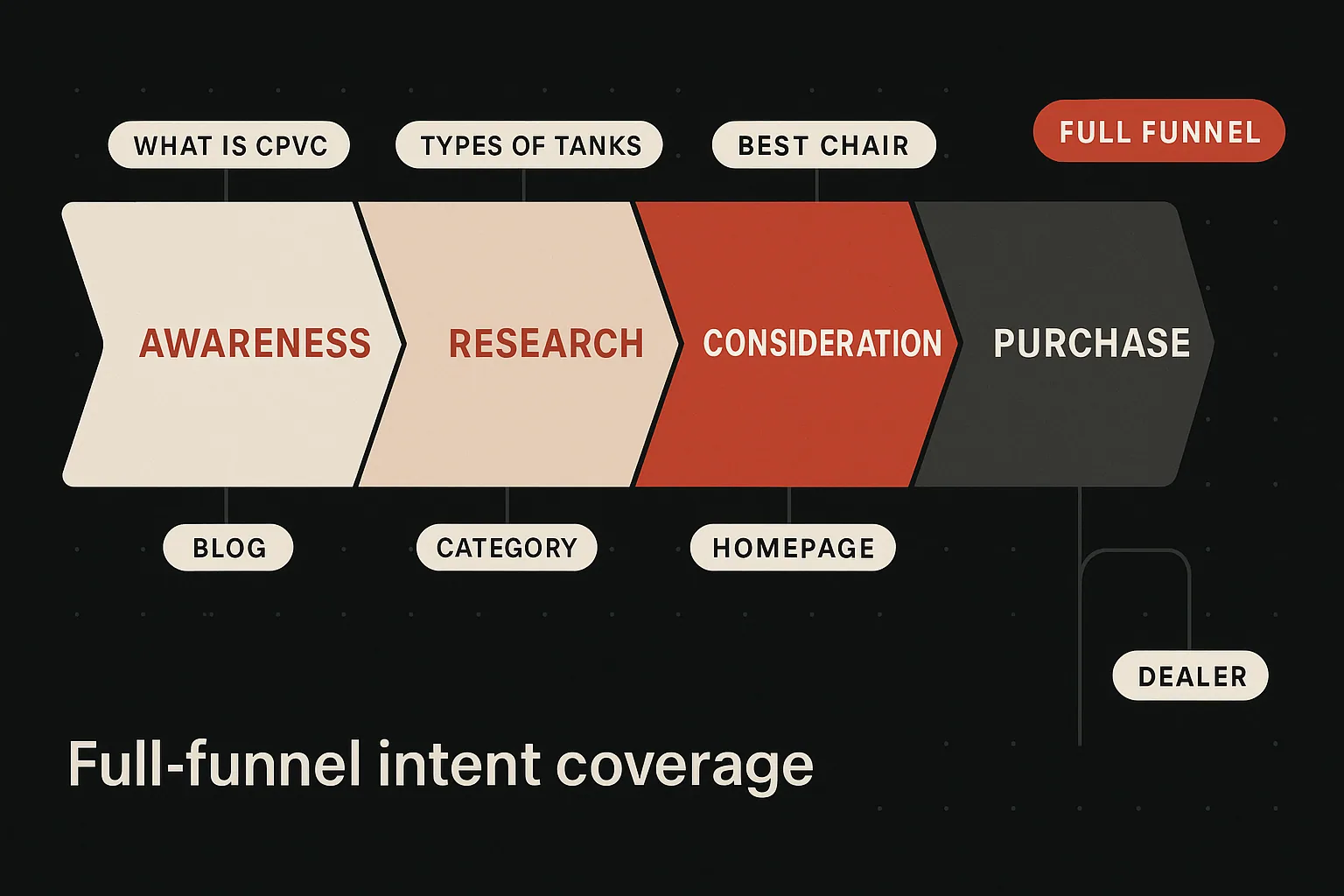
Full-funnel intent coverage, from awareness through dealer discovery.
Ranking Factor #4: Manufacturing Authority as an SEO Asset
Here is where Supreme separates itself from the marketplaces and pure-play retailers it shares SERPs with. Amazon, Flipkart, IndiaMart and Meesho can list a plastic chair — but they cannot credibly be a manufacturer with five decades of infrastructure behind the listing. Supreme can, and it has wired that credibility directly into its site.
The trust architecture
Supreme maintains a dedicated corporate cluster that signals exactly the kind of entity Google's quality systems are built to reward:
/overviewand/milestones— decades of operating history, establishing the brand as an established entity rather than a thin affiliate./group-locations— the physical manufacturing footprint, plant by plant. Real-world operational presence is a powerful trust signal in an era where Google is increasingly skeptical of sites that have no verifiable existence./sustainability,/csr,/supreme-impact— governance and responsibility content that maps to the "trustworthiness" leg of Google's experience-expertise-authority-trust framework./investor— a full investor-relations section with annual reports, presentations, and disclosures. This is among the strongest authority signals a site can carry: a publicly-listed company's financial transparency, externally validated and frequently cited./careers— an active hiring presence, another marker of a real, operating organisation.
The schema layer
A look at the homepage source confirms Supreme is explicitly declaring its identity to search engines through structured data, implementing Organization, Brand, WebSite, SearchAction, and ContactPoint schema. The SearchAction markup positions the site for a sitelinks search box; the Organization and Brand markup feed Google's Knowledge Graph the canonical facts about who Supreme is. This is the on-page mechanism by which a manufacturer tells Google "I am a real, branded entity" — and Supreme has it dialed in. (Schema, internal linking, and crawlability all sit inside technical SEO — the layer Supreme has clearly invested in and most of its competitors haven't.)
Why these signals strengthen rankings
In commercial and especially YMYL-adjacent categories — and "what water tank should I install in my home" sits closer to that line than it looks — Google leans heavily on entity trust. When two pages are otherwise comparable, the one published by a verifiable, established, transparent manufacturer with investor disclosures and a physical plant network will tend to win.
Supreme's competitors in the SERPs fall into two camps: marketplaces (which have authority but no manufacturing credibility for any specific product) and smaller specialists (which may have product focus but lack Supreme's corporate depth). Supreme is the rare entity that is both a credible manufacturer and a transparent, listed, well-documented organisation. That combination is an authority signal competitors structurally cannot fabricate — you can't noindex your way to fifty years of plants and audited financials.
This is the quiet reason Supreme holds rankings against far larger domains. Google is likely treating the entity itself as a trust anchor, and every commercial page inherits a share of that trust.
Ranking Factor #5: Topic Cluster Expansion
Supreme doesn't rank in one topic. It ranks across eight loosely-connected but individually deep topical territories — and the breadth itself has become a moat.
The topic map
                    SUPREME TOPICAL TERRITORY
        ┌──────────────────────────────────────────────┐
        │                                                │
   ┌────▼─────┐  ┌──────────┐  ┌──────────┐  ┌──────────▼┐
   │  PIPING  │  │ FURNITURE│  │ MATERIAL │  │PROTECTIVE │
   │ & WATER  │  │          │  │ HANDLING │  │ PACKAGING │
   ├──────────┤  ├──────────┤  ├──────────┤  ├───────────┤
   │ PVC pipe │  │ chairs   │  │ crates   │  │ foam mat  │
   │ CPVC     │  │ tables   │  │ pallets  │  │ EPE foam  │
   │ water tk │  │ storage  │  │ bins     │  │ interlock │
   │ conduit  │  │ stools   │  │ trolleys │  │ mats      │
   │ plumbing │  │ dining   │  │ dustbins │  │           │
   │ drainage │  │ office   │  │          │  │           │
   └──────────┘  └──────────┘  └──────────┘  └───────────┘
   ┌──────────┐  ┌──────────┐  ┌──────────┐  ┌───────────┐
   │  FILMS / │  │SPECIALTY │  │INDUSTRIAL│  │ COMPOSITE │
   │   XF     │  │  FILMS   │  │ PRODUCTS │  │ CYLINDERS │
   ├──────────┤  ├──────────┤  ├──────────┤  ├───────────┤
   │ tarpaulin│  │ films    │  │ moulded  │  │ LPG       │
   │ cross-lam│  │ packaging│  │ components│ │ composite │
   └──────────┘  └──────────┘  └──────────┘  └───────────┘
Each of these is its own keyword ecosystem with its own head terms, its own long tail, and its own SERP competitors. Supreme ranks meaningfully in all of them.
How topical authority accumulates
Topical authority isn't a single page ranking — it's Google's accumulated confidence that a domain is a legitimate, comprehensive source on a subject. Supreme builds it the hard way, and the right way: by covering a topic exhaustively through the division → category → product hierarchy, then reinforcing it with supporting blog content.
Take piping. Supreme doesn't just have a "pipes" page. It has the division hub, category facets for plumbing, drainage, water tanks, agriculture, and electrical conduits, specific product lines (the named CPVC, the underground drainage system, the inspection chambers, the overhead tanks), and blog explainers like the CPVC guide. To Google, that pattern reads as comprehensive subject ownership — the domain answers the head term, the sub-categories, the products, and the questions. That breadth-plus-depth is what earns the category-level trust that lifts every page in the cluster.
Why breadth is itself a moat
A single-category specialist — say, a pipes-only brand — can match Supreme inside one topic with enough effort. But Supreme is defending eight topics at once, each with the same architectural rigor. A competitor would have to out-execute Supreme not in one vertical but across furniture and piping and material handling and packaging and cylinders — verticals that don't even share the same buyers. Almost no one has the product range to attempt it, and the few who do (large conglomerates) rarely have the architectural discipline.
The breadth also produces a subtler benefit: cross-topic entity reinforcement. Every division strengthens the domain's overall authority, and that domain-level authority flows back down into every individual page. A new furniture product launches into a domain Google already trusts deeply — so it ranks faster than a standalone furniture brand's equivalent page ever could.
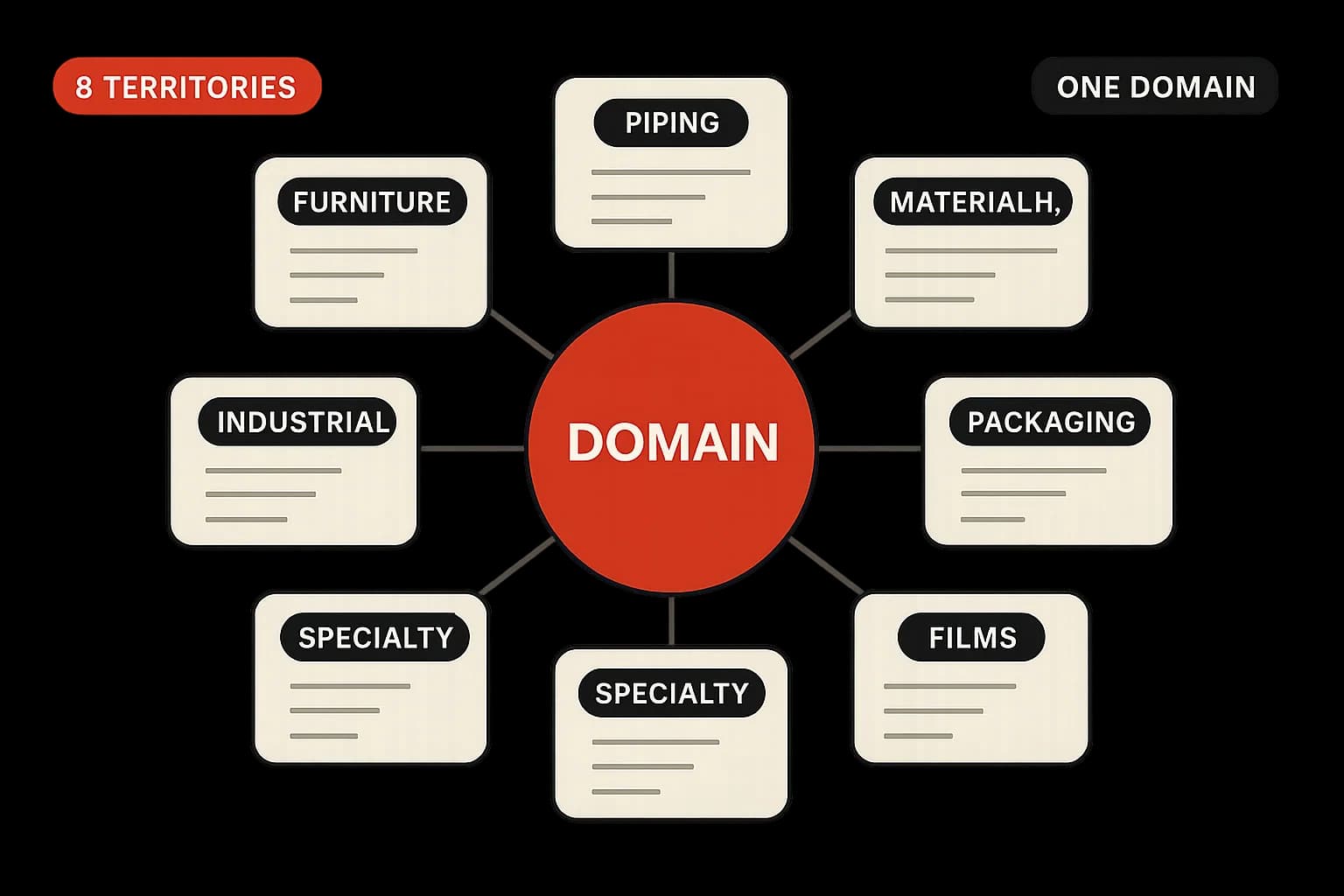
Eight topical territories under one domain — breadth that compounds into authority.
Ranking Factor #6: Internal Linking and Authority Distribution
Authority enters a site through links and the brand entity. What determines rankings is how that authority is distributed internally — and Supreme's link architecture is built to push equity exactly where the commercial value sits.
The authority flow
                 HOMEPAGE  (1,440 kw, ~41K visits)
                 strongest authority node
                        │
        ┌───────────────┼────────────────┐
        ▼               ▼                 ▼
   DIVISION HUBS    DIVISION HUBS     DIVISION HUBS
   /pipe (40.9K)    /furniture        /mhd /ppd /xf...
        │               │                 │
        ▼               ▼                 ▼
   CATEGORY        CATEGORY          CATEGORY
   FACETS          PAGES             PAGES
   (water-tanks    (seatings 45K,    (crates 9.2K)
    51.9K)          table, storage)
        │               │                 │
        ▼               ▼                 ▼
   PRODUCT         PRODUCT           PRODUCT
   PAGES           PAGES (~1,600)    PAGES
        │               │                 │
        └───────────────┴── link UP ──────┘
              (products reinforce categories)
What the data reveals about the flow
The homepage is the strongest single node — ranking for ~1,440 keywords itself — and it passes authority down to the eight division hubs through primary navigation. The /pipe hub alone ranks for ~1,378 keywords, meaning it functions as a secondary authority distributor inside its own division.
From the hub, equity flows to the category facets — and this is where the architecture is cleverest. The faceted category pages (water-tanks, plumbing, drainage) receive links from both directions: down from the hub and up from every product page they contain. That two-way reinforcement is why a single faceted URL can rank for 315 keywords and pull 52,000 visits. It's the most-linked commercial node in its division.
Product pages sit at the bottom but aren't dead ends. They link up to their category and across to related products, which recirculates equity back into the category surfaces rather than letting it pool uselessly on individual SKUs.
Why this distribution wins
Many large catalog sites leak authority — equity flows into thousands of product pages and gets stranded there, never recirculating to the pages that rank for valuable terms. Supreme's structure does the opposite: it deliberately concentrates equity at the category level, where the high-volume commercial terms live, while keeping the long-tail product pages connected enough to rank for their specific queries without hoarding link value.
The result is an authority gradient that mirrors the commercial-value gradient: the most link equity sits on the pages that capture the most valuable demand. That alignment between link architecture and commercial intent is the hallmark of an SEO system that was designed, not accreted.
Ranking Factor #7: The Distributor and Dealer SEO Flywheel
This is the part of Supreme's system that competitors find nearly impossible to copy — not because it's technically complex, but because it's rooted in a real-world asset that takes decades to build: a national dealer and distributor network.
The pages that capture it
Supreme runs two dedicated discovery pages that most manufacturers either don't have or bury:
/stores— a store/dealer locator that ranks for "plastic store near me" (22,200 monthly searches) and similar local-commercial queries, pulling an estimated 4,400+ visits a month on its own./become-a-dealer— a distributor-recruitment page that captures the B2B side: people searching to become a Supreme dealer, which is both a lead-generation surface and a topical-relevance signal.
Why this is a flywheel, not just a page
Here's the mechanism. Supreme has thousands of physical dealers across India. Those dealers generate three things that feed search rankings:
PHYSICAL DEALER NETWORK
        │
        ├──► Local search demand ("supreme dealer near me",
        │     "plastic store near me") → captured by /stores
        │
        ├──► Local citations & mentions (dealers list Supreme
        │     as a brand they carry across directories & maps)
        │     → distributed brand & entity signals
        │
        └──► Real-world transactions → brand searches
              ("supreme pipes", "supreme chair") → branded
              demand Google sees and rewards
                        │
                        ▼
              Stronger entity authority
                        │
                        ▼
              Better rankings on non-branded terms
                        │
                        ▼
              More buyers discover Supreme → more dealer
              sell-through → more local mentions → repeat
The dealer network manufactures the exact signals Google uses to validate a brand: local relevance, distributed citations, and branded search demand. And because those signals originate offline — in thousands of shops actually stocking and selling Supreme products — they can't be reverse-engineered by a competitor with a better content team.
The local-relevance advantage
When someone searches "plastic store near me" or a city-qualified product query, Google weighs local relevance and entity prominence. Supreme's physical distribution gives it a legitimate claim to local relevance everywhere its dealers operate — which, for a national manufacturer, is effectively the whole country. A digital-only competitor has no equivalent. They can write the content, but they can't manufacture the thousands of real-world touchpoints that tell Google "this brand is genuinely present in this market." (For brands with stores or dealers, this is the highest-leverage angle in local SEO — wiring physical footprint into search the way Supreme does.)
Why it's difficult to replicate
To copy this, a competitor would need to build a comparable physical distribution network first, then wire it into search — a multi-year, capital-intensive undertaking that has nothing to do with SEO skill. The dealer flywheel is the point where Supreme's business moat and its search moat become the same moat. The offline scale is the online defensibility.
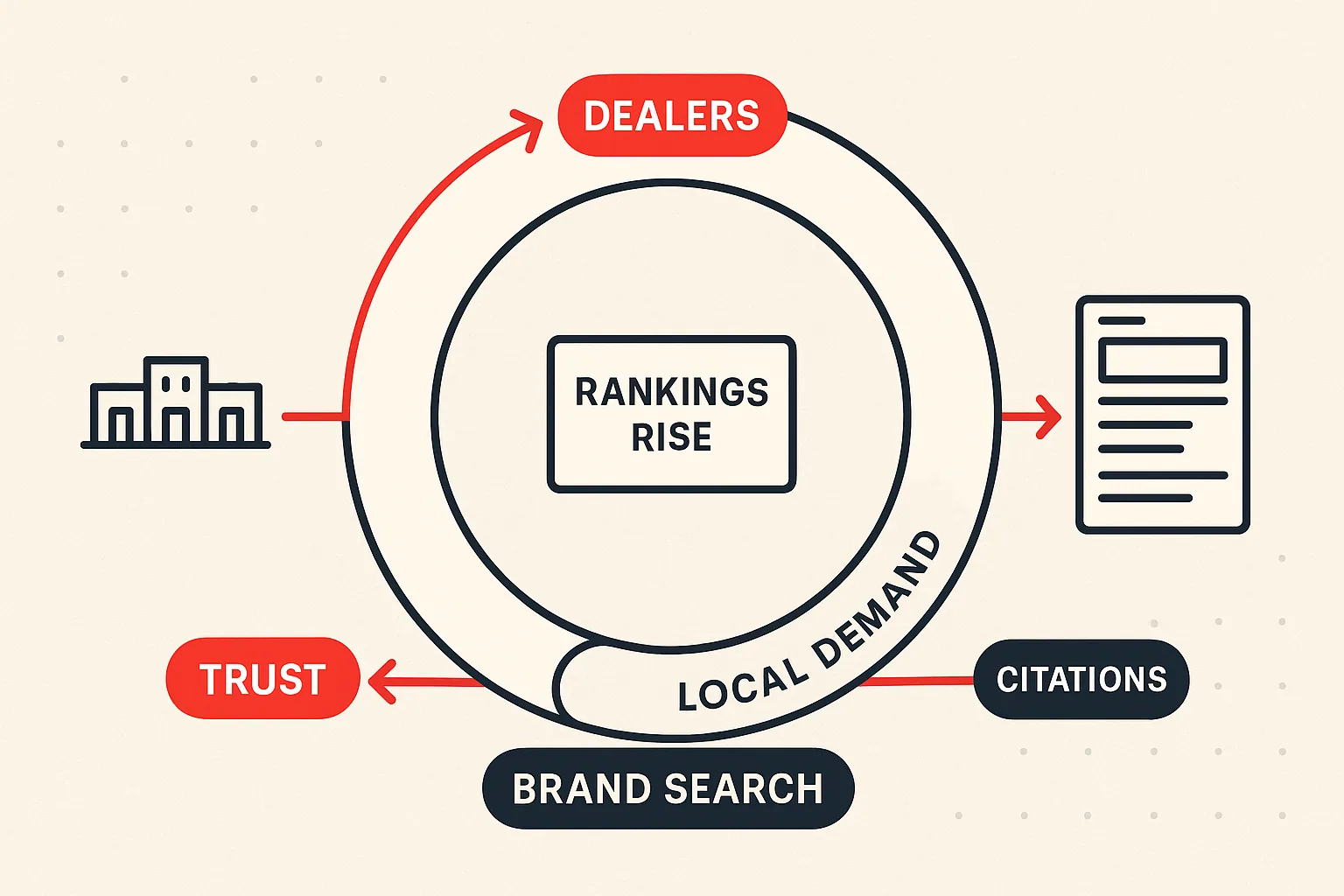
The dealer-network flywheel: offline distribution manufacturing online search signals.
Ranking Factor #8: Brand Signals and Search Authority
The brand layer is where every other factor converges into a measurable search asset.
The branded SERP
Supreme's brand terms rank exactly as a dominant entity's should:
| Branded query | Monthly volume | Position |
|---|---|---|
| supreme chair | 12,100 | 1 |
| supreme pipes | 9,900 | 1 |
| supreme industries ltd | 6,600 | 1 |
| the supreme industries limited | 8,100 | 1 |
| supreme industries | 14,800 | ~2 |
Owning position 1 for branded terms isn't impressive on its own — every brand should. What's notable is the volume of branded demand. Tens of thousands of monthly searches contain the Supreme name, and that branded search volume is itself a ranking signal: Google interprets high branded demand as evidence of a prominent, trusted entity, and that prominence spills over into non-branded rankings.
The brand-as-amplifier mechanism
There's a well-understood relationship between branded search demand and non-branded ranking strength. Brands that people actively search for tend to outrank brands they don't, even on generic terms, because search engines treat sustained branded demand as a proxy for real-world authority and user trust.
Supreme sits in a virtuous position here. Its offline scale (the dealer network, the product ubiquity, the decades of operation) generates large and stable branded search volume. That branded volume strengthens the entity in Google's eyes. The stronger entity then ranks better on the non-branded category terms — "water tank," "plastic chair," "cpvc pipe" — which drives more discovery, more purchases, and ultimately more branded search. The brand signal isn't a separate factor; it's the amplifier that makes all seven preceding factors compound.
Media and citation footprint
Supreme's status as a listed, widely-covered industrial company means its name appears across financial media, trade publications, industry directories, and investor coverage — a steady stream of unlinked and linked brand mentions that reinforce entity authority. For an industrial manufacturer, this kind of editorial and citation presence is difficult for younger or smaller competitors to match, and it continuously refreshes the trust signals that keep the commercial pages ranking.
The SEO Flywheel: How It All Compounds
Pull the eight factors together and a single self-reinforcing system emerges. This is the "aha": none of the factors is decisive alone, but wired together they form a loop where each output becomes the next input.
            THE SUPREME ORGANIC GROWTH FLYWHEEL

      ┌─────────────────────────────────────────────┐
      │                                               │
      ▼                                               │
 [1] BROAD PRODUCT RANGE                              │
     (8 divisions, thousands of SKUs)                 │
      │                                               │
      ▼                                               │
 [2] HUGE NON-BRANDED SEARCH DEMAND                   │
     (water tank, chair, pipe, crate...)              │
      │                                               │
      ▼                                               │
 [3] CATEGORY-LED RANKINGS                            │
     (architecture converts demand → top-10)          │
      │                                               │
      ▼                                               │
 [4] HIGH ORGANIC TRAFFIC (~417K/mo, near-zero PPC)   │
      │                                               │
      ▼                                               │
 [5] MORE BRAND DISCOVERY & DEALER SELL-THROUGH       │
      │                                               │
      ▼                                               │
 [6] GROWING BRANDED SEARCH + LOCAL CITATIONS         │
      │                                               │
      ▼                                               │
 [7] STRONGER ENTITY TRUST & AUTHORITY                │
      │                                               │
      ▼                                               │
 [8] MARKET LEADERSHIP → MORE PRODUCTS, MORE DEALERS ─┘
              (feeds back into [1])
Walking the loop
Product range creates the surface area. Eight divisions means Supreme has a legitimate claim to demand across dozens of category terms it would never reach as a single-category brand.
Search demand is the fuel. Those categories — water tanks, chairs, pipes — carry enormous, durable, non-branded search volume that exists whether or not Supreme does anything. The opportunity is just there.
Architecture is the conversion engine. The division → category-facet → product hierarchy, plus disciplined internal linking, converts that latent demand into top-10 rankings far more efficiently than a sprawling, unstructured catalog ever could.
Traffic is the immediate payoff — hundreds of thousands of visits a month at near-zero paid-media cost.
Discovery and sell-through turn traffic into real-world activity: more people find Supreme, more dealers move product, more transactions happen.
Branded demand and citations are generated by that real-world activity — searches for the Supreme name, mentions across directories and media, local references from dealers.
Entity trust accumulates from those branded signals, strengthening the domain's authority in Google's models.
Market leadership is the compounding output: a stronger entity ranks better, sells more, recruits more dealers, and launches more products — which expands the product range and starts the loop again, one turn stronger.
Every rotation makes the next rotation easier. That's what a moat looks like in motion: not a wall, but a wheel that's heavy enough that no competitor can match its momentum from a standing start.
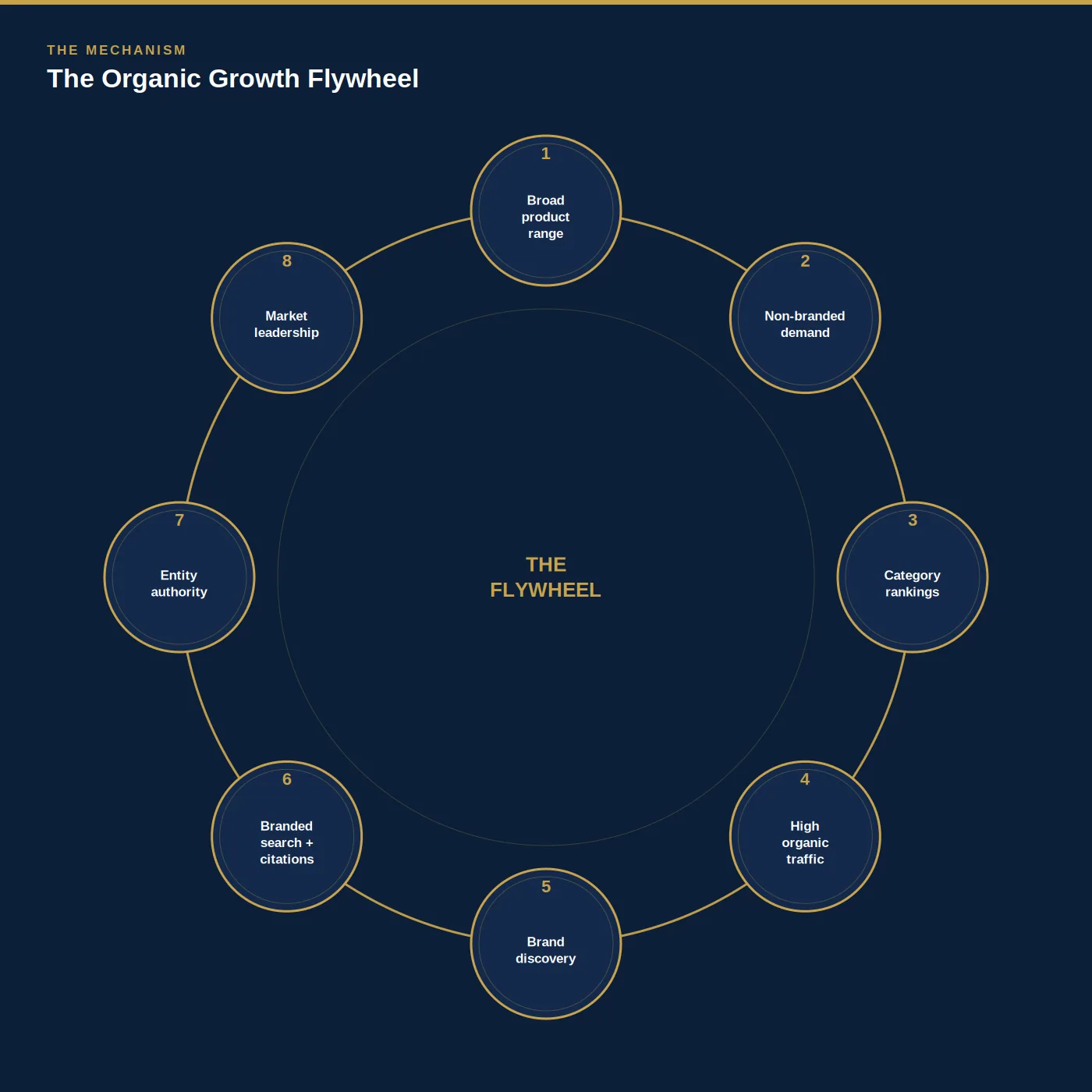
The master growth flywheel — eight stages, each output feeding the next input.
Want this kind of compounding engine for your brand? Our team has built division-level category architectures, dealer-discovery layers, and entity-trust stacks for industrial, D2C, and B2B clients across India, the US, UK and APAC. Talk to us about a teardown of your own organic footprint →
Competitive Comparison
The clearest way to see what Supreme has built is to put it next to the brands it shares SERPs with. Pulled across the same Indian Google index, the contrast is sharp.
Organic visibility, head to head
| Brand | Keywords | Top-3 | Top-10 | Est. monthly visits | Profile |
|---|---|---|---|---|---|
| Supreme | 8,109 | 689 | 2,935 | ~417,000 | Diversified manufacturer, 8 categories |
| Nilkamal | 22,422 | 3,209 | 9,503 | ~3,446,000 | Furniture + e-commerce retail |
| Sintex | 2,535 | 769 | 1,304 | ~661,000 | Water-tank specialist |
| Plasto | 1,535 | 247 | 618 | ~226,000 | Water-tank specialist |
| Astral | 2,913 | 357 | 953 | ~217,000 | Piping specialist |
| Finolex | 2,082 | 396 | 907 | ~155,000 | Piping specialist |
| Prince Pipes | 2,451 | 291 | 808 | ~107,000 | Piping specialist |
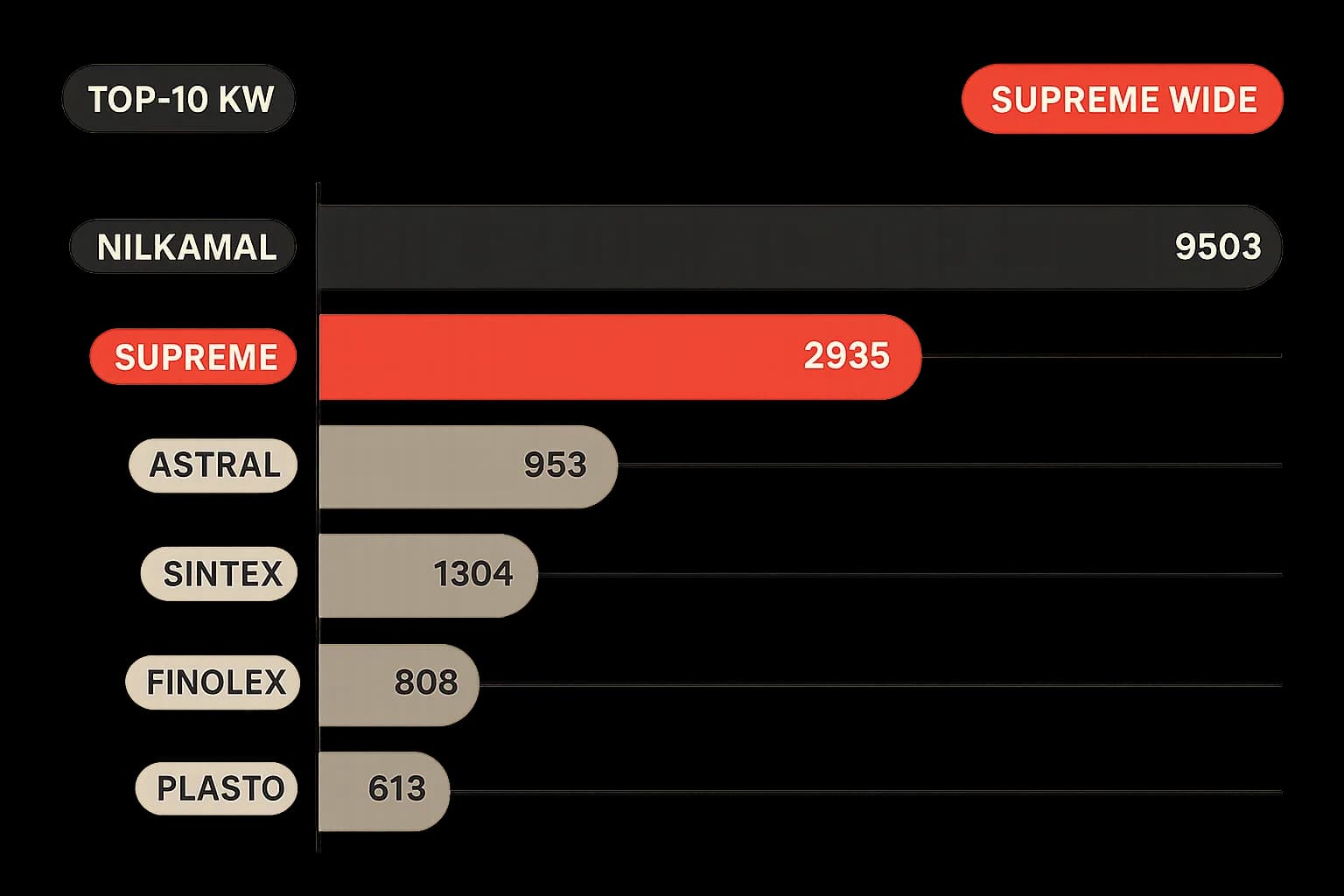
Page-one (Top-10) keyword visibility across the competitive set. Supreme leads the diversified manufacturers; Nilkamal's volume is retail-driven and Sintex's strength is concentrated in a single category.
Reading the table correctly
Two numbers look like they beat Supreme — Nilkamal's traffic and Sintex's top-3 count — and both deserve a caveat that actually reinforces Supreme's position.
Nilkamal shows far higher traffic, but it operates a transactional e-commerce storefront with thousands of purchasable SKUs and the long-tail product-query footprint that comes with running an online shop. It's competing as a retailer, not purely as a manufacturer. On a like-for-like manufacturer basis, Supreme's footprint is built on category authority rather than checkout pages — a more defensible foundation that doesn't depend on price competitiveness against Amazon.
Sintex posts more top-3 rankings, but they're concentrated almost entirely in one category: water tanks, where Sintex is the historical category leader. That's depth in a single vertical. The moment you widen the lens beyond tanks, Sintex has nothing — no furniture, no material handling, no cylinders, no films.
And that's the whole point. Against each individual specialist, Supreme may not be #1 in that specialist's home turf — Sintex edges it on tanks, Nilkamal on chairs, Astral on certain pipe terms. But Supreme is present and competitive in all of their territories simultaneously, while none of them can touch the other seven divisions.
The breadth differential
| Capability | Supreme | Piping specialists (Astral/Finolex/Prince) | Sintex/Plasto | Nilkamal |
|---|---|---|---|---|
| Piping & water | ✅ | ✅ | partial (tanks) | ❌ |
| Furniture | ✅ | ❌ | ❌ | ✅ |
| Material handling | ✅ | ❌ | ❌ | partial |
| Protective packaging | ✅ | ❌ | ❌ | ❌ |
| Films / cross-laminated | ✅ | ❌ | ❌ | ❌ |
| Composite cylinders | ✅ | ❌ | ❌ | ❌ |
| Corporate/investor trust layer | ✅ | ✅ | partial | ✅ |
| Dealer-discovery SEO layer | ✅ | partial | ❌ | partial |
No competitor checks more than three or four boxes. Supreme checks all eight. The specialists win narrow; Supreme wins wide — and width, across uncorrelated categories, is the thing that can't be matched without becoming a different company.
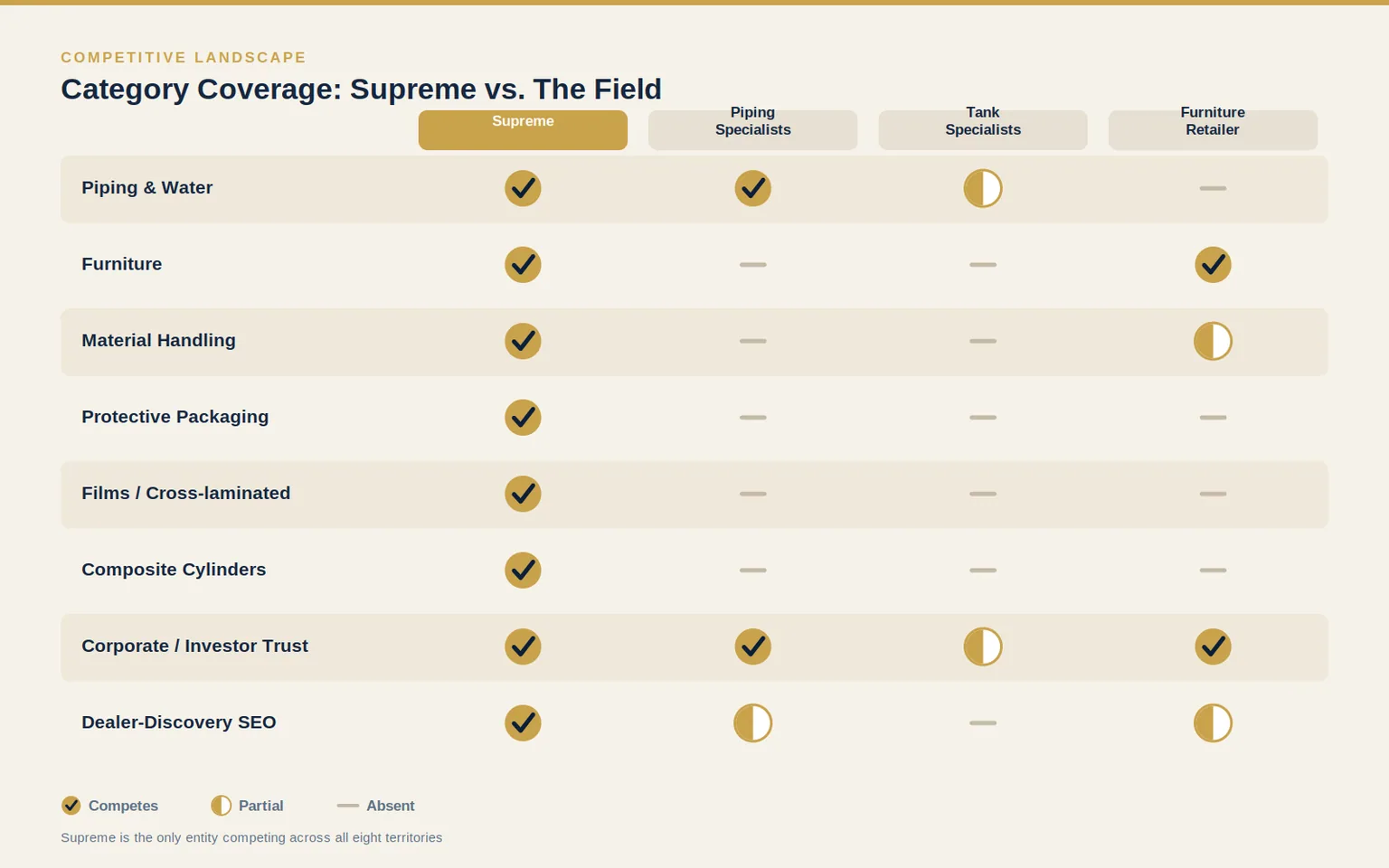
Category coverage: Supreme competes across all eight territories; specialists do not.
The SEO Moat
Pull every observation together and the defensibility resolves into eight reinforcing layers — a moat that has to be crossed all at once, not one plank at a time.
1. Brand authority. Tens of thousands of monthly branded searches and a listed-company media footprint give Supreme an entity-trust advantage that smaller competitors cannot manufacture quickly. Brand demand is the amplifier that lifts every non-branded ranking.
2. Product breadth. Eight uncorrelated divisions mean a challenger would have to win furniture and piping and packaging and cylinders — categories with different buyers, different SERPs, and different competitors. The breadth isn't just coverage; it's a requirement that no single specialist can meet.
3. Content and architectural depth. Where demand is fragmented (furniture, ~1,600 URLs), Supreme goes deep; where it's consolidated (piping, ~80 URLs), it goes lean and category-led. Matching structure to demand shape, division by division, is execution discipline that took years to refine.
4. Topic ownership. Comprehensive division → category → product → blog coverage in each vertical accumulates category-level topical authority that lifts every page in the cluster and lets new pages rank fast.
5. Trust signals. The corporate, sustainability, governance, and investor layers — plus Organization/Brand schema — give Google exactly the entity-validation evidence its quality systems reward, and they're backed by real plants and audited financials that can't be faked.
6. Infrastructure as authority. The physical manufacturing footprint and group-locations content convert real-world operational scale into on-page trust signals. The business moat and the search moat are the same asset.
7. Industry presence. Media coverage, trade citations, and directory listings continuously refresh entity authority, and the dealer network distributes brand and local signals across the entire country.
8. Captured search demand. Supreme doesn't depend on creating demand; it sits on top of the durable, high-volume, non-branded demand that already exists for tanks, chairs, pipes, and crates — and its architecture converts that demand into top-10 rankings at near-zero paid cost.
Why the moat holds
The defensibility comes from the interlock. A competitor could, with enough effort, match any single layer — build a deep furniture catalog, or publish strong investor content, or write better pipe explainers. But to actually outrank Supreme system-wide, they'd have to match all eight simultaneously: the breadth, the architecture, the topical depth, the trust signals, the physical network, the brand demand, and the captured intent — and keep them reinforcing each other through the flywheel. That's not an SEO project. That's rebuilding Supreme.
The most durable moats in search aren't built from links or content alone. They're built when a company's real-world structure — its products, its plants, its dealers, its decades — is mirrored faithfully into its site architecture, so that every offline advantage becomes an online one. Supreme has done exactly that, and it's why the rankings have held even as the footprint was deliberately pruned by nearly two-thirds.
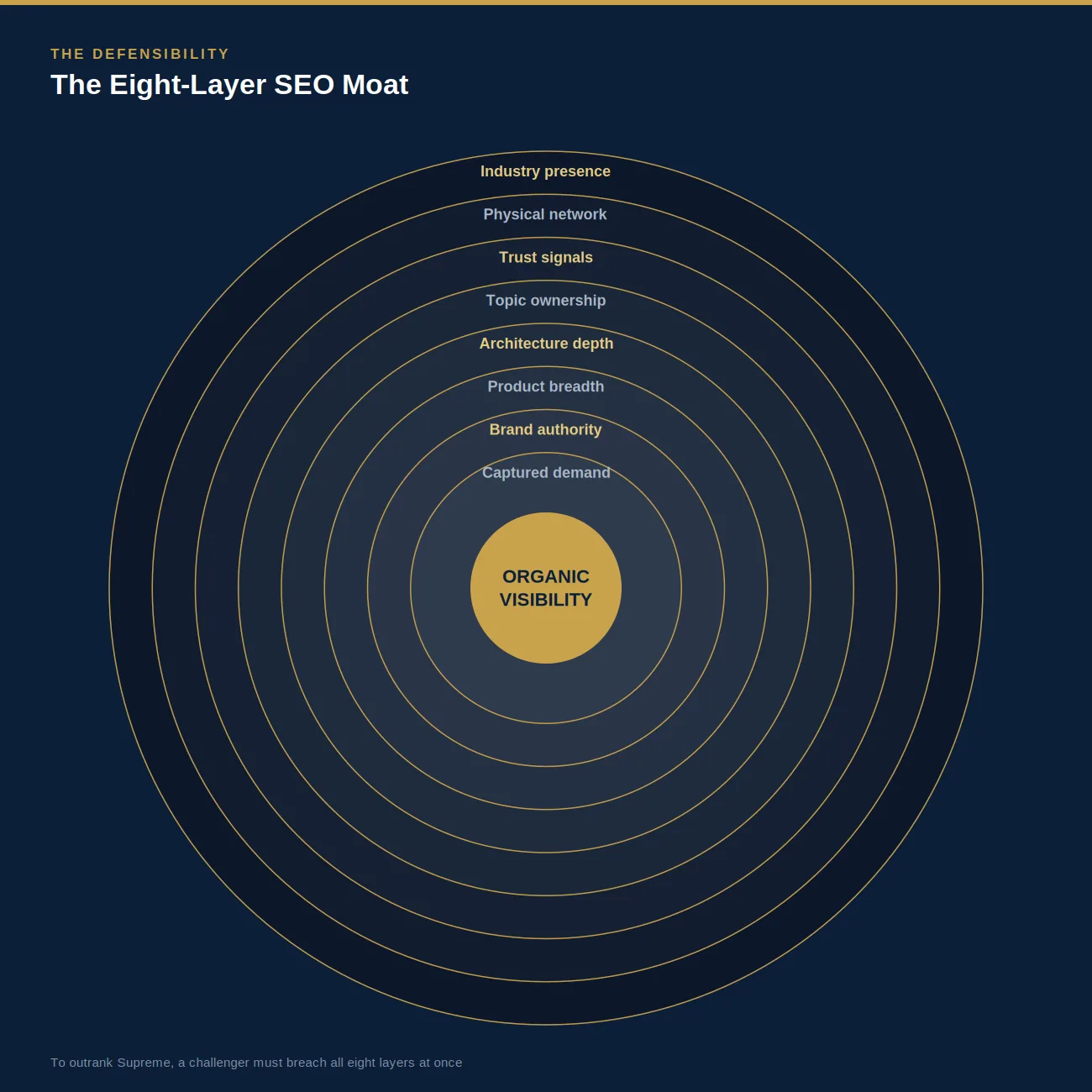
The eight-layer moat — a challenger must breach every layer simultaneously.
Key Lessons for Manufacturing Brands
Every lesson below is tied directly to something observable in Supreme's system — not generic best practice, but the specific moves that produced the results above.
1. Make your category facets first-class, indexable pages. Supreme's single highest-traffic URL is a faceted category page (?pipe_categories=water-tanks). The instinct to noindex faceted navigation throws away the exact surfaces that absorb head-term demand. Identify the category facets that map to real search clusters, give them clean stable URLs, and build them to be the best answer to the broad category query.
2. Match architecture to demand shape, not to a house style. Supreme runs lean where demand is consolidated (piping) and deep where it's fragmented (furniture). Before deciding "we'll publish lots of pages" or "we'll keep it minimal," map the demand curve of each category. Consolidated demand rewards a few powerful category surfaces; fragmented demand rewards product depth. Applying one philosophy everywhere wastes the categories that needed the other.
3. Build the category layer before the product layer. Supreme's category pages out-earn its product pages because category pages match the broad, high-volume, undecided queries where the volume actually is. Most manufacturers over-invest in product pages and under-invest in the category surfaces that capture the searcher before they've chosen a model.
4. Treat your corporate trust pages as ranking infrastructure, not compliance. The investor section, sustainability content, plant locations, and milestones aren't just for stakeholders — they're entity-trust signals that lift commercial rankings. Implement Organization and Brand schema, publish your real-world footprint, and make your operational legitimacy machine-readable.
5. Build a dealer-discovery layer. A store locator and a become-a-dealer page convert local commercial intent ("plastic store near me") and B2B recruitment demand into captured traffic — and they wire your physical distribution into your search presence. If you have a dealer network and no pages capturing local intent, you're leaving your single most defensible advantage off the website.
6. Let breadth compound into a moat. Each new category Supreme covers strengthens the whole domain's authority, which flows back into every existing page. If you operate across multiple product lines, structure them as parallel division hubs under one strong domain rather than splitting them across microsites — the consolidated authority is worth more than the focus.
7. Cover the full funnel, especially the top. Supreme's blog explainers capture awareness-stage searchers who later convert, and feed topical relevance into the commercial pages. A manufacturer that only publishes product pages is invisible until the moment of purchase — and increasingly absent from AI Overviews, which pull heavily from explanatory content.
8. Engineer for branded demand, then let it amplify. Supreme's offline scale generates branded search volume, which strengthens the entity, which lifts non-branded rankings. You can't fake this, but you can feed it: consistent brand presence, real distribution, and media visibility all convert into the branded-search signal that amplifies everything else.
9. Prune without fear when the data supports it. Supreme cut its tracked footprint by roughly two-thirds over six months while its top-3 rankings rose and traffic held flat. A bloated long tail of position-80 pages isn't an asset. Concentrating authority on the pages that can actually rank is often worth more than the keyword count you lose.
Final Thoughts: The System in One Sentence
Strip away the eight divisions, the faceted URLs, the schema, the dealer pages, the investor section, and the topic clusters, and Supreme's entire organic advantage reduces to a single principle:
Supreme built a search system that mirrors its business — so every real-world advantage it has becomes a ranking advantage it keeps.
That's why it ranks so strongly. The product breadth becomes keyword breadth. The category leadership becomes category-page dominance. The manufacturing scale becomes entity trust. The dealer network becomes local relevance and branded demand. The decades of operation become the kind of established-entity authority that Google's quality systems are built to reward. None of it is borrowed; all of it is structural.
Of the ranking factors examined, three carry the most weight. Category-led architecture is the engine — it's what converts latent demand into top-10 rankings at scale. Entity trust, manufactured from real corporate substance and made machine-readable through schema, is what holds those rankings against far larger domains. And the dealer flywheel is what makes the whole thing self-reinforcing and impossible to copy, because it ties the search moat to a physical-distribution moat that took half a century to build.
Their biggest competitive advantage is the one competitors can see clearly and still can't replicate: breadth that interlocks. Anyone can win a single category with enough focus. Supreme wins eight at once, and each victory makes the next one cheaper. The flywheel turns, the entity strengthens, the rankings compound — and the gap between Supreme and the field widens a little more with every rotation.
That is the difference between a website that ranks and a system that dominates. Most manufacturing brands have a website. Supreme built a system. And systems, unlike websites, only get harder to beat with time.
Want a System Like This for Your Brand?
You don't need Supreme's plant network, fifty years of operation, or eight divisions to apply the playbook. You need the same architectural discipline applied to the demand curve sitting in front of your business.
That is what we build for clients at Nico Digital. We map the real shape of category, comparison, and dealer-intent demand in your vertical; we engineer the division → category → product hierarchy (or its analogue) so that authority concentrates where the commercial value sits; and we wire trust, schema, internal linking, and local-intent surfaces into the same system rather than running them as separate workstreams.
If you want a teardown of your own organic footprint — what's leaking, what's hiding, and what a Supreme-style architecture would look like translated to your industry — we'd be glad to run it.
- Industrial / B2B manufacturers — see how we engineer category dominance in enterprise SEO and B2B verticals.
- E-commerce / D2C brands — ecommerce SEO plus D2C playbooks for fragmented category demand.
- Need a Supreme-style site rebuild — start with a technical SEO audit and an architectural pass from a senior SEO consultant.
- Just want to talk to a human first — book a 30-minute strategy call and we'll diagnose the biggest organic lever in your business on the call.

Aditya Kathotia
Founder & CEO
CEO of Nico Digital and founder of Digital Polo, Aditya Kathotia is a trailblazer in digital marketing. He's powered 500+ brands through transformative strategies, enabling clients worldwide to grow revenue exponentially. Aditya's work has been featured on Entrepreneur, Economic Times, Hubspot, Business.com, Clutch, and more. Join Aditya Kathotia's orbit on LinkedIn to gain exclusive access to his treasure trove of niche-specific marketing secrets and insights.