

Gen Z is now the largest generation on earth, with significant purchasing power either directly or through influence over household and family spending decisions.
Most marketing strategies built to reach them are still operating on surface-level observations - be authentic, use short-form video, care about sustainability - without understanding the underlying dynamics that make those observations true or how to operationalize them in ways that actually drive revenue.
This piece goes deeper than the standard generational marketing playbook. The goal is not to hand you a list of tactics. It is to build the mental model that lets you make better decisions about where and how to invest in reaching this audience, and what the real trade-offs look like.

Who Gen Z Actually Is - Beyond the Demographics
Gen Z broadly refers to people born between the mid-1990s and early 2010s, making the oldest members of this cohort now in their late twenties and the youngest still in secondary school.
The range matters commercially: a 26-year-old with a career and disposable income behaves differently as a buyer than a 16-year-old navigating their first purchases. Treating Gen Z as a monolithic audience produces campaigns that resonate with no one specifically.
What unifies the cohort is not age - it is formative experience.
Gen Z grew up with smartphones as a given rather than a new technology, with social media as ambient infrastructure rather than a novel channel, and with economic uncertainty (the 2008 financial crisis, COVID-19, housing affordability) as a persistent background condition rather than an interruption.
Those experiences shape values and behavior in ways that generational labeling tends to flatten.
A few dynamics worth understanding at depth:
Digital nativity changes the trust calculus.
Growing up with algorithmic content, targeted advertising, and influencer marketing as the baseline - rather than something new - produces a high degree of fluency with how brands operate online. Gen Z audiences are not necessarily more cynical than previous generations. They are better informed about the mechanics of brand communication. They know when they are being sold to, they recognize the difference between a genuine brand perspective and marketing copy dressed as a point of view, and they make decisions accordingly.
The economics of attention are different.
The average number of platforms Gen Z uses regularly is higher than any previous generation, and the content consumption within those platforms is faster-paced and higher-volume. This is not primarily an "attention span" problem - it is a prioritization problem.
Content that does not immediately signal relevance gets scrolled past, not because the viewer lacks patience, but because there is always something else equally available. The implication for brands is that the entry point of any piece of content needs to earn engagement within the first few seconds, not build toward it.
Values as a filter, not a campaign.
Gen Z's alignment with issues like environmental sustainability, social justice, and brand ethics is real - but it is commonly misunderstood as a marketing opportunity rather than a baseline expectation. Brands that "support" a cause as a campaign strategy are reliably identified and criticized.
Brands that have organizational practices that genuinely align with stated values tend to retain Gen Z customers. The distinction is between performance and evidence.
The Channels: What Is Actually Working and Why
Platform selection for Gen Z marketing is not static, and the specific platforms that dominate usage shift faster than most brand strategy cycles.
The more durable question is: which types of environments does this audience trust, and what content formats drive genuine engagement rather than passive exposure?
Short-form Video Is the Default Medium
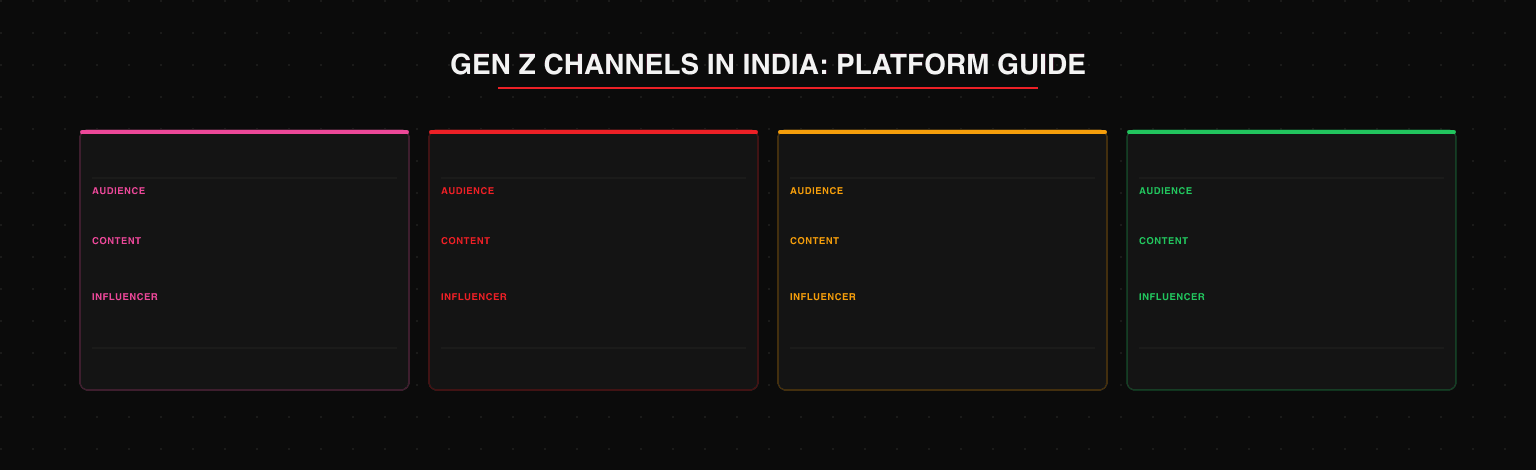
Instagram Reels and YouTube Shorts have established short-form vertical video as the consumption norm for mobile-first Gen Z audiences in India. Moj and Josh serve regional language audiences - particularly in tier-2 and tier-3 cities - and have built substantial Gen Z user bases among vernacular content consumers.
A note specific to India: TikTok has been banned in India since June 2020. Any marketing strategy referencing TikTok for Indian audiences is factually incorrect and will undermine your credibility with the Indian Gen Z audience it claims to address. The short-form video landscape in India is Instagram Reels, YouTube Shorts, Moj, and Josh - not TikTok.
A well-defined content marketing strategy that accounts for these format realities will map content types to the platforms where Gen Z actually spends their attention, rather than retrofitting existing long-form assets into short-form contexts.
What makes short-form video work for this audience is not just brevity. It is the combination of low production pretension and high creative specificity.
Overproduced brand videos with obvious advertising intent perform consistently worse than content that matches the aesthetic and pace of organic creator content.
The practical implication: Invest in understanding the specific content culture of the platform before investing in production. What works on Instagram Reels from a format and tone perspective is meaningfully different from what works on YouTube Shorts or Moj. Applying a single creative to all platforms and expecting equivalent results misunderstands each channel.
Influencer Marketing: The Quality Problem and How to Solve It
Influencer marketing to Gen Z is well-established enough that the standard playbook no longer produces standard results.
Large-follower celebrity influencers generate awareness metrics without necessarily producing purchase behavior, and Gen Z audiences are generally better than older cohorts at distinguishing genuine product enthusiasm from paid placement.
What works more reliably: mid-tier and micro-creator partnerships where the influencer has a genuinely specific audience and a track record of authentic product engagement, rather than broad reach and high production value.
The evaluation criteria that matter:
- audience specificity (does this creator's audience match your target customer?),
- engagement quality (are followers interacting with commentary and questions, or just liking passively?), and
- content authenticity (does sponsored content feel consistent with the creator's organic voice?).
Follower count is a secondary metric at best.
One non-obvious consideration: the most effective influencer relationships with Gen Z are often long-term rather than one-off campaign placements. A single sponsored post reads as advertising. A creator who has used and discussed your product across multiple months reads as a recommendation.
Social Commerce and The Collapsing Purchase Journey
Brands that want to engage Gen Z where they spend the most time should treat social media marketing India as a core acquisition channel rather than a secondary awareness layer.
The distance between content discovery and purchase has shortened significantly for Gen Z. Native shopping features on Instagram and Pinterest mean that the traditional funnel - discovery, consideration, website visit, purchase - is increasingly compressed into a single session or even a single post. For D2C brands in particular, this has meaningful implications for how product content is structured.
Content that serves a dual purpose - entertainment or information value that also communicates what makes a product worth buying - outperforms pure brand advertising and pure product photography.
Authenticity: What It Actually Means Operationally
"Be authentic" is the most frequently repeated advice in Gen Z marketing and the most frequently misapplied. The reason is that authenticity is treated as a tone choice rather than an organizational practice.
Authentic communication with Gen Z is not primarily about how your brand sounds. It is about whether what you say is verifiable and consistent with what you do.
A brand claiming sustainability credentials while operating supply chains with documented labor violations does not have an authenticity problem - it has a credibility problem that no marketing tone can resolve. A brand with genuinely sustainable practices that communicates about them plainly, acknowledges the areas where it is still improving, and provides verifiable evidence for its claims does not need to optimize for sounding authentic. The substance creates the perception.
What authentic communication looks like in practice:
- specificity over generality ("we use recycled materials in 78% of our packaging" rather than "we care about the planet"),
- acknowledgment of limits ("we are working toward X and here is where we are now" rather than claiming goals as current achievements), and
- willingness to engage with criticism directly rather than through carefully managed PR responses.
User-Generated Content as Trust Infrastructure
One of the most consistent findings across Gen Z marketing research is that peer recommendations and user-generated content significantly outperform brand-produced content on purchase influence.
Building systems that generate, collect, and amplify genuine customer content is a higher-leverage investment than most brand content production budgets.
The practical mechanisms:
- post-purchase follow-up sequences that make sharing easy and rewarding,
- hashtag architecture that organizes organic content into discoverable streams, and
- community spaces where customers engage with each other rather than just with the brand.
The brand's role in these systems is facilitating and amplifying, not producing.
Digital Experience: The Must-Invest Conversion Layer
Gen Z forms judgments about brands based on digital experience quality at a higher rate than any previous generation. This is not about aesthetic preference - it is a functional expectation.
A slow-loading mobile experience, a confusing checkout flow, or a customer service interaction that requires significant friction to resolve a simple issue produces brand perception damage that advertising spend cannot easily offset.
Mobile optimization is the baseline expectation, not a differentiating feature.
Over 70% of Gen Z purchase journeys involve a mobile touchpoint, and the expectation is that the experience is as seamless on mobile as on desktop.
The investment priority that most brands underweight: post-purchase experience. Gen Z customers who have a positive post-purchase experience - fast shipping, easy returns, proactive communication, responsive customer service - are significantly more likely to become repeat purchasers and to generate organic advocacy.
Augmented reality and interactive product experiences have moved from novelty to expectation in certain categories like beauty, apparel, and footwear.
What Gen Z Values From Brands: Sustainability and Social Responsibility
Environmental and social issues are genuine purchase drivers for Gen Z - but the relationship is more nuanced than "support sustainability to win Gen Z customers."
The failure mode that produces the most brand damage: vague sustainability claims or cause-marketing campaigns that are proportionally small relative to the brand's actual environmental footprint. "We planted 10,000 trees," from a company with a large carbon footprint, reads as greenwashing.
The approach that builds genuine brand equity:
- being specific about what you are actually doing,
- honest about where you are in the process, and
- transparent about the trade-offs involved.
Companies that acknowledge complexity - "transitioning our supply chain fully takes time, and here is what we have accomplished in year one of a five-year roadmap" - are perceived as more trustworthy than companies claiming to have solved sustainability.
Apple's approach is instructive because of the underlying substance: they published detailed data on their progress, set specific targets with measurable milestones, and acknowledged areas where they had not yet achieved their goals. Indian brands can apply this model too - the principle is transparency, not the size of your sustainability program.
Reaching Gen Z in Tier-2 and Tier-3 Indian Cities
Urban Gen Z marketing receives most of the attention, but a significant and growing portion of India's Gen Z population lives in tier-2 and tier-3 cities - and they have distinct characteristics that brands often overlook.
Platform preferences differ. YouTube Shorts and Moj have higher penetration relative to Instagram Reels in tier-2/3 markets. Josh has a strong presence among vernacular-language Gen Z audiences. WhatsApp status updates are a meaningful content discovery channel in these markets.
Vernacular content is not optional. Gen Z in Kanpur, Bhopal, Coimbatore, or Kochi may understand English but engages more deeply with content in Hindi, Tamil, or other regional languages. Brands that produce vernacular short-form content - not just translated text, but genuinely vernacular-first content - build stronger connections than those who simply add Hindi subtitles to English videos.
Price sensitivity is higher, but value consciousness is also higher. Tier-2/3 Gen Z shoppers are not simply looking for the cheapest option - they are looking for verifiable value. Detailed product reviews, comparison content, and transparent pricing communicate value more effectively than aspirational lifestyle advertising.
Trust signals differ. For tier-2/3 Gen Z, peer recommendations in their own social networks - friends, family, local community groups - carry more weight than macro-influencers. Micro-influencers with a local following in a specific city can be more effective than national creators.
Gaming and Esports as a Marketing Channel for Gen Z in India
The gaming and esports market in India is a significant Gen Z marketing channel that most brand strategies completely overlook.
The scale is real. India has over 500 million mobile gamers, with Gen Z representing the largest segment. Games like Battlegrounds Mobile India (BGMI), Free Fire, Valorant, and mobile casual games collectively capture enormous amounts of Gen Z attention time - often more time than social media platforms.
Marketing channels within gaming:
- In-game advertising: Direct advertising placements within mobile games, available through platforms like InMobi and Google Ads gaming formats
- Esports sponsorship: BGMI and Free Fire competitive scenes have significant viewership on YouTube and Rooter; brand sponsorships of esports teams and tournaments reach highly engaged Gen Z audiences
- Creator partnerships: Gaming content creators on YouTube have massive Gen Z followings; integrations that feel native to gaming culture perform significantly better than obvious brand placements
- Branded in-game content: Some games allow branded items, skins, or challenges - relevant for fashion, tech, and lifestyle brands
What makes gaming marketing work: Authenticity and cultural fluency are even more important in gaming contexts than elsewhere. The gaming audience is highly skeptical of brands that do not understand gaming culture. Partnerships with gaming content creators who have genuine gaming credibility produce far better results than brands simply buying ad placements.
Memes, Trends, and Cultural Fluency: The Strategic Logic
Brands that engage fluently with internet culture - memes, trending formats, platform-specific humor - build audience relationships more efficiently than brands operating with a formal communication posture.
The distinction between good and bad trend engagement: whether the brand's participation adds something or just borrows attention. A brand that adapts a trending format in a way that is genuinely funny, creative, or relevant to both the trend and the brand's audience earns positive engagement. A brand that simply applies a trending audio or format to its product content without any creative contribution reads as opportunistic.
Cultural fluency also has a defensive value. Understanding what Gen Z audiences consider acceptable versus performative, what current cultural moments are sensitive versus appropriate for brand engagement, and what forms of humor land versus alienate is the intelligence that prevents costly missteps.

A Measurement Framework for Gen Z Marketing
Standard brand campaign metrics - impressions, reach, engagement rate - are insufficient for evaluating Gen Z marketing effectiveness at the level a CMO needs to report on.
The metrics worth tracking, in order of commercial relevance:
Customer acquisition and retention by cohort.
Are the Gen Z customers you are acquiring staying? What is the retention rate at 90 days, 6 months, and 12 months for customers acquired through Gen Z-specific channels? If retention is low, the acquisition spend is less valuable than it appears - you are buying customers who try once and churn.
Organic advocacy rate.
What share of Gen Z customers generate organic content, referrals, or social mentions? This is the most direct measure of whether the brand experience is producing genuine advocacy rather than passive satisfaction.
Channel attribution quality.
Gen Z purchase journeys are multi-touch and cross-platform. Standard last-click attribution significantly undervalues the upper-funnel content investments - organic social, influencer partnerships, and user-generated content - that initiate the journey.
Brand perception among 18-to-28-year-olds specifically.
Track brand perception within the commercially active Gen Z subset (broadly 18 to 28) rather than cohort-wide sentiment. The oldest members of the cohort are in careers and making independent financial decisions; the youngest are still in secondary school. These groups have meaningfully different purchasing power and brand relationship dynamics.
The brands that build durable relationships with Gen Z do not do it by executing a generational marketing checklist. They do it by building products worth recommending, experiences worth talking about, and communication that is honest enough to earn trust rather than just attention.
The measurement framework above will tell you if you're doing it right.
Frequently Asked Questions
How do I create content for Gen Z on Instagram Reels vs. YouTube Shorts?
Instagram Reels and YouTube Shorts have distinct content cultures despite both being short-form vertical video. Reels favors highly polished or highly casual content - either production quality that signals aspirational brand values, or lo-fi creator content that signals authenticity. The algorithm favors content that generates saves and shares, not just views. YouTube Shorts rewards searchable content - tutorials, "how to," and educational formats perform well because YouTube is still fundamentally a search-driven platform. Duration can go longer on Shorts (up to 3 minutes) than on Reels for formats that benefit from additional time.
What budget should I allocate for Gen Z influencer marketing in India?
Micro-influencer partnerships (10K-100K followers) in India typically range from ₹5,000-₹50,000 per piece of content depending on engagement rate and category. Mid-tier creators (100K-500K followers) range from ₹50,000-₹2,00,000. For Gen Z marketing, the best ROI typically comes from 10-20 micro-influencer partnerships rather than 1-2 large creator deals - the aggregate reach is similar, but the trust transfer from multiple niche creators is stronger. Budget 20-30% of your social media spend on influencer partnerships if Gen Z is a primary target audience.
How do I market to Gen Z in tier-2 and tier-3 cities in India?
Focus on platforms with strong tier-2/3 penetration: YouTube Shorts, Moj, and Josh for video content. Create content in regional languages - Hindi for North/Central India, Tamil for Tamil Nadu, Telugu for Andhra and Telangana. Partner with micro-influencers who have local followings in your target cities rather than national macro-creators. Price positioning and value communication (detailed product specifications, peer reviews) matter more than lifestyle aspiration in these markets. WhatsApp marketing to opted-in customer lists has higher effectiveness in these markets than in metros.
Marketing to Gen Z without understanding what drives their purchase decisions is expensive noise. Tell us about your brand and target audience and we'll build a channel and content strategy that actually converts this cohort. Start the Conversation →

Aditya Kathotia
Founder & CEO
CEO of Nico Digital and founder of Digital Polo, Aditya Kathotia is a trailblazer in digital marketing. He's powered 500+ brands through transformative strategies, enabling clients worldwide to grow revenue exponentially. Aditya's work has been featured on Entrepreneur, Economic Times, Hubspot, Business.com, Clutch, and more. Join Aditya Kathotia's orbit on LinkedIn to gain exclusive access to his treasure trove of niche-specific marketing secrets and insights.