

Google Discover is the largest mobile traffic channel most SEO teams ignore. Here is the technical and editorial playbook we use to get client sites surfaced in the feed, including image specs, content patterns, and the E-E-A-T threshold that separates publishers Google pushes from publishers Google buries.
Most SEO conversations stop at Search. Rankings, queries, click-through rates, snippets. The conversation behaves as though Search is the entire surface area Google has for sending traffic to your site.
It is not. There is a second feed, larger than Search for many publishers, that operates by an entirely different logic. It does not require a query. It does not even require a user to be looking for you. It picks pages and pushes them at audiences who Google believes will care, and the traffic arrives in spikes that can change a publisher's monthly numbers.
That feed is Google Discover. And the gap between the publishers who win it and the ones who do not is rarely about content quality in the abstract. It is about a small set of technical and editorial decisions that most teams have never consciously made.
This is the playbook we use on client sites to enter the Discover feed and stay there.
What Google Discover Actually Is
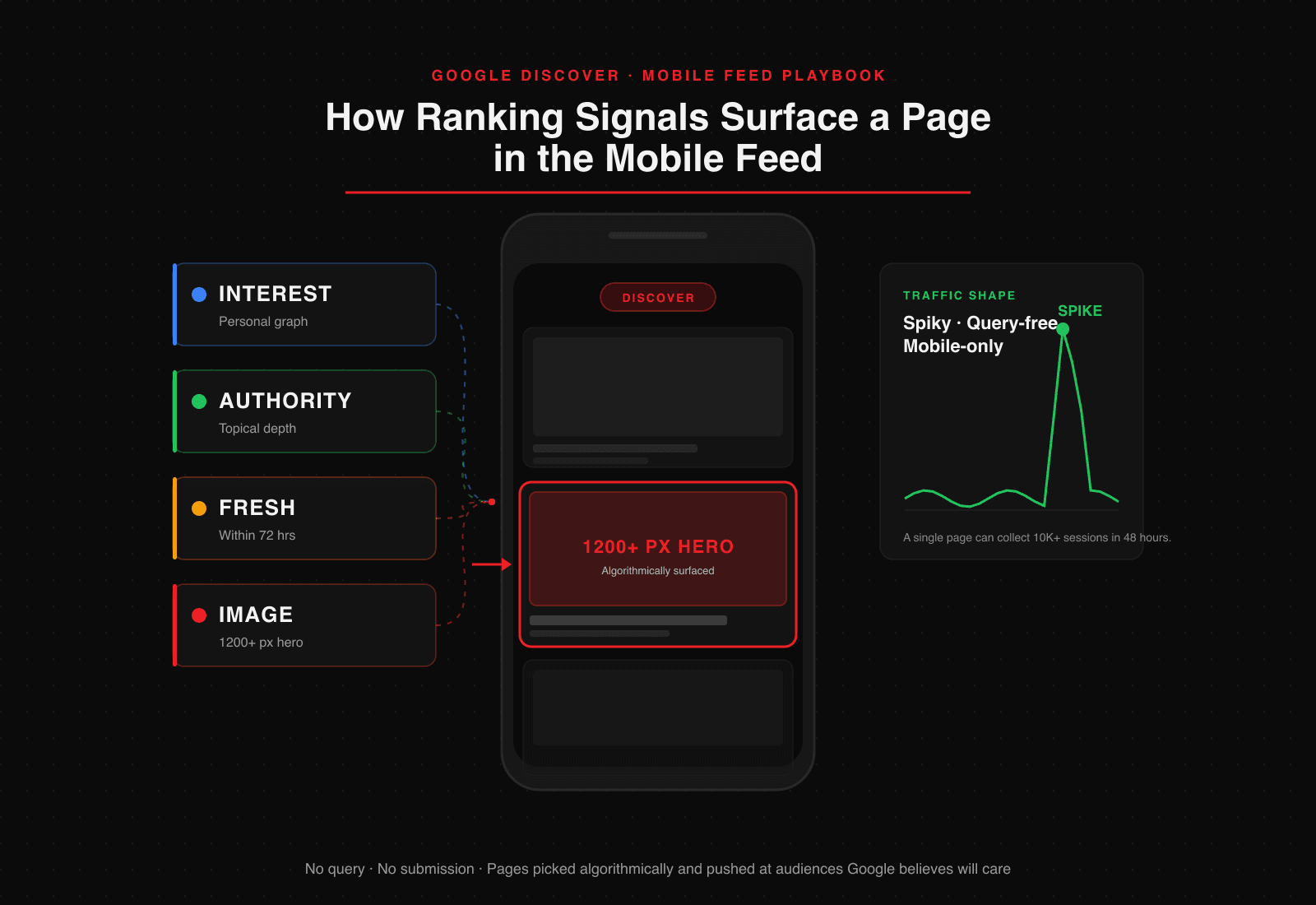
Discover is the personalized content surface that appears on mobile when a user opens the Google app or scrolls below the search bar on Chrome for Android. It serves articles, videos, recipes, product pages, and explainers selected algorithmically based on the user's interests, search history, location signals, and engagement history.
Three properties separate Discover from traditional Search:
There is no query. The user is not asking a question. Google is volunteering content the user did not ask for, based on the implicit interest profile Google has built about that user.
It is mobile-only. Discover does not appear in desktop Chrome. It does not appear on iOS Safari. The traffic comes from Android Google app users and from Chrome on Android. This shapes everything about the design and content patterns that win the surface.
The traffic shape is spiky. A single page can collect tens of thousands of sessions in 48 hours and then return to baseline. This is the opposite of Search, where traffic to a page that ranks well is steady over months. Discover spikes are real revenue but they require infrastructure to handle and an editorial cadence that produces fresh surfaces regularly enough to earn repeat appearances.
For most publishers, Discover is between 15 and 40 percent of total organic traffic when it is working, and exactly zero when it is not. There is no middle state.
Why Most Sites Get Zero Discover Traffic
When we audit a site that has never appeared in Discover, the cause is almost always one of these failures, in order of frequency:
The max-image-preview:large directive is missing. Without this meta tag, Google defaults to small image previews regardless of the actual size of your images. A small thumbnail kills click-through in Discover. This is the single highest-frequency technical mistake we find.
Hero images are below 1200 pixels wide. Google requires at least 1200 pixels for full-size feed display. Sites that hero image at 800 to 1000 pixels disqualify themselves from prominent placement even if everything else is correct.
The site has no clear topical pattern. Discover wants to push content to users with a known interest. If your site publishes across eight unrelated topics, Google cannot build the topical association needed to feed your pages to a defined audience. We covered the deeper logic of this in the topical authority playbook.
The content has no temporal anchor. Discover rewards freshness. Pages tied to a current event, recent product launch, or evolving technology shift surface more readily than evergreen reference content. Sites that publish only timeless explainers struggle to enter the feed.
E-E-A-T signals are weak. Discover applies stricter author transparency requirements than Search. Pages without clear authorship, expert credentialing, or organizational identity often never appear, especially in YMYL categories. We unpacked this standard in our piece on what E-E-A-T actually means in practice.
Page experience is poor. Cumulative Layout Shift, slow Largest Contentful Paint, and intrusive interstitials are weighed more heavily on Discover than they are on Search because the mobile feed context magnifies the experience cost. The 2025 Core Web Vitals reality check explains why.
A site failing two or more of these will not earn Discover impressions even if the content itself is strong.
The Seven Signals Google Discover Uses to Pick Content
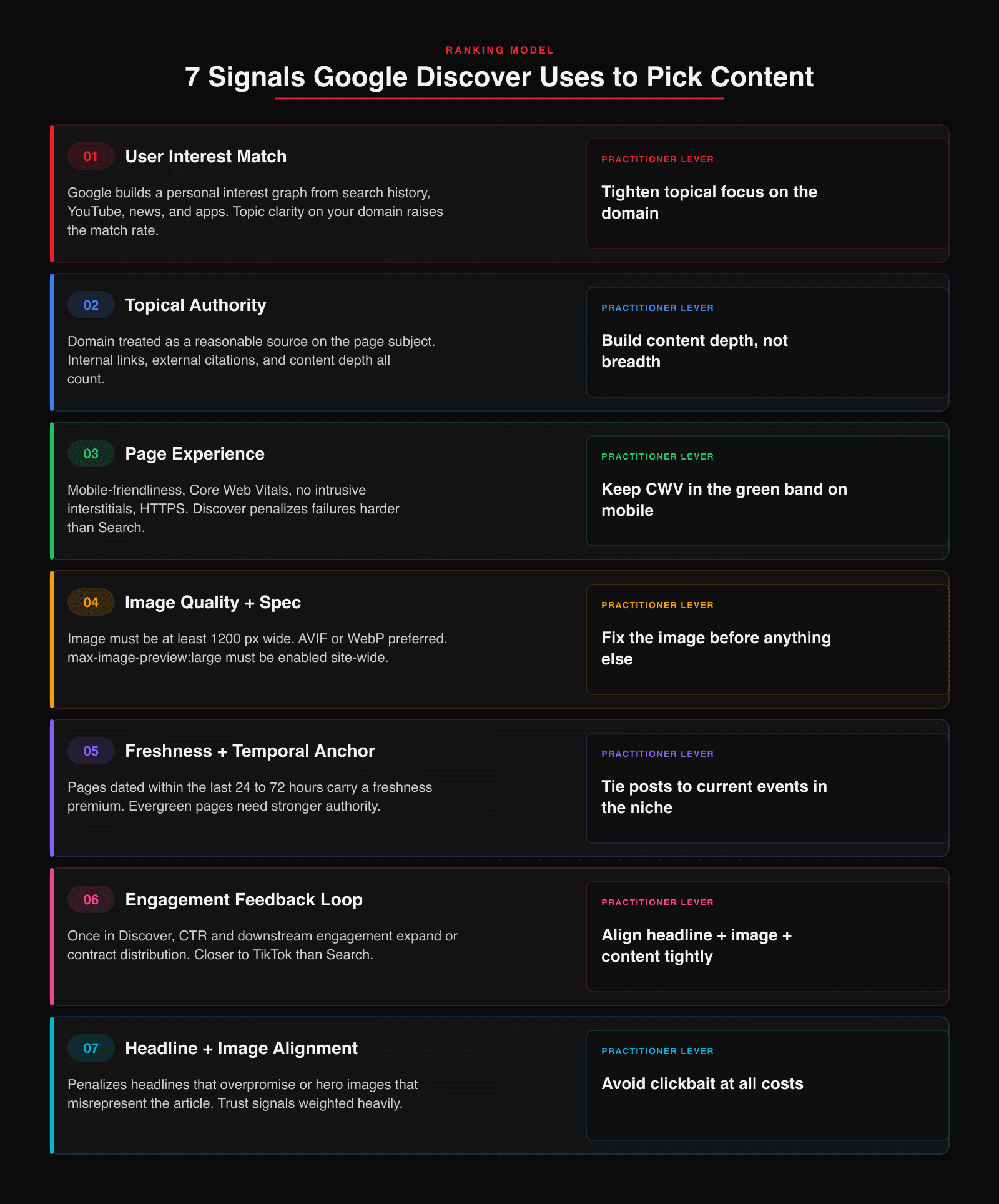
We have inferred the model Google uses to rank Discover candidates from a combination of public guidelines, observed correlations across client sites, and the structured data Google explicitly references in its publisher documentation. The signals below are not a leaked algorithm. They are the variables that move impressions when we change them.
1. User interest match. Google has built an interest graph for each user from search history, YouTube watches, news consumption, and apps used. Your page is evaluated against the interest profiles of users for whom Google believes the topic is relevant. Topic clarity on your domain raises the match rate.
2. Authority on the topic. Google evaluates whether your domain is a reasonable source on the subject of the page. This is a topical-authority calculation that draws from internal linking density, external citation patterns, and content depth across the cluster. Single-post incursions into a topic outside your normal coverage rarely earn Discover impressions.
3. Page experience. Mobile-friendliness, Core Web Vitals, no intrusive interstitials, HTTPS, no broken layouts. Discover penalizes page experience failures more aggressively than Search.
4. Image quality and specification. Image must be at least 1200 pixels wide. Format should be the modern standard your CMS supports, AVIF or WebP preferred for performance. Max-image-preview:large must be enabled. The image must be representative of the page content; misleading hero images trigger the clickbait classifier.
5. Freshness and temporal anchor. Pages with publication dates within the last 24 to 72 hours have a strong freshness premium for news-adjacent topics. Evergreen content can also enter Discover but requires a stronger authority signal to compensate.
6. Engagement feedback loop. Once a page enters Discover and accumulates impressions, the click-through rate and downstream engagement are used to expand or contract its distribution. Pages that earn high CTR get pushed to more users. Pages that earn low CTR or short visits get pulled. This is closer to a TikTok-style ranking mechanic than a traditional search algorithm.
7. Headline and image alignment. Discover penalizes headlines that overpromise relative to the content delivered, or hero images that misrepresent the article. Both are weighted heavily because they degrade user trust in the feed itself, which is Google's actual product, not your individual page.
The Image Specification Most Sites Get Wrong

Image quality is the lever that produces the largest measurable impact when fixed. The full specification we apply on client sites:
| Property | Specification |
|---|---|
| Minimum width | 1200 pixels |
| Recommended width | 1600 to 2400 pixels |
| Aspect ratio | 16:9 for landscape, 1:1 for square |
| Vertical images | Avoid; crop awkwardly in feed |
| Format | AVIF preferred, WebP fallback, JPEG acceptable |
| Compression | Quality 75 to 85, no banding |
| File size | Under 200 KB ideal, 500 KB ceiling |
| max-image-preview meta | Must be set to "large" globally |
| Image alt text | Descriptive, not keyword-stuffed |
| Image rights | Original or properly licensed |
The max-image-preview tag goes in the document head:
<meta name="robots" content="max-image-preview:large" />
If you operate a site at scale and image dimensions vary, the image optimization guide we wrote on performance versus design tradeoffs explains how to systematize this so editorial does not have to think about pixels every time a post ships.
The Content Pattern That Wins Discover
Evergreen content can enter Discover. It is not the easy path. The patterns we see overperform in client data, ranked by reliability:
Pattern 1: News-adjacent commentary. A current event in your niche, plus expert analysis the news article does not provide. The news article is a hook for Discover's freshness signal. Your analysis is the value the news article does not deliver. We use this pattern most frequently for B2B clients in regulated industries where new policy or product announcements drop weekly.
Pattern 2: Deep-dive explainers tied to a recent change. Same hook mechanic as pattern 1, but the format is a comprehensive explainer rather than commentary. Works well for technology categories where readers need to understand a new concept introduced by a vendor or platform shift.
Pattern 3: Contrarian expert takes. A recognized author argues against a prevailing assumption in the category. Discover's algorithm rewards engagement, and contrarian content earns higher CTR than agreeable content because it pattern-breaks the user's expectation of what the feed will show.
Pattern 4: Visual-heavy guides. Listicles, comparison guides, or transformation walkthroughs that warrant a strong hero image and multiple in-content images. Discover's mobile feed format is image-first; image-rich content has a structural advantage.
Pattern 5: Product or category guides with strong commercial intent. "Best of" guides, comparison reviews, and category overviews with clear editorial standards and demonstrated expertise. Discover surfaces these when the user has shown shopping intent in adjacent searches. E-commerce sites that build editorial layers on top of their catalog earn measurable Discover impressions for these formats.
What does not work: thin content, AI-generated content with no editorial layer, generic SEO listicles padded for word count, and pages with no clear author or expertise signal. We have written separately on the AI content originality threshold that distinguishes ranking content from invisible content, and the same threshold applies harder in Discover.
Technical Setup Checklist
Before any editorial pattern can produce Discover traffic, the technical foundation has to be in place. The full checklist we run on new clients:
- max-image-preview:large is set globally in the document head
- Hero images are at least 1200 pixels wide on every published page
- Image alt text is present and descriptive on all hero and in-body images
- Mobile rendering passes the Mobile-Friendly Test for every template type
- Core Web Vitals are in the green band for at least 75 percent of mobile sessions
- Structured data is present where applicable (Article, NewsArticle, Recipe, Product, BreadcrumbList) and validates without errors
- Author markup is present on every editorial page with sameAs links to credible profiles
- Publication dates are accurate, machine-readable, and not silently bumped on republish
- No intrusive interstitials between page entry and content visibility
- HTTPS site-wide with no mixed content warnings
- Sitemap includes all editorial URLs and is submitted in Search Console
- robots.txt does not block the Googlebot user agent or image indexing
- Hreflang is correctly configured if the site serves multiple languages
- AMP is not required and is no longer a Discover ranking factor; do not invest in AMP for Discover purposes
This is the floor, not the ceiling. A site that meets all 14 still has to clear the editorial and authority bars to earn impressions.
The E-E-A-T Threshold for Discover
Discover applies E-E-A-T more strictly than Search. The reason is product strategy: Discover is a curation layer Google personally vouches for to its users, so the failure mode of surfacing low-quality content damages Google's product reputation rather than just a query result. Google compensates by raising the author and organizational trust threshold for entry.
The minimums we apply on client editorial:
Every published page has a named human author. No anonymous editorial. No "Team [Brand]" bylines for substantive content. The author has a profile page on the same domain with biographical detail, professional credentials, and links to credible external profiles like LinkedIn.
The author's expertise on the topic is verifiable. A finance writer covering tax policy should have a finance background. A doctor authoring health content should have credentials linked. Lateral coverage where the author has no demonstrated expertise on the subject is filtered out.
The organization has visible identity. A clear About page, leadership team, contact information, and physical address. Sites that hide their organizational identity rarely earn Discover impressions in YMYL or commercial categories.
Editorial standards are public. A page describing the editorial process, fact-checking standards, and correction policy. This is no longer optional for sites that want to earn Discover impressions in news-adjacent or YMYL categories.
External validation exists. Citations of the brand or its experts in third-party publications, conference appearances, podcast guesting, and demonstrated subject-matter authority over time.
These are the same E-E-A-T fundamentals our clients see most clearly impact rankings across Search and AI surfaces. We unpacked the operationalization of E-E-A-T in our deep dive on the framework Google actually uses to assess expertise.
How to Diagnose Why You Are Not in Discover
If your site is not earning Discover impressions and you want to find out why, the diagnostic order is:
Step 1: Check the Search Console Discover Performance report. If the report does not appear in the left navigation, your site has never accumulated enough impressions to trigger reporting. If it does appear but shows zero recent impressions, you have lost Discover surface and need to investigate the regression date.
Step 2: Audit max-image-preview. View source on five to ten article URLs and confirm the meta tag is present. This is the most common single-fix issue.
Step 3: Audit hero image dimensions. Pull a sample of 20 recent posts and check the actual rendered hero image width. If anything is below 1200 pixels, the image is the bottleneck.
Step 4: Check Core Web Vitals on mobile. Open Search Console's Core Web Vitals report. If more than 25 percent of mobile URLs are in the poor band, page experience is suppressing Discover entry.
Step 5: Audit topical clarity. List your last 30 published articles. If they cluster into more than three to four clear topics, your topical authority is too dispersed for Discover's interest matcher to lock onto.
Step 6: Check author and organizational E-E-A-T markup. Confirm every editorial URL has a named author with a profile page, schema.org Person or Organization data, and external sameAs links.
Step 7: Look for engagement disqualifiers. Misleading headlines, hero images that do not represent the article, pages with high pogo-stick rates from previous Search traffic. Discover's engagement loop will lock these out.
If a Discover impressions decline started on a specific date, the Search Console traffic-drop decision tree walks through the systematic diagnosis we use across both Search and Discover regressions.
How to Recover Lost Discover Traffic
The recovery sequence depends on which signal is failing:
For technical regressions (image size, max-image-preview, Core Web Vitals): fix the technical issue first, then expect 7 to 21 days for impressions to return as Google recrawls affected URLs. Submit the sitemap again after the fix to accelerate recrawl on high-priority URLs.
For editorial pattern decay (your content has stopped matching current interest cycles): identify three to five topic threads in your category that are currently moving and produce 5 to 10 high-quality posts mapped to those threads within four weeks. Discover responds to renewed editorial signal more quickly than Search does.
For E-E-A-T regressions (loss of author or organizational trust signals): rebuild the author profile pages with deeper biographical content, verify all schema.org markup, audit the About page, and consider securing third-party press citations or expert quotes in industry publications. This is a slower fix; expect 60 to 120 days.
For engagement-loop suppression (your site has been classified as clickbait or misleading): reset the editorial bar, audit recent headlines and hero images for misalignment, and rebuild trust signals by publishing 4 to 6 weeks of disciplined content where the headline, image, and content all align tightly. The classifier is conservative; recovery takes 90 to 180 days.
The recovery is not symmetric to the loss. A two-week regression often takes two months to fully unwind because Discover's ranking model has memory.
Discover for Niche and B2B Sites
Most public Discover guidance assumes a consumer publisher. The model works differently and often better for niche B2B sites if you understand the leverage points.
The audience is more concentrated. A B2B niche audience that searches actively in Google is also browsing Google Discover with related interest signals. Your potential per-impression CTR is higher than a consumer publisher's because the user-content match is tighter when both sides are concentrated.
Topic depth matters more than topic breadth. Niche B2B sites win Discover by going deeper on a small surface area, not wider. A 200-post blog covering one industry from 12 angles will outperform a 1,500-post blog covering eight industries shallowly.
News hooks are easier to find than they look. B2B categories generate news constantly: regulatory changes, vendor announcements, platform updates, market data, hiring movements. Most B2B blogs ignore these in favor of evergreen "what is X" content. Reversing that ratio produces Discover impressions.
Original data is the highest-leverage Discover asset. A proprietary survey, benchmark report, or client-data analysis with a strong hero image and a clear takeaway is the single most reliable Discover entry pattern for B2B. Discover's freshness premium combines with the citation incentive to produce repeat surfaces.
We have applied this approach across B2B SaaS, fintech, and industrial clients. The Discover share of organic traffic is typically lower than for consumer publishers in absolute terms, but the conversion rate per Discover session is meaningfully higher because the audience match is tighter. Our broader B2B SEO and demand-capture frameworks lay out how Discover fits into a multi-channel B2B program.
Common Mistakes to Avoid
Across hundreds of audits, the same mistakes repeat:
Treating Discover like Search. It is not Search. Optimizing for query-driven keywords does not translate to Discover surfaces. The mental model has to shift from "what is the user searching for" to "what would this user want to read if they had not asked".
Pursuing Discover impressions at the expense of search rankings. A page that wins one Discover spike but fails to rank in Search loses long-term value. Discover should be additive to Search, not a substitute. The pages that win both are the ones with strong editorial substance and clean technical execution.
Republishing old content with a date bump. Google detects this and discounts it. The freshness premium is meant to reward genuinely new editorial. Cosmetic date changes erode trust and produce eventual suppression.
Chasing trending topics outside your topical authority. A finance site publishing about a viral celebrity moment will not earn Discover impressions even if the topic is hot. The interest matcher checks domain authority on the topic before surfacing the page.
Ignoring image rights. Hero images sourced from low-quality stock libraries or scraped without licensing trigger downstream issues that compound over time. Investing in original photography or properly licensed imagery is a larger ROI play than most editorial teams treat it as.
Skipping structured data because the post type does not require it. Article schema, BreadcrumbList, and Person markup all reinforce the Discover ranking signals even when Google does not strictly mandate them.
KPIs to Track
Three primary metrics, tracked weekly:
Discover impressions. Total per week and per published URL. Look for the distribution: are 80 percent of impressions concentrated in 5 percent of URLs, or is the distribution flatter? A flatter distribution means your editorial pattern is reliable. A concentrated distribution means you are getting lucky with one or two pieces.
Discover CTR. Average across all surfaced URLs. Below 5 percent CTR, you have a headline or hero image problem. Between 5 and 12 percent is healthy for most categories. Above 12 percent indicates strong editorial alignment but check that your traffic quality (engagement, conversions) supports the high CTR; runaway CTR with low engagement is a sign of clickbait that the algorithm will eventually penalize.
Discover share of organic traffic. Percentage of organic sessions arriving from Discover versus Search. Above 30 percent is normal for active publishers in news-adjacent categories. Below 5 percent indicates Discover is an underdeveloped channel for your site.
Pair these with downstream metrics: conversion rate of Discover sessions, pages-per-session, and revenue-per-Discover-impression for commercial sites. Discover traffic that does not convert is not free; it costs hosting, content production, and editorial cycles.
The Compounding Case for Discover Investment
Search traffic on informational queries is being compressed by AI Overviews. The CTR on informational SERPs has dropped meaningfully across categories, and the trajectory is one-way. Publishers that had a single-channel dependency on Search rankings for traffic continuity are watching their unit economics erode.
Discover is the primary mobile counterbalance. It is query-free, AI-Overview-resistant in the moment, and it serves users in a context where they are predisposed to engage rather than skim. The publishers building Discover share now are insulating themselves against the second-order effects of the AI search transition we have been mapping in our work on AI search visibility and the topical authority systems that earn citation across both surfaces.
The technical work to enter Discover is not large. The editorial discipline is the harder part, but it is also the part that compounds: the same authority signals that earn Discover impressions also earn Search rankings, AI citations, and direct branded demand. Discover is the surface where that compounding becomes visible the fastest.
Final Word
Discover is not a side channel. For mobile-first audiences in interest-driven categories, it is the channel. The publishers winning it are not running secret tactics. They are running disciplined editorial, clean technical execution, and the same E-E-A-T fundamentals that earn trust across every Google surface.
If you want a structured audit of where your site stands on the Discover entry signals, including image specs, topical authority, page experience, and E-E-A-T readiness, reach out for a Discover audit. We will map the gaps, show you which pages are closest to Discover-eligible, and lay out the publishing pattern that gets you into the feed and keeps you there.

Aditya Kathotia
Founder & CEO
CEO of Nico Digital and founder of Digital Polo, Aditya Kathotia is a trailblazer in digital marketing. He's powered 500+ brands through transformative strategies, enabling clients worldwide to grow revenue exponentially. Aditya's work has been featured on Entrepreneur, Economic Times, Hubspot, Business.com, Clutch, and more. Join Aditya Kathotia's orbit on LinkedIn to gain exclusive access to his treasure trove of niche-specific marketing secrets and insights.