

The frustrating reality of SEO for most brands is this: you can produce genuinely better content than Forbes, NerdWallet, or Investopedia on a given topic and still rank behind them.
Not because Google is broken, but because content quality is one input into a ranking decision that weighs many factors, and brand authority is one of the heaviest.
The conventional response to this problem is to build more backlinks or produce more content. Both are directionally correct but tactically incomplete. The part of the authority site advantage that is most overlooked, and most replicable, is their internal linking architecture.
The way large authority sites route link equity through their own content is the structural advantage that compounds their domain authority at the topic level. This is something a focused brand can replicate without needing a decade of history or a thousand external backlinks.
This piece explains how authority site brand bias works at the algorithmic level, which parts of that advantage are replicable, and the internal architecture strategies that have produced measurable SERP gains against established competitors.
What Brand Bias Actually Is and Why It Exists
Brand bias is the informal name for a well-documented ranking phenomenon: Google systematically favours established, high-authority domains on competitive queries, sometimes to the detriment of content quality.
A 900-word article from Forbes with no original research can outrank a deeply researched, data-backed piece from a smaller publisher, and the explanation is not that Google's quality evaluation failed. It is that Google's quality evaluation includes entity-level trust signals that accumulate over the years and are difficult to displace quickly.
The signals that create this advantage are well understood:
- Domain age and history: Longer crawl history, stable link patterns, richer behavioral data signals.
- External backlink volume: Thousands of referring domains indicate broad trust across the web.
- Brand search volume: High branded query demand signals strong user trust and recognition.
None of those signals is individually decisive. Google does not rank Forbes because Forbes is Forbes. It ranks Forbes because the combination of entity recognition, link authority, behavioural signals, and content volume creates a domain-level quality floor that Google has calibrated through years of user data.
Understanding what is in that combination matters because some components are replicable and some are not. The brands that outrank authority sites are the ones that identified which components they could close the gap on within a realistic timeframe. The component that is most underutilized by challengers - and most directly actionable - is internal linking architecture.
Why Internal Architecture Is the Most Replicable Authority Advantage
External backlinks from authority domains are difficult to earn quickly and impossible to manufacture credibly. Domain age is simply a function of time. Brand search volume requires sustained brand building across many channels.
But internal linking architecture is entirely within your control; it can be implemented and iterated on quickly, and its effects on ranking performance compound over time as the architecture deepens. This is why technical SEO services that address internal site structure often produce outsized ranking gains relative to the effort involved.
The way large authority sites structure their internal links is not accidental. It reflects a deliberate information architecture decision: create central hub pages on broad topics, build a network of supporting pages that address specific subtopics and questions within those topics, and link aggressively between them using keyword-rich anchor text.
The result is that when Google crawls the site, it consistently finds signals pointing from high-authority pages toward specific content pages. This elevates the effective authority of those content pages far above what their individual backlink profiles would suggest.
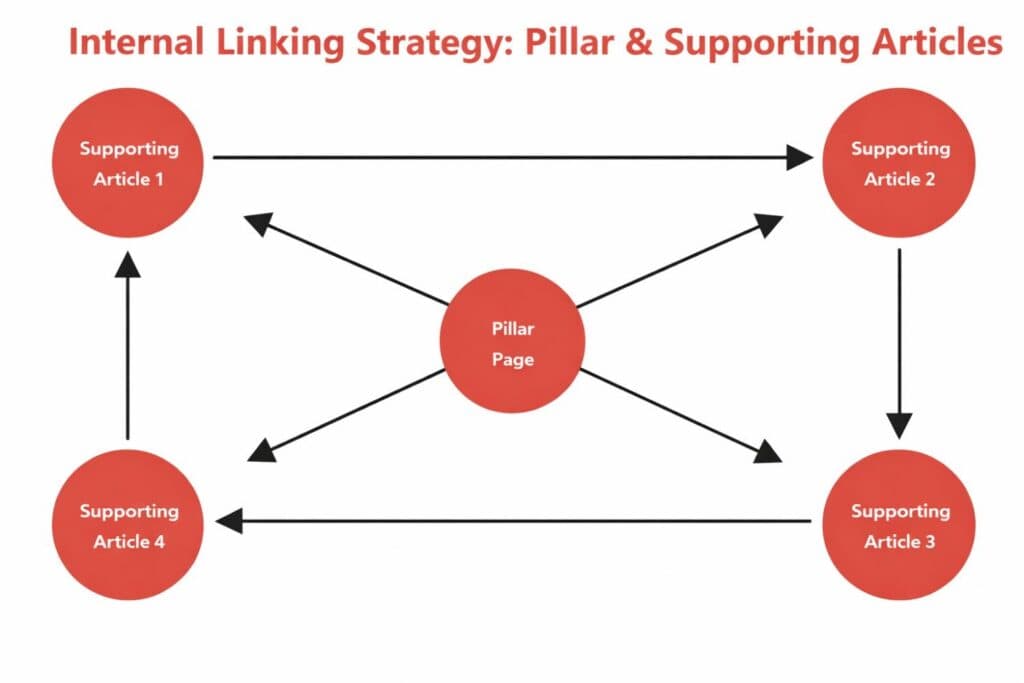
Consider how a site like NerdWallet approaches a topic like credit cards. There is a central hub page covering the category broadly. Below it, there are specific pages for travel cards, balance transfer cards, cards for building credit, and cards by issuer. Each supporting page links back to the hub. The hub links to each supporting page. Supporting pages cross-link to each other where relevant. The result is a dense semantic network that tells Google, clearly and repeatedly, that this is a comprehensive, authoritative resource on the topic. This architecture is central to how enterprise SEO at scale works - not just content volume, but the deliberate routing of authority through internal links.
A brand entering this space with a single credit card review page and no internal architecture is not competing with NerdWallet's content. It is competing with NerdWallet's network. Those are different problems, and only one of them can be solved by writing a better article.
The Authority Signals: What Is Replicable and What Is Not
| Authority Signal | What Authority Sites Have | How Challengers Can Compete |
|---|---|---|
| Domain age and history | Decades of indexed content, established crawl patterns, long trust signals | Cannot be replicated directly, but topical depth on a focused niche can close the gap faster than domain age suggests |
| External backlink volume | Tens of thousands of referring domains, many from high-authority publishers | Targeted link acquisition in the specific topic cluster you are contesting; quality over volume matters more at the cluster level than at the domain level |
| Internal linking density | Thousands of interconnected pages passing link equity across topic clusters | Replicable through deliberate hub-and-spoke architecture on your target topics; this is the most actionable authority gap to close |
| Brand search volume | Millions of branded queries monthly, signaling trust to Google | Cannot replicate at scale, but brand search in a niche category is achievable and signals entity recognition |
| Content breadth | Coverage of entire topic universes with thousands of pages | Breadth is a weakness as well as a strength; deep, current, accurate coverage of a specific topic cluster can outrank broad, shallow coverage by large sites |
| User engagement signals | High CTR on branded results; strong dwell time on established content | Content that answers intent more precisely than generic authority site content will outperform on engagement; this directly affects ranking |
The practical implication of this table is that competitive strategy against authority sites should concentrate resources on the signals that can be closed in 6 to 12 months. Internal linking architecture can be built in weeks and produces results within months. Content depth and freshness advantages can be established quickly on a focused topic cluster. These are the leverage points.
Trying to match an authority site on domain age, total backlink volume, or brand search volume as a primary strategy is a multi-year commitment with uncertain returns. Focusing on out-building them on internal architecture within a specific topic cluster - while producing content that is measurably more current and useful than their equivalent pages - is a more bounded problem with more predictable outcomes.
The Internal Architecture Playbook
Building an internal linking architecture that competes with authority sites is a structured process, not a content sprint. The sequence matters because each phase creates the foundation for the next.
| Phase | Action | Tools | What It Achieves |
|---|---|---|---|
| Audit | Crawl your own site to map current internal linking patterns; identify pages with high authority but few outbound links to priority targets | Screaming Frog, Ahrefs Site Audit | Reveals existing link equity you can redirect toward your target pages without creating new content |
| Competitor analysis | Crawl competitor authority sites to map their hub-and-spoke structure for your target topic cluster; document their anchor text patterns and linking frequency | Screaming Frog, Ahrefs, LinkWhisper | Identifies the specific internal linking architecture you are competing against and what you need to replicate |
| Architecture design | Define your pillar page and 5 to 10 supporting cluster pages; map the intended link relationships between them before writing a word | Spreadsheet or content mapping tool | Ensures the content you create is architected for link equity flow rather than retrofitted after the fact |
| Content creation | Write pillar and cluster pages with deliberate link placement; use keyword-rich, contextual anchor text rather than generic call-to-action links | In-house or agency content team | Each internal link becomes a relevance and authority signal, not just a navigation element |
| Historical audit | Search existing content for opportunities to add internal links to the pillar and cluster pages; prioritize pages with existing traffic or authority | Screaming Frog, site search operators | Activates existing site authority that is currently not flowing toward your target pages |
| Monitoring | Track crawl depth, link equity distribution, and ranking changes for target pages at two-week intervals for the first three months | Google Search Console, Ahrefs rank tracker | Confirms whether the architecture is working and identifies where additional linking is needed |
Selecting the Right Topic Cluster
The most common mistake when attempting to outrank authority sites is selecting a topic cluster that is too broad or too competitive for the available resources.
A challenger brand targeting "personal finance" as a content cluster is attempting to compete with NerdWallet across its entire content universe. A challenger brand targeting "high-yield savings accounts for self-employed individuals" is competing with a specific segment where the authority site has thinner and more generic content.
When choosing your target cluster, use this diagnostic checklist:
- Does the cluster have clear commercial intent for your business?
- Is the scope specific enough to build deeper coverage than the authority site?
- Are there enough related subtopics to support a full hub-and-spoke structure (at least 5-8 supporting pages)?
- Is the cluster large enough to generate meaningful traffic if you achieve top-3 visibility?
- Can you identify the specific authority site pages outranking you and audit their internal architecture?
If you can answer yes to all five, that is your cluster. If not, narrow the scope until the answer is yes across the board.
Building the Hub-and-Spoke Structure
The pillar page is the center of the architecture. It covers the topic broadly, links to all supporting cluster pages, and is the page you want to rank for the primary category keyword. It should be genuinely comprehensive, well-structured, and regularly updated. Its ranking performance will be largely determined by how much internal authority the architecture routes toward it.
Supporting cluster pages address specific subtopics, user questions, and comparison queries within the category. Each one should:
- be focused enough to rank for its specific target query,
- link back to the pillar page with keyword-rich anchor text relevant to the pillar's primary target, and
- cross-link to other relevant cluster pages where the content relationship is genuine.
The anchor text decisions matter. Authority sites link internally using descriptive, keyword-relevant phrases rather than generic link text. The difference between linking with "read more" and linking with "compare high-yield savings account rates" is the difference between passing no semantic signal and passing a clear relevance signal. Every internal link should communicate something specific to Google about the page it points to.
The Historical Content Audit
Most established sites have existing content that is passing very little authority to their target pages, because those pages were created before anyone thought about strategic internal linking. A systematic audit of existing content to find opportunities to add contextual links to the pillar and cluster pages is often the fastest way to route existing domain authority toward the pages that need it.
The process is straightforward. Use a site search operator (site:yourdomain.com "target topic") to find existing pages that mention topics related to your target cluster. Review those pages for natural opportunities to add an internal link with relevant anchor text - ideally describing the topic of the destination page, not a generic phrase. Then update and republish.
For sites with meaningful content libraries, this exercise alone can produce measurable ranking improvements on target pages within four to six weeks - without creating any new content. Understanding when content marketing delivers results is important here: historical link audits accelerate the compounding timeline by activating dormant authority.
Case Study: From Position 47 to Position 2 Against NerdWallet
A fintech company ranked position 47 for its primary target keyword in a category dominated by NerdWallet, Forbes, and Investopedia.
The content was genuinely superior to the authority site equivalents: more recent data, an interactive rate calculator, expert commentary, and a more organized structure. The content quality problem was not the ranking problem.
An audit of the three authority site pages outranking the client showed that each was heavily supported by:
- internal links from category hub pages,
- comparison roundup pages, and
- related topic pages, all using keyword-rich anchor text.
The client had one standalone page with no internal architecture supporting it.
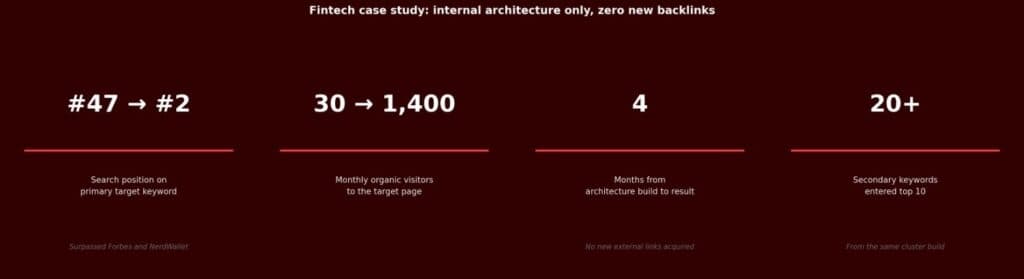
The intervention built a pillar page on the broad savings category, four supporting cluster pages on specific subtopics, and a historical audit that identified eleven existing pages where internal links to the pillar could be naturally added. The existing content was updated to include those links. No new external link acquisition was attempted.
Within four months, the target page moved from position 47 to position 2, surpassing Forbes and NerdWallet. Monthly organic traffic to that page went from approximately 30 visitors to over 1,400. Twenty-plus secondary keywords entered the top 10.
The client's comment was direct: they had assumed those keywords were permanently inaccessible to them. They were not. The barrier was architectural, not competitive.
The Structural Weaknesses of Authority Sites
The same scale that gives authoritative sites their ranking advantages also creates exploitable weaknesses.
Content Freshness Decay
Large content libraries are difficult to maintain. Authority sites publish thousands of pieces per year, which means the maintenance of existing content is perpetually deprioritized in favour of new production. A challenger that keeps a focused content cluster current has a freshness advantage that compounds over time, particularly in categories where accurate, current information has direct user value.
Generic Coverage at the Subtopic Level
Authority sites optimize for breadth at the category level and depth at the head term level. Their coverage of specific subtopics, niche audience segments, and long-tail queries within a category is often thin and generic. This is where a focused challenger can build a depth advantage that the authority site cannot easily close. The traffic from those clusters may be smaller in raw volume, but the conversion quality is typically higher because the intent is more specific.
Internal Linking Debt
Older, larger sites frequently have internal linking architectures that have grown organically over the years without strategic design. Important pages may be poorly linked internally because they were created before the hub-and-spoke approach was in place. A challenger building its internal architecture from the start - on a focused topic cluster - can create a more coherent and deliberate linking structure than the authority site has for those specific topics. The authority site has more total internal links across its domain; the challenger can have a better-designed network for the topics that matter.
Your authority site competitors have a structural internal linking advantage you can map and replicate. - Request a competitive architecture audit - we'll identify the specific gap between your site and the sites outranking you, and outline what closing it requires.
The Realistic Timeline and What to Measure
The internal architecture approach produces results more quickly than many SEO practitioners expect, but it does not produce overnight results.
The typical timeline for a well-executed hub-and-spoke build against established authority sites in a competitive category is three to five months for meaningful ranking movement and five to eight months for stabilized top-10 performance.
Several factors influence the timeline:
- the domain authority of the site starting the effort,
- how often competing authority sites update their pages,
- how well your content matches search intent, and
- how complete the internal link architecture is before new external links are earned.
The metrics that should drive the monitoring process are:
- organic traffic to the pillar and cluster pages (not just position),
- engagement quality on those pages (dwell time, scroll depth, bounce rate),
- conversion rate from organic visitors landing on the cluster, and
- the number of secondary keywords in the top 20 from the cluster.
Position tracking is useful as a leading indicator but should not be the primary performance metric. One common mistake is abandoning the approach when initial ranking movement is slower than expected. The architecture builds link equity progressively, and the ranking gains follow with a lag.
Frequently Asked Questions
What is the best tool to audit my internal linking structure?
Screaming Frog is the most commonly used tool for crawling your own site to map internal link patterns and identify pages with high authority but few outbound internal links. Ahrefs Site Audit provides similar data with a more visual dashboard and competitive comparison features. For most sites, using Screaming Frog for the initial audit and Ahrefs for ongoing monitoring is a practical combination.
How many internal links should a pillar page have?
A pillar page should link out to every supporting cluster page in its topic - typically 5 to 15 supporting pages - and receive links back from all of them. There is no fixed ideal number. What matters is that every supporting page links to the pillar with keyword-rich anchor text, and the pillar links to each supporting page contextually within the body content rather than only in sidebars or footers.
What is anchor text cannibalization and how do I avoid it?
Anchor text cannibalization occurs when multiple pages on your site use the same anchor text to link to different pages targeting the same keyword, confusing Google about which page should rank. Avoid it by maintaining a simple internal link map: reserve your exact target keyword anchor text for links pointing specifically to the pillar page for that keyword, and use variant descriptive phrases for links to supporting pages.
How often should I update a pillar page?
Review pillar pages at minimum every six months, and whenever there is a meaningful change in the topic - new data, updated regulations, new tools or competitors, or significant SERP changes on your target keyword. A freshly updated pillar page with a clear "last updated" date outperforms a stale pillar in competitive categories. Build content maintenance into your editorial calendar as a recurring function, not an afterthought.
Does internal linking help with Google indexing speed?
Yes, significantly. Google discovers content by following links. Pages with no inbound internal links - orphan pages - may take weeks or months to be indexed. Adding contextual internal links from well-crawled, high-authority pages accelerates indexing for new content and can be especially important for large sites where crawl budget is a constraint.
Conclusion
The barrier most brands face in competing with authority sites is not content quality - it is architecture. The same structural internal linking advantage that authority sites use to hold competitive positions is available to any brand willing to build it deliberately and systematically.
The fintech case study above was not an exceptional result. It was the normal outcome of closing an architectural gap that the brand had unknowingly left open. If you are ranking in the second half of page one or below for your most commercially important keywords, there is a reasonable chance your internal architecture is the binding constraint - not your content and not your backlinks.
Understanding how link building compounds over time alongside a strong internal architecture creates a ranking advantage that becomes increasingly difficult for competitors to close.
Every competitive SERP has authority sites holding positions that better content alone will not displace. - Request a competitive authority site analysis → - we'll map the specific internal architecture of the sites outranking you and show you exactly what a challenger architecture would require for your topic cluster.

Aditya Kathotia
Founder & CEO
CEO of Nico Digital and founder of Digital Polo, Aditya Kathotia is a trailblazer in digital marketing. He's powered 500+ brands through transformative strategies, enabling clients worldwide to grow revenue exponentially. Aditya's work has been featured on Entrepreneur, Economic Times, Hubspot, Business.com, Clutch, and more. Join Aditya Kathotia's orbit on LinkedIn to gain exclusive access to his treasure trove of niche-specific marketing secrets and insights.