

Competitor mentions are already sitting in forums across your niche, unlinked and unmonitored. Here is exactly how we turned them into high-trust backlinks, organic rankings, and a repeatable acquisition loop.
Most SaaS link-building campaigns are solving the wrong problem.
They chase domain authority, editorial placements, and Connectively (formerly HARO) responses, while entirely ignoring the free, high-relevance signal sitting in plain sight: the people who are already recommending your competitors by name inside active community threads.
We found this out by accident while working with a bootstrapped productivity SaaS.
Small team, tight budget, no PR relationships, and a product that was genuinely better than the tools people kept recommending in every relevant subreddit.
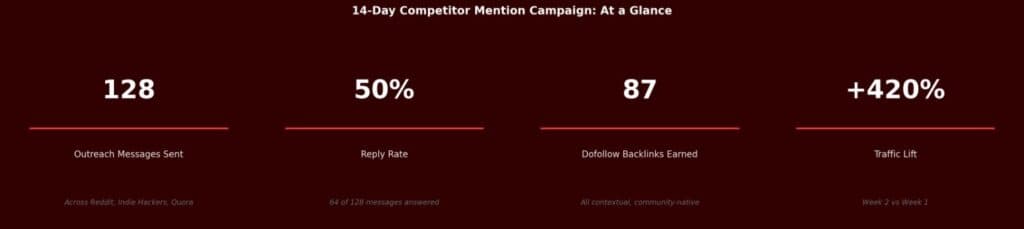
Within 14 days of running a focused, unlinked competitor mention campaign, we had 87 do-follow backlinks, nine keywords on page one, and a 420% traffic lift. Here is everything we did and why it actually worked.
The Situation We Were Working With
The client was running a lightweight collaboration tool aimed at remote teams.
Think Notion without the overhead. The product had solid retention from its early adopters, but organic acquisition was essentially flat. Traffic was hovering around 200 visits per week. Domain Rating was low.
They had published blog content, tested cold outreach, and done a round of guest posting. None of it produced meaningful movement.
The constraint was real: no budget for additional link building. What they did have was a free trial they could extend to the right people, and a product worth showing off.
Before defaulting to a guest post campaign we knew would take months to produce results - or engaging a SaaS SEO agency - we ran a diagnostic. The question was simple: where are people already talking about this problem, who are they recommending, and why is our client's tool not part of that conversation?
The answer was sitting in forum threads across Reddit, Indie Hackers, Quora, and several niche SaaS communities. Dozens of active, highly upvoted posts where users were recommending competitors by name, without a link, without any affiliate incentive, because they genuinely found those tools useful.
Those unlinked mentions are the warmest possible audience for an alternative pitch. They already care about the problem. They are actively influencing purchase decisions.
That was the insight.
Those unlinked mentions are not dead ends. They are the warmest possible audience for an alternative pitch.
The person who wrote them already cares about the problem space, already has credibility with their audience, and is actively influencing purchase decisions. All we needed to do was show up with something genuinely useful and make it easy for them to update their recommendation.
What Unlinked Competitor Mention Outreach Actually Is
Unlinked brand mentions are references to a product, tool, or company by name without an accompanying hyperlink. Traditionally, this tactic is used to reclaim links for your own brand.
What we ran here was a variation: identify unlinked mentions of competitors and convert them into new links for our client.
This is not scraping or spamming. It is community-native outreach grounded in a genuine value exchange.
The person who mentioned a competitor tool and earned 70 upvotes on Reddit is an influencer in that community. If you can show them a credible alternative and give them a reason to update their post, you have earned a contextual link from a page that Google already treats as authoritative for that topic.
The reason most teams ignore this is that it does not scale like a tool-driven link campaign. It requires reading threads, understanding context, writing personalized messages, and offering something real.
That friction is also why the links it produces are among the most durable and the most trusted in Google's evaluation.
The Three-Part Strategy
Part 1: Identify the mentions
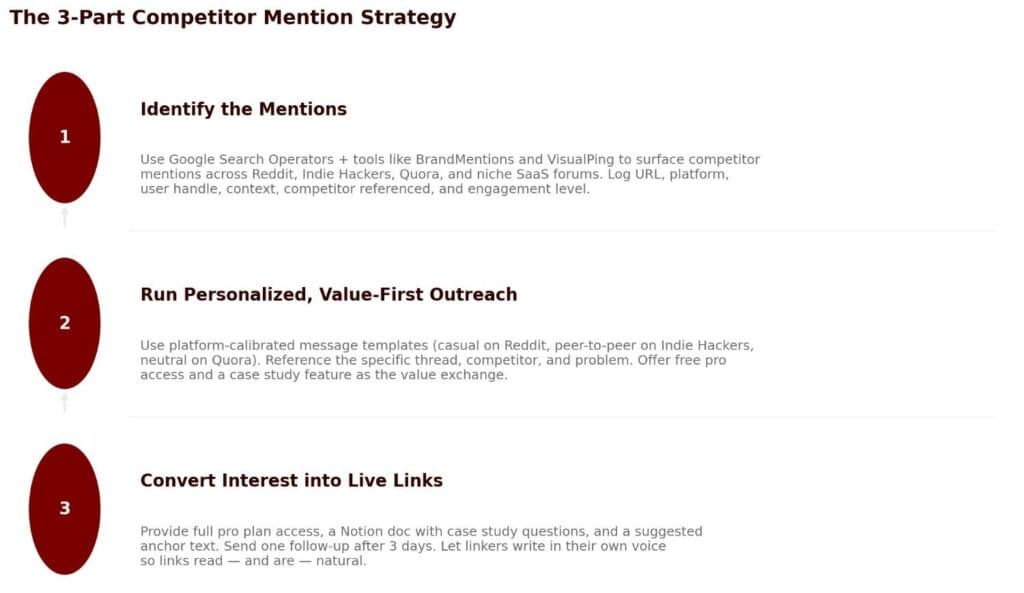
We used a combination of Google Search Operators and manual community research to surface relevant threads.
The core queries looked like this: site:reddit.com "I use Notion" or site:indiehackers.com "switched from Trello". We also set up real-time monitoring with BrandMentions and VisualPing so new mentions would surface as they were published.
Beyond Reddit and Indie Hackers, we searched Quora answers, niche SaaS forum threads, and a few Slack community digests that were publicly indexed. Every usable mention went into a tracking sheet with the URL, platform, user handle, mention context, competitor referenced, and engagement level.
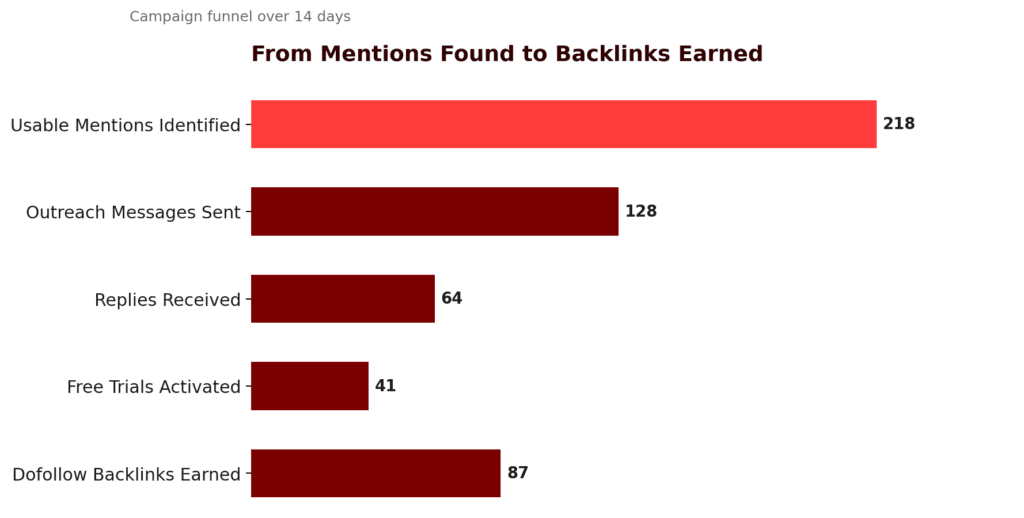
After four days, we had 218 usable entries. That was more than enough to run a statistically meaningful outreach campaign.
Part 2: Run personalized, value-first outreach
Personalization here is not a nice-to-have. It is the whole mechanism.
We built three message templates calibrated to the tone of each platform, but the templates were starting points, not scripts. Every message referenced the specific thread, the specific competitor mentioned, and the specific problem the person was trying to solve.
Reddit (casual register)
"Hey [Name], saw your reply about [Competitor] in the [Subreddit] thread. We're building something similar but more lightweight and faster to set up. Would you be open to trying it free for a few months? If it fits your workflow, we'd love to be included in your comment or a new post."
Indie Hackers (peer-to-peer register)
"Hey [Name], read your post mentioning [Competitor]. I'm helping a SaaS team building in the same space. Happy to give you early access. If you find it useful, we'd love a mention, and we'd like to feature your use case in our case study series if you're up for it."
Quora (neutral, informational register)
"Hi [Name], thanks for sharing your experience with [Competitor]. We're working on a similar tool and would be happy to offer a free trial if you'd like to test it. If it fits better for your use case, feel free to update your answer."
The case study offer deserves specific mention. Framing the outreach around a potential feature in a published case study meaningfully increased positive response rates.
People want to be recognized for expertise, and a legitimate case study offers signals that we are treating them as a practitioner, not a link target.
Part 3: Convert interest into live links
When someone expressed interest, we moved fast.
They received full access to the pro plan, a short Notion doc with case study questions if they wanted to participate, and a suggested anchor text and placement recommendation so they did not have to figure out the mechanics of updating their post.
We did not write the update for them or ask them to copy a script verbatim. We gave them a starting point and let them use their own voice.
The links that resulted read naturally because they were natural. The person actually tried the product and actually chose to mention it.
One follow-up message was the policy. If someone did not respond after three days, we sent a single soft nudge: "Just checking in case my message got buried. No pressure either way." After that, we moved on.
The Results After 14 Days
Campaign Performance / 14-Day Window:
- 128 Outreach messages sent
- 64 Replies received (50% rate)
- 41 Free trials activated
- 87 Dofollow backlinks earned
- +420% Traffic, week 2 vs. week 1
- 9 Keywords moved to page 1
The traffic increase was notable, but referral traffic was the more immediate signal. These were not passive SEO clicks arriving weeks later.
Within days of a link going live, people were clicking through from the thread because they had just read someone they trusted vouching for a new tool. That is a different quality of visitor than someone arriving from a position-eight ranking.
The domain rating increase of six points in two weeks is also worth noting in context.
- Broad link campaigns targeting DA-80 editorial placements can run for months without producing that kind of movement, partly because those links sit in content that is never organically discovered or discussed.
- Forum links earn link equity because they earn engagement, and engagement is what makes Google take the signal seriously.
Why This Works: The Structural Reasons
This is not a hack. The results follow logically from a few durable SEO principles that many teams have stopped applying because they take effort.
Topical relevance is the multiplier.
A link from a thread explicitly discussing the problem your product solves carries far more semantic weight than a link from an unrelated industry blog. Google has been explicit about this.
Relevance between the linking page and the target URL is a primary signal. Every link we earned came from a page whose entire topic was the exact problem space our client competed in.
Forum authority is real and often underestimated.
Reddit, Indie Hackers, and Quora are not high-DA directories. They are trusted platforms with genuine editorial standards enforced by community moderation.
A contextual link from an active thread in r/productivity carries different trust signals than a link from a freshly-built niche site.
Anchor text diversity is an outcome, not an afterthought.
Because we let the linkers write in their own voice, the anchors varied naturally between brand name, naked URL, and descriptive phrase. That is what organic link profiles look like.
Campaigns that force-feed exact-match anchors into every link are leaving a fingerprint that conservative SEOs should be worried about.
The "neighborhood" effect compounds over time.
Being consistently mentioned alongside established competitors is a relevance signal that builds category authority in Google's semantic model.
After several weeks, we started seeing the client appear in threads organically, because their tool was now part of the conversation that the community had about that problem.
What Goes Wrong and How to Avoid It
Lazy personalization kills the campaign.
There is a meaningful difference between changing a name at the top of a template and actually reading the thread and addressing the specific thing the person said. On one occasion during this campaign, a semi-copied message got called out publicly on the forum. The fix is treating every message as its own small project, not a mail merge.
Trying to contact everyone.
Some users do not have DMs open, some accounts are inactive, and some threads are on platforms where outreach would violate community rules. Trying to force contact in those cases damages trust and risks account suspension. A good mention you cannot reach is just a skip.
Sending the tool before the product is ready.
Giving someone pro access to a tool with friction, bugs, or an unclear onboarding experience undermines the entire approach. If they have a bad experience, they do not just decline to link; they sometimes say so publicly.
No tracking infrastructure.
Without a centralized sheet logging contact status, link status, and follow-up timing, campaigns like this collapse into confusion quickly. Keeping clean records is not optional when you are running 100+ outreach threads simultaneously.
When This Tactic Fits, and When It Does Not
| Signal | Assessment | Why |
|---|---|---|
| B2B SaaS with identifiable competitors | Strong fit | Named competitors generate organic mentions across forums and communities constantly |
| Product with meaningful free trial value | Strong fit | Value exchange is the engine; without it, you are just asking for a favor |
| Active niche communities online | Strong fit | The tactic has no inventory if the conversations are not happening |
| Broad consumer products | Poor fit | Mention volume is high but quality and relevance drop significantly |
| Products with no obvious community-visible competitors | Poor fit | No competitor mentions to find means no campaign inventory to work with |
| Teams unwilling to give genuine free access | Poor fit | Without a real value offer, this becomes cold outreach, and the conversion rates show it |
Making This Repeatable
The 14-day campaign was a sprint, but the infrastructure we built made it repeatable.
Once the monitoring setup was running and the message templates were refined through real responses, maintaining the campaign became a 90-minute daily workflow. New mentions surface, get triaged, get outreach, get tracked.
The compounding effect matters here. As the tool accumulated more community mentions, organic word-of-mouth started producing its own mentions, some of which were linked without any outreach at all.
A brand that is visibly part of community conversations earns unsolicited references over time. That is the version of this strategy that becomes a durable acquisition channel rather than a one-time sprint - and it compounds especially well when supported by broader SEO services India that reinforce organic authority.
Frequently Asked Questions
How do I find competitor unlinked mentions for my SaaS?
Use Google Search Operators as your starting point: site:reddit.com "[Competitor Name]", site:indiehackers.com "[Competitor Name]", and site:quora.com "[Competitor Name]". Set up BrandMentions or Google Alerts for real-time monitoring. Check Slack community digests that are publicly indexed, and niche SaaS community forums in your category. Four days of systematic searching typically produces 150-300 usable mentions for most SaaS products with identifiable competitors.
What response rate should I expect from competitor mention outreach?
The campaigns that consistently hit 40-55% response rates share three characteristics: messages that reference the specific thread rather than the competitor generically, a genuine product to offer for free trial, and a value exchange that goes beyond "please mention us." Response rates below 20% almost always indicate a personalization or product quality problem. If fewer than 20% of people who try your free trial update their post, the product onboarding or trial experience needs attention before scaling outreach.
Can I run this campaign myself or do I need an agency?
You can run this yourself. The required tools - Google Search Operators, BrandMentions (has a free tier), a spreadsheet - are accessible without a large budget. The skill requirement is writing personalized messages that read like genuine human outreach, not templates. The time requirement is approximately 3-4 hours per day during the active outreach phase, reducing to 60-90 minutes per day for ongoing maintenance. If your team genuinely cannot allocate that time, a specialist agency can run the outreach on your behalf with your product access and messaging guidelines.
How long do forum backlinks last?
Forum links are generally durable as long as the thread remains active and the post is not deleted or edited. Reddit threads with high upvotes remain indexed for years. Indie Hackers and Quora posts tend to be stable. The risk of link loss is lower than for guest posts on third-party blogs, where the site owner can remove or no-follow links at any time. Monitor your backlink profile monthly to catch any lost links early.
Is this approach against community guidelines?
It depends on execution. Transparently identifying yourself as building an alternative product, offering genuine free access, and letting the person decide whether to mention you is widely accepted on Reddit, Indie Hackers, and Quora. Posting fake reviews, paying for mentions, or creating sockpuppet accounts to upvote your own mentions violates community rules and Google's link guidelines. The ethical test is simple: if you had to explain what you were doing to the community moderator, would you be comfortable doing so?
Conclusion
The competitor unlinked mention campaign works because it is built on a genuine value exchange, not a technical workaround. The person who gets free access to a product they find useful and chooses to mention it is participating authentically in community discourse - and the link that results carries the trust signals that Google responds to.
This is not a replacement for a full SaaS SEO program. It is one of the highest-return starting points available to a bootstrapped team: zero media budget, meaningful results within two weeks, and a monitoring infrastructure that compounds over time as the brand becomes part of category conversations.
SaaS product with competitors being mentioned everywhere - but not you? We run structured competitor mention outreach campaigns alongside broader link acquisition programs that compound over time. Book a SaaS Link Building Strategy Call →
If you want to run this yourself, start with one competitor and one community.
- Find ten mentions.
- Write ten genuinely personalized messages.
- See what replies look like.
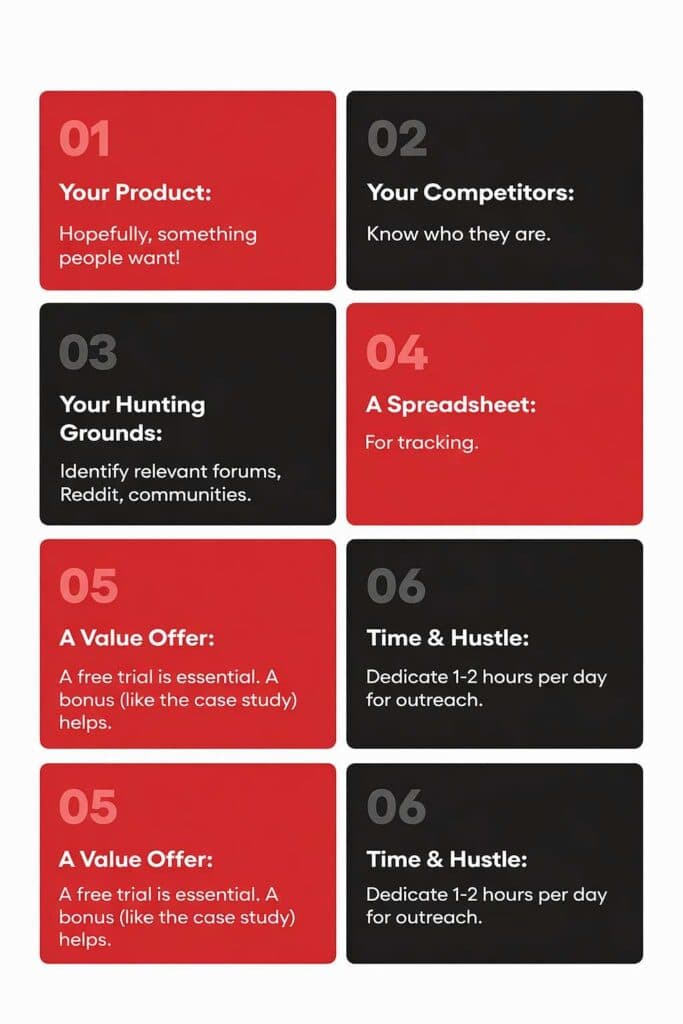
The first batch teaches you more about your product's positioning and your audience's actual language than most market research projects ever do.

Aditya Kathotia
Founder & CEO
CEO of Nico Digital and founder of Digital Polo, Aditya Kathotia is a trailblazer in digital marketing. He's powered 500+ brands through transformative strategies, enabling clients worldwide to grow revenue exponentially. Aditya's work has been featured on Entrepreneur, Economic Times, Hubspot, Business.com, Clutch, and more. Join Aditya Kathotia's orbit on LinkedIn to gain exclusive access to his treasure trove of niche-specific marketing secrets and insights.