

The most consequential thing about Google Gemini is not its benchmark scores. It is what a genuinely multimodal AI model integrated into Search, Ads, and Google's broader ecosystem means for how people find information, evaluate products, and make purchase decisions.
Most coverage of Gemini has focused on the technology competition with OpenAI. That is the wrong frame for a growth or marketing leader. The right frame is this: Google is rebuilding its core surfaces around AI, and that rebuild has direct implications for organic visibility, paid performance, and the content strategies that have driven search ROI for the past decade.
This article is a practitioner's read on what Gemini actually is, how it differs from what came before, and what the strategic implications are for businesses competing for attention in Google's evolving ecosystem.

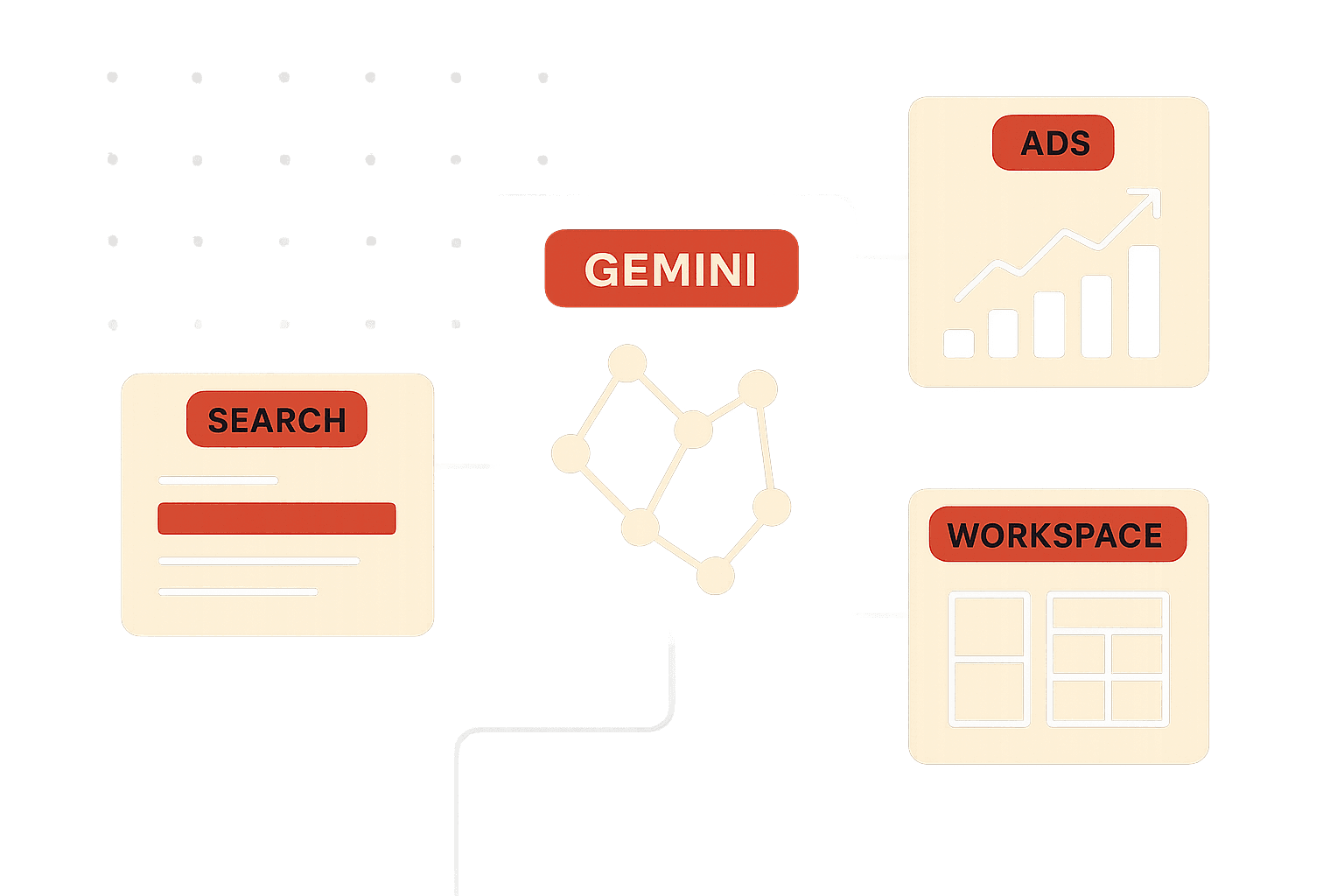
Google Gemini Explained: Why Multimodality Matters
Gemini is Google's large language model family, developed through a collaboration between Google DeepMind and Google Research. Unlike earlier AI systems that processed text and treated images, audio, or video as secondary inputs requiring separate integration, Gemini was trained natively across all of these modalities simultaneously.
That distinction matters more than it might initially appear. Previous multimodal approaches, including GPT-4's image capabilities, were built by connecting separate specialized models. Gemini processes text, images, audio, video, and code as a unified input from the ground up. The result is a model that can reason across these input types in a more cohesive way rather than switching between siloed processing systems.
For context on where this sits in Google's product stack: Gemini operates across three tiers.
- Gemini Ultra is the highest-capability version designed for complex reasoning tasks and enterprise applications.
- Gemini Pro powers the Gemini assistant (formerly Bard) and is available via API through Google Cloud Vertex AI and AI Studio.
- Gemini Nano runs on-device on Pixel hardware, enabling AI processing without a server connection, which has meaningful implications for latency and privacy in mobile applications.
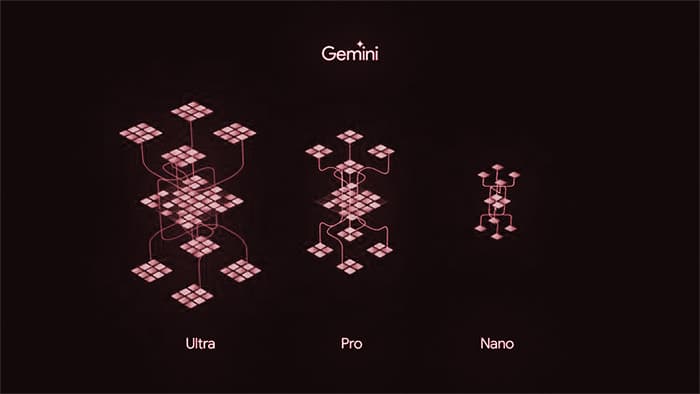
The version that matters most for most businesses is Gemini Pro, which powers Google's AI features in Search - including AI Overviews - and is accessible through the API for product and application development.

How Gemini Differs from GPT-4 in Practice
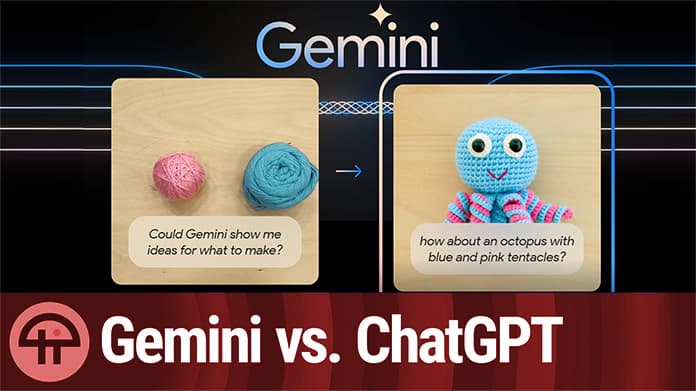
The ChatGPT versus Gemini comparison has generated substantial coverage, most of it framed around benchmark performance. Benchmark comparisons have a known limitation: they measure performance on defined test conditions that may not reflect how the models perform on the specific tasks a given business cares about.
What is more practically useful is understanding the architectural differences and what they imply for use cases.
GPT-4's multimodal capability was built by integrating separate trained systems. Gemini's native multimodality means it was optimized to reason across input types as a unified system from training. For tasks that require genuine cross-modal reasoning - analyzing a video to extract structured information or interpreting a diagram alongside accompanying text - this architectural difference can produce meaningfully better outputs.
Gemini also has access to Google's data infrastructure during training in a way no competitor can replicate: the training corpus incorporates inputs from across Google's services, which provides both scale and a particular kind of grounding in real-world information that reflects how people actually search, communicate, and consume content.
The honest caveat: both models have weaknesses. Hallucination - the tendency to generate plausible-sounding but inaccurate information - remains a real limitation of Gemini, as it is for every large language model. Governance, transparency, and accuracy at the output level require human oversight regardless of which model you are using.
Gemini Integration: The Reality of Search and Ads in 2026
This is where the strategic implications for growth and marketing teams become concrete.
Google has integrated Gemini into Search, Ads, Chrome, and other core products. The integration into Search is fully operational through AI Overviews - the AI-generated answers that appear at the top of search results for many queries. AI Overviews were moved from beta to a live, scaled feature in 2024 and have continued expanding to more query types and markets throughout 2025 and 2026.
The implications for organic search visibility are significant and largely underappreciated by teams that have not yet adapted their SEO strategy to account for AI-generated responses.
When Google's AI generates a summary answer at the top of a search results page, it pulls from source content it deems authoritative and relevant. The sources cited in AI Overviews receive a different kind of visibility than traditional blue-link rankings.
For informational and research-oriented queries, the AI response often satisfies the user's need without requiring a click, which means organic traffic to those page types can decline even when rankings remain stable.
The content strategies that held up well in traditional search - comprehensive long-form guides targeting informational keywords - are not automatically transferring their traffic value in the AI Overview environment. Some are seeing traffic stability or growth if they are being cited as sources. Others are seeing traffic decline despite maintaining rankings because the click is no longer necessary.
This does not mean informational content loses its strategic value. It means the value calculation changes. Content that builds topical authority, earns citations in AI-generated answers, and creates brand recognition as a trusted source continues to matter for mid-funnel intent and conversion. The metric shifts from organic clicks alone to a broader measure of share of presence in AI-mediated search. Businesses investing in enterprise SEO for Google's AI era are rethinking this value calculation now rather than reactively.
For paid search, Gemini's integration into Ads introduces more AI-generated ad copy and creative variation, more automated campaign management through Performance Max, and better multi-format creative optimization. Teams working with a specialist in Google Ads management are better positioned to leverage Gemini-powered Smart Bidding effectively.
How to Rank in AI Overviews: What Actually Works
This is the question the rest of this article raises - and the one most guides fail to answer directly. Here is what the evidence shows about which content earns AI Overview citations.
Answer questions directly and completely. AI Overviews are triggered by question-intent queries. Content that leads with a direct, accurate answer to the query before elaborating performs better than content that buries the answer in paragraph three. The "inverted pyramid" format - answer first, detail second - aligns with how AI systems extract information.
Use structured data markup. FAQ schema, HowTo schema, and Article schema all help Google understand your content's structure and extractability. Pages with properly implemented schema are more likely to have their content parsed and cited.
Build entity authority, not just keyword rankings. AI systems use Google's Knowledge Graph and entity relationships to assess source authority. Consistent mentions of your brand, people, and domain across authoritative third-party sources builds the entity authority that influences citation decisions.
Cover your topic with depth and specificity. Broad overview content that covers many topics superficially is less likely to be cited than content that covers a specific topic with genuine depth. The AI is looking for the best answer to a specific question - not the most comprehensive overview of a category.
Ensure technical accessibility. If Googlebot cannot fully crawl, render, and index your content, it cannot be considered as an AI Overview source. Clean technical SEO - no render-blocking issues, fast server response, correct canonicalization - is a prerequisite.
Maintain content freshness. AI Overviews increasingly favor recent, updated content for queries where recency matters. Regularly refreshing and updating your most important content signals ongoing accuracy.
Gemini and India: What Indian Marketers Need to Know
Google Gemini and AI Overviews have specific implications for the Indian market that are worth understanding separately.
Regional language AI Overviews are expanding. Google has been rolling out AI Overviews for Hindi and other Indian languages. For brands with audiences who search in Hindi, Tamil, Telugu, or other regional languages, monitoring how AI Overviews appear for vernacular queries is becoming necessary alongside English-language tracking.
India's AI Overview rollout is accelerating. AI Overviews have expanded significantly in India through 2025 and 2026, covering more query categories. The impact on search traffic for informational queries in India is now comparable to what US markets experienced earlier.
Gemini's Hindi language support creates content opportunities. Gemini's training includes substantial Hindi-language data, which means AI Overviews for Hindi queries are generating reasonably high-quality responses. Brands that publish authoritative content in Hindi can earn citations in Hindi-language AI Overviews - a largely untapped competitive advantage.
Practical Applications for Marketing and Growth Teams
Beyond the Search implications, Gemini Pro's API availability opens legitimate use cases for marketing teams willing to invest in integration.
Content strategy and research
Gemini's ability to process and reason across large documents, images, and structured data makes it useful for competitive research, content gap analysis, and topic modeling at scale. Feeding it a competitor's content library alongside your own and asking for differentiation analysis is a real use case that saves significant analyst time.
The quality of output here depends entirely on the quality of prompting and the specificity of the task definition. Generic prompts produce generic analysis. Teams that invest in prompt engineering for their specific workflows see materially better results.
Multimodal product content
For e-commerce businesses, Gemini's native image understanding creates the ability to analyze product photos, extract attributes, and generate consistent product descriptions at scale. This is particularly valuable for large catalogs where manual product content creation is a bottleneck. The accuracy of attribute extraction varies by product category, so human review of outputs remains necessary before publication.
Customer insight synthesis
Gemini Pro via the API can process large volumes of customer feedback, support transcripts, and survey data to surface patterns that manual analysis would take significantly longer to identify. The outputs are directional rather than statistically rigorous, but for qualitative theme extraction across large datasets, the efficiency gains are real.
Code generation for marketing operations
For marketing operations teams building internal tools, automating reporting, or creating data pipelines, Gemini's code generation capability is competitive and meaningfully extends what a technically capable marketer can build independently.
The Risks and Constraints Worth Accounting For
Any honest treatment of Gemini for business needs to include the constraints that marketing coverage tends to minimize.
Accuracy and hallucination
Gemini, like all large language models, generates outputs that are sometimes wrong in ways that sound authoritative. For any customer-facing application, any content published without review, or any decision made directly from model output without verification, this is a real risk. The mitigations are operational: human review workflows, output validation checks, and domain-specific grounding wherever possible.
Privacy and data handling
Inputs to Gemini via Google's consumer products are subject to Google's data policies. For businesses with sensitive customer data, proprietary research, or confidentiality obligations, the API route with appropriate contractual terms is the appropriate path, not the consumer product.
Dependency and switching costs
Deeply integrating Gemini into operational workflows creates dependency on Google's API pricing, availability, and policy decisions. Building architecturally portable workflows - or that can function with alternative models - reduces this risk.

A Decision Framework for How to Engage With Gemini Now
For growth and marketing leaders, the strategic question is not whether Gemini is impressive. It is where to invest attention and integration effort given realistic resource constraints.
Immediate attention - these affect your current performance:
Understand how AI Overviews are affecting your current organic traffic. Pull your Search Console data and look for query categories where impressions are stable but clicks are declining. This pattern often indicates that AI-mediated search is satisfying the query before the click. Adjust your content strategy accordingly.
Evaluate your Google Ads setup for AI-readiness. Performance Max and AI-generated assets work better with high-quality data inputs. If your product feeds, audience lists, and conversion tracking are not clean, the AI optimization layer cannot function effectively.
Six to twelve month horizon:
- Pilot Gemini Pro API integrations for high-volume, repetitive content operations where accuracy can be verified through existing workflows.
- Start with internal use cases before customer-facing applications.
- Monitor the evolution of AI Overview citations in your category.
- Understand which content attributes correlate with citation and use this to guide content investment decisions.
Can wait until the market stabilizes:
Deep architectural integrations that would be costly to unwind. The model landscape is evolving quickly enough that flexibility has real strategic value right now.
Frequently Asked Questions
What type of content is most likely to appear in Gemini AI Overviews?
Content that directly answers a specific question with accurate, expert-backed information is most frequently cited. Structured content with clear question-and-answer formats, supported by FAQ schema markup, is particularly well-suited for AI Overview citation. Original data, case studies, and content reflecting genuine practitioner expertise are harder for the AI to replicate internally and therefore more likely to be cited as a source.
Should I use Gemini or ChatGPT for SEO content creation?
For SEO content specifically, neither should be used as a primary author without strategic oversight. As tools for accelerating content production within a human-led strategy process, both have legitimate use. Gemini's advantage is for content where Google ecosystem alignment matters - understanding AI Overviews query patterns, structuring content for Google's extraction, and tasks where Google's data training provides relevant grounding. ChatGPT's advantage is in its broader plugin ecosystem and generally stronger long-form reasoning for complex topics.
How do I check if my content appears in AI Overviews in Google Search?
There is no automated tool that comprehensively tracks AI Overview citations across all queries, but you can monitor this manually. Search your target queries in Google (in incognito mode to reduce personalization) and observe whether AI Overviews appear and which domains are cited. For systematic monitoring, some SEO platforms (Semrush, Ahrefs, BrightEdge) have begun adding AI Overview visibility tracking. Compare your Search Console impression-to-click ratios over time - a widening gap between impressions and CTR is a reliable signal of AI Overview impact.
Bottom Line
The bottom line for growth leaders: Gemini matters most not as a tool to adopt, but as a signal of how Google's core surfaces are changing. The teams that understand those changes and adapt their search, content, and advertising strategies accordingly will maintain and extend their organic and paid performance.
Gemini's integration into AI Overviews is live and expanding. The question is no longer whether AI search affects your traffic - it's whether you're being cited as the answer or watching a competitor take that position.
Is your content being cited in Google AI Overviews - or are your competitors getting the visibility? We'll audit your AI Overview presence across your target queries and give you a content roadmap to get cited. Get Your AI Overview Audit →

Aditya Kathotia
Founder & CEO
CEO of Nico Digital and founder of Digital Polo, Aditya Kathotia is a trailblazer in digital marketing. He's powered 500+ brands through transformative strategies, enabling clients worldwide to grow revenue exponentially. Aditya's work has been featured on Entrepreneur, Economic Times, Hubspot, Business.com, Clutch, and more. Join Aditya Kathotia's orbit on LinkedIn to gain exclusive access to his treasure trove of niche-specific marketing secrets and insights.