

Most SEO agencies are now producing deliverables that would have taken a junior analyst two weeks in a fraction of that time.
The problem isn't the speed. The problem is that clients are paying for strategic expertise and receiving something that costs the agency twenty minutes and a ChatGPT subscription.
This isn't speculation. The pattern is consistent enough across agency audits that it's worth treating as an industry-wide structural issue rather than a few bad actors.
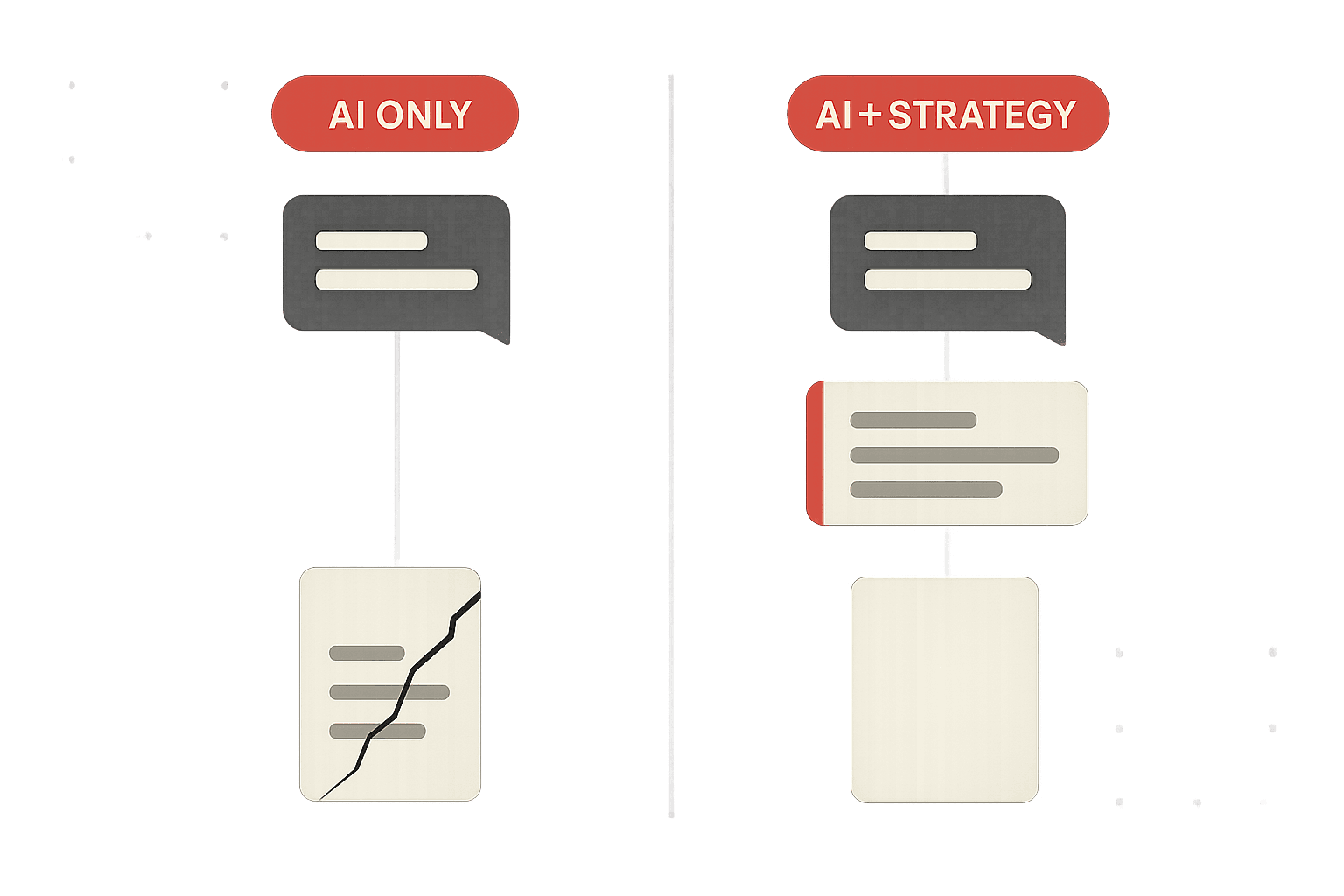
When AI tools are used to augment skilled SEO work, the output improves. Research gets faster, content outlines get sharper, and data processing that used to require hours of manual effort gets compressed. That's the appropriate use case.
What's happening instead in a significant portion of the agency market is different: AI isn't augmenting the work. It's replacing it. The human judgment, the industry context, and the strategic reasoning that clients are paying for are simply absent.
The commercial consequences are real, and they take about six months to fully manifest.
Why This Problem Goes Unnoticed
The economics of running an SEO agency are brutal. Skilled practitioners are expensive, the work is genuinely time-intensive, and clients often lack the internal expertise to evaluate what they're receiving.
That combination creates a predictable incentive. If a client can't tell the difference between AI-generated analysis and expert analysis, there's strong financial pressure to deliver the former while pricing for the latter.
What makes this particularly difficult to catch early is that AI-generated SEO work looks plausible. The reports are formatted correctly. The keyword lists are populated. The traffic might even improve in the short term as more content is published.
The dysfunction doesn't surface until Google's systems have had enough time to evaluate what's actually on the site, or until a content audit reveals that two hundred articles are fighting over the same ten keywords.
By then, the agency is already six months into an engagement, the client has invested significant budget, and unwinding the mess is harder than building something right would have been.
What AI Cannot Actually Do in an SEO Program
There's a version of this conversation that's about AI being bad. That's not the right frame. AI tools have genuine utility in SEO work, and the practitioners who use them well are more productive than those who don't.
The issue is task-matching: understanding which parts of SEO require human judgment and which parts can be meaningfully accelerated with AI assistance.
The tasks that require human judgment are not peripheral. They're central to what makes SEO produce lasting commercial results.
Keyword cannibalization diagnosis
When multiple pages on a domain compete for the same search terms, the result is diluted ranking signals and confused indexing behavior.
Identifying and resolving this requires understanding the site's content architecture holistically, how pages relate to one another, which should be consolidated, and which need to be repositioned around different intent.
AI can surface keyword overlap. It cannot reason about the strategic implications of that overlap for a specific site's competitive position.
Technical SEO triage
Automated crawl tools, many of which use AI, are good at identifying technical issues. They are not good at prioritizing them.
A site with 847 flagged issues needs a practitioner who understands which of those issues are actively limiting crawl budget, which are affecting rendering, and which can be addressed in the next quarterly cycle without urgency.
That triage judgment comes from experience, not pattern matching on a dataset.
Content gap analysis with competitive intent
Finding topics your site doesn't cover is a task AI handles reasonably well. A thorough content gap analysis cross-references your keyword coverage against competitor rankings to surface commercially viable opportunities your current strategy is missing.
Understanding which of those gaps represent defensible commercial opportunities versus high-volume keywords where you have no realistic path to ranking without significantly more domain authority requires a different kind of analysis.
Most AI-generated content strategies don't make this distinction.
Local SEO and market-specific strategy for Indian brands
Ranking in one city versus another for the same service category involves understanding local competitive dynamics, regional search behavior patterns, and the specific trust signals that matter in a given market.
This is not a generalizable problem. AI tools treat it as if it were.
For Indian brands specifically, this gap is severe. The SERP for "digital marketing agency Mumbai" behaves differently from "digital marketing agency Hyderabad" - not just in competition levels but in the content types Google rewards, the local authority signals that matter, and the review platforms that carry weight. An AI tool has no access to current field data on any of this.
Aligning SEO with business objectives
An SEO program that drives traffic from keywords your business can't convert is expensive noise. Understanding the connection between search behavior and your specific funnel, your conversion architecture, your CAC economics, and your LTV profile requires someone who thinks in business outcomes, not just search metrics.
This is where most AI-generated strategies fail most visibly: They optimize for rankings rather than for the revenue events that rankings are supposed to produce.
Case Study: How AI-Dependent SEO Cost One Brand 60% of Organic Traffic
An e-commerce company came in looking for a traffic recovery engagement.
Their previous agency had overseen an eighteen-month period during which organic traffic declined by nearly 60%, despite what the agency's reports had characterized as consistent progress.
The content audit was clarifying. The site had accumulated over 2,000 blog posts, the majority clearly AI-generated, covering virtually every keyword permutation in their category with thin, interchangeable content. A proper technical SEO audit would have surfaced the cannibalization and quality issues long before they compounded.
The articles read coherently but contained no actual expertise, no product-specific insights, and no differentiation from what any other site in the category had published.
The cannibalization problem was severe. Dozens of near-identical articles were competing for the same terms, splitting whatever ranking signal existed across pages that individually had no authority. External sites weren't linking to any of it because there was nothing worth linking to.
The damage compounded when Google's quality-focused updates ran.
The site had essentially trained Google to view it as a low-signal domain. Recovering from that requires not just better content going forward but active remediation of what's already there: consolidation, redirection, in some cases, full removal of content that's actively harming the site's authority profile.
The cost of that remediation, in time, resources, and lost revenue during the recovery period, significantly exceeded what a properly executed content program would have cost from the start.
This is the actual financial case against AI-dependent SEO. It's not about principle. It's about the compounding cost of short-term shortcuts.
How to Audit Your Current Agency to Prevent Problems
You don't need to wait for a traffic decline to evaluate whether your agency is delivering genuine strategic work. The signals are visible in the deliverables themselves.
Run the reports through an AI detection pass
This isn't perfectly reliable, but consistent AI detection flags across multiple documents are meaningful. If your monthly strategy documents, content briefs, and keyword analyses all register as likely AI-generated, that tells you something about the workflow producing them.
Check whether the strategy references your specific competitive environment
A legitimate SEO strategy for a B2B SaaS company should be specific.
- It should name real competitors.
- Reference the SERP features and content types dominating those rankings.
- And explain why the strategy fits your current domain authority position.
If the recommendations could apply to any company in any industry, the strategy was never built for you.
Look for evidence of keyword cannibalization in your current content
Pull your top-performing URL clusters and check whether multiple pages are targeting the same or closely related terms. If they are, and your agency hasn't identified this as a problem, that's a gap in their technical analysis.
Ask for the reasoning behind content prioritization decisions
A strategist who built your content calendar should be able to explain every topic choice.
- They should know the search volume.
- The competitive difficulty.
- The intent behind the keyword.
- And how the article connects to a conversion path.
If the explanation sounds vague or circular, the strategy likely wasn't there to begin with.
Evaluate the quality of backlink acquisition
AI can identify potential link targets. But it cannot build relationships or create the editorial value that earns real links.
Authoritative backlinks come from trust, relevance, and genuine contribution.
If your backlink profile from the last six months is dominated by low-authority placements - or obvious paid link insertions - there is a problem. Your agency's link-building program likely has an integrity issue.
What Appropriate AI Use Looks Like in an SEO Program
Because the goal here is clarity rather than an indictment of AI tools, it's worth being specific about the applications where AI meaningfully improves SEO work.
Research synthesis
Gathering competitive intelligence, summarizing industry trends, and identifying SERP feature patterns across a keyword set can be accelerated significantly with AI assistance. The output still requires a practitioner to evaluate, interpret, and apply it to a specific strategic context.
Content briefing
AI can generate topic outlines and identify commonly covered subtopics for a given keyword. A senior editor still needs to determine what angle genuinely differentiates the piece, what the primary claim is, and what expertise or data the article needs to earn authority.
Large dataset analysis
Crawl data, Search Console exports, and GA4 behavioral data at scale benefit from AI-assisted pattern identification. What those patterns mean for your specific site requires human interpretation.
Templated reporting
The mechanical work of compiling performance data into a consistent report format is an appropriate use of automation. The insights, recommendations, and strategic commentary in that report should not be.
The practical test is whether the AI output has been reviewed, challenged, and improved by someone with genuine domain expertise before it reaches the client. If the answer is yes, AI is functioning as a productivity tool. If the answer is no, it's functioning as a replacement for the expertise the client is paying for. A genuine SEO agency India operation maintains that human oversight layer at every stage of delivery.
What This Looks Like for Indian Brands Specifically
The AI-SEO problem is particularly acute in the Indian agency market for a few reasons.
First, the pressure to offer low-cost SEO retainers is intense. When an agency is competing at ₹15,000-₹30,000 per month, there is almost no margin to employ senior strategists who are doing the actual analytical work. AI fills that gap.
Second, Indian SERPs require genuine local expertise that AI cannot provide. Google India's behavior for local queries, the relative authority of Indian domains, Hinglish content performance, and regional language SEO are all areas where an AI tool working from global training data will produce generic recommendations that miss the actual opportunity.
Third, the Indian brands most likely to detect the problem early - those with sophisticated analytics and attribution infrastructure - are often not the brands paying the lowest retainer rates. The brands most at risk are SMBs who rely on their agency entirely and lack the internal capability to evaluate what they're receiving.
Concerned your agency is costing you more than they're earning? Get an independent SEO audit - no agency involvement, no conflict of interest. We'll tell you exactly what's working, what's not, and what it would take to fix it. Request an Independent Audit →
The Selection Criteria That Highlight Capable Agencies
Given that most agencies now use AI in some form, the evaluation question has shifted from "do you use AI?" to something more nuanced about how it's integrated into a workflow that's still accountable to expert judgment.
When evaluating or re-evaluating an agency relationship, these factors are more diagnostic than references or case studies alone.
Specificity of their strategic reasoning
Ask why they would prioritize a specific keyword cluster for your site right now.
A real practitioner will give a precise answer. They will reference your current authority level, the cluster's competitive difficulty, and the traffic and conversion potential at your current ranking trajectory.
A vague explanation about "targeting high-value keywords" is not enough.
Their approach to content that isn't working
Capable agencies identify underperforming content, diagnose the cause, and make specific recommendations:
- consolidate with a stronger page,
- redirect,
- rewrite with a different angle, or
- build internal links to improve the page's authority.
If an agency's answer to underperforming content is "publish more content," they're not doing the diagnostic work.
Evidence of proactive technical recommendations
Strong SEO programs surface technical issues before they affect performance, not after. If your agency's technical recommendations have been reactive - arriving only after you've noticed a ranking decline or a crawl error - their monitoring and analysis process is passive.
Transparency about what AI produces in its workflow
You should be able to ask directly what role AI tools play in the deliverables you receive and get a specific answer. Vagueness on this question, from an agency that clearly uses AI in some capacity, is its own signal.
Alignment between their KPIs and your revenue outcomes
An agency that reports primarily on keyword rankings and organic traffic is measuring inputs. An agency that connects organic performance to pipeline influence, new customer attribution, and content's role in the conversion path is thinking about your business.
What to Do This Week
If this article has raised concerns about your current agency relationship, here are three concrete next steps.
Pull a sample of content for AI detection. Run your last five agency-delivered pieces through an AI detection tool. Consistent high scores across multiple documents are a meaningful signal.
Check for keyword cannibalization. Export your top 50 organic landing pages and their primary keywords from Search Console. Look for clusters where multiple pages are targeting the same or near-identical queries. If your agency hasn't flagged this, they haven't done the analysis.
Request a strategy call focused on your competitive environment. Ask your agency to walk through your top three competitors by name - their domain authority, their top-ranking content, and why they outrank you for specific queries. If they can't answer this specifically, the strategy they've been executing isn't grounded in real competitive data.
The Window Before This Becomes a Crisis
Google's quality evaluation systems have grown considerably more sophisticated at identifying thin, undifferentiated content, even when it reads coherently.
The sites that accumulated AI-generated content over the past two years are increasingly experiencing the consequences in their ranking data. The cleanup cost, in time and lost revenue, is real and ongoing.
For brands that are currently in an agency relationship and are uncertain about the quality of the work they're receiving, the right move is an independent audit before the problem compounds further.
This doesn't require ending the relationship. It requires clarity about what's actually being produced and whether it's building long-term organic equity or eroding it.
SEO done well is a compounding asset: content that earns authority over time, a backlink profile that strengthens domain trust, and a technical foundation that makes every new piece of content more efficient.
SEO done wrong is a liability that gets more expensive to unwind with every month it continues.
Frequently Asked Questions
How do I know if my SEO agency is using ChatGPT without telling me?
The most reliable signal is whether their deliverables contain your-specific intelligence. Does the keyword strategy name your actual competitors and explain why they outrank you? Does the content brief reflect your specific SERP environment? Does the monthly report connect organic activity to your revenue outcomes? Generic deliverables that could apply to any client in any industry are almost always AI-generated without strategic overlay.
Can I recover rankings after my site was penalized for thin AI content?
Yes, but it requires active remediation, not just better content going forward. The recovery process involves auditing all existing content for quality issues, consolidating or redirecting thin pages, removing content that's actively harming your authority profile, and rebuilding the topical depth and E-E-A-T signals that the previous content eroded. Recovery timelines typically run six to twelve months from the start of active remediation.
What should a good SEO agency deliver monthly?
At minimum: organic traffic attributed to revenue by landing page type, keyword ranking movements tied to pages being actively optimized, a list of technical issues identified and resolved, and a clear commentary section explaining what drove changes and what's being adjusted. If your agency's report doesn't include revenue attribution, they are not measuring whether their work is producing commercial outcomes.
Get an independent SEO audit - no agency involvement, no conflict of interest. We'll tell you exactly what's working, what's not, and what a properly structured program would look like for your competitive position. Request an Independent Audit →

Aditya Kathotia
Founder & CEO
CEO of Nico Digital and founder of Digital Polo, Aditya Kathotia is a trailblazer in digital marketing. He's powered 500+ brands through transformative strategies, enabling clients worldwide to grow revenue exponentially. Aditya's work has been featured on Entrepreneur, Economic Times, Hubspot, Business.com, Clutch, and more. Join Aditya Kathotia's orbit on LinkedIn to gain exclusive access to his treasure trove of niche-specific marketing secrets and insights.